Book Appointment Now
IPTV Reseller Invoice Requirements UK: Mistakes to Avoid 2026
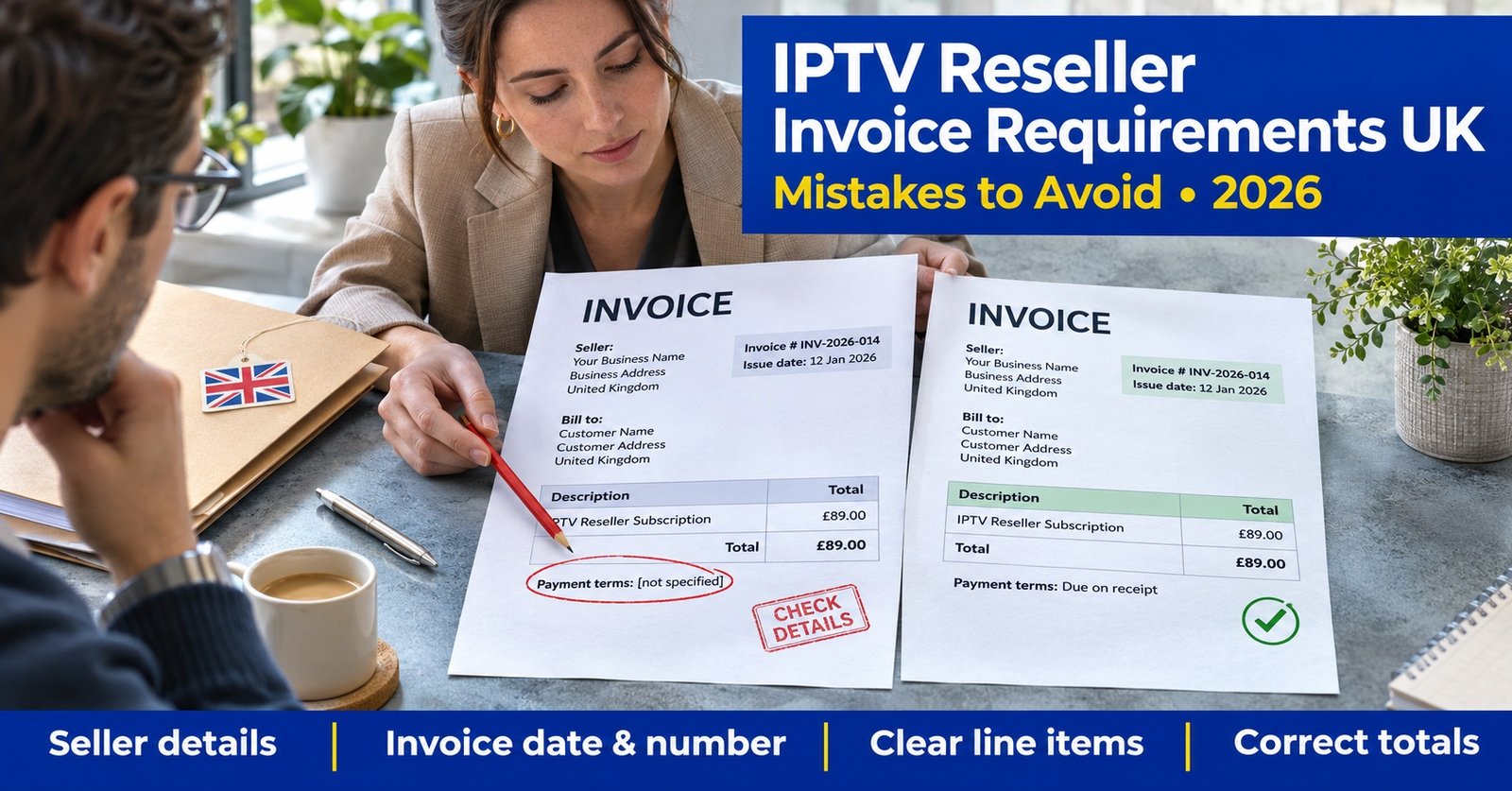
The IPTV Reseller Invoice Requirements UK sellers have to meet are the same rules every British business follows, with nothing special written for streaming. Each invoice needs a unique number, your business name and contact details, the customer’s name and address, a clear description of what you charged for, the supply date, the invoice date, the amounts charged and the total owed. A limited company adds its full registered name, a sole trader adds their own name, and only once you’re registered for VAT do HMRC’s stricter VAT invoice rules switch on.
What catches resellers out is rarely the template. It’s the description line. Listing channels on an invoice doesn’t make a subscription lawful, and it can turn an ordinary bookkeeping record into a written claim you never meant to make. An invoice proves that a sale happened between two parties; it says nothing about whether the content behind a panel is licensed, so the wording should match what you actually supplied, which for most IPTV panel resellers is account access, credits or a software service.
Three Sets of Rules Sit Behind One Invoice
It helps to separate the obligations, because they come from different places and apply to different sellers.
The first layer is the general invoicing guidance on GOV.UK, which covers every business regardless of size or VAT status. That’s the list in the opening paragraph, and it’s the baseline for a hobby-sized reseller and a growing company alike.
The second layer is company law. Under the Companies Act 2006 and the 2015 trading disclosure regulations, a limited company must show its registered name on invoices and other demands for payment. Its registered number, the part of the UK where it’s registered and its registered office address are required on business letters, order forms and websites. Strictly, those three details aren’t listed as invoice requirements, but most companies print them on invoices anyway because an emailed invoice often doubles as correspondence, and there’s no downside to including them.
The third layer is VAT. HMRC’s VAT Notice 700/21 sets out what a VAT invoice must contain, and it only applies once you’re VAT registered. The registration threshold has been £90,000 of taxable turnover over a rolling 12 months since April 2024. Below that, registration is voluntary for UK-based businesses.
Here’s how those layers combine in practice:
| Your situation | What your invoice must carry |
|---|---|
| UK sole trader, not VAT registered | GOV.UK basics, your own name, any trading name, and an address for legal documents if you use a trading name |
| UK limited company, not VAT registered | GOV.UK basics plus the full company name exactly as on the certificate of incorporation |
| VAT registered, selling to another VAT-registered business | A full VAT invoice under Notice 700/21, issued normally within 30 days of the supply |
| VAT registered, selling to household subscribers | No VAT invoice required unless the customer asks; a simplified version is allowed at £250 or less |
IPTV Reseller Invoice Requirements UK, Line by Line
Thinking about an invoice in four blocks makes the rules easier to apply consistently, especially if you raise them by hand from your reseller dashboard rather than through accounting software.
Who you are
Use the name that matches your legal status. If you trade as a limited company, the name must appear exactly as Companies House holds it, including “Limited” or “Ltd”. A catchy brand name can sit alongside it but can’t replace it. Sole traders show their personal name and any trading name, plus an address where legal documents can be delivered if a trading name is used.
Directors’ names are optional. The catch is that if you choose to name one director, you must name them all.
Add a working contact method. A phone number or support email is enough; what matters is that the customer can reach the business that billed them.

Who bought
Every invoice needs the customer’s name and address. For a sub-reseller that’s their business name and address. For a household subscriber, a name and postal address is the standard approach, and it should match what you hold in your customer records so the two can be reconciled later.
What and when
You need a clear description, the date the service was provided and the date the invoice was raised. Subscriptions complicate this slightly, because a three-month or twelve-month line is supplied over time. Stating the service period on the invoice (“Account access, 1 December 2026 to 28 February 2027”) removes any doubt about what the payment covers and makes refund conversations easier.
The money
Show each amount charged, any VAT, and the total owed. If you aren’t VAT registered, don’t show VAT at all, not even as “VAT 0%”. Only a registered business can charge VAT or issue a VAT invoice.
Once you are registered, a full VAT invoice needs more: a sequential number, the time of supply, your VAT number, a description with quantity, the unit price, the VAT rate and net amount for each line, any cash discount rate, and the total VAT in sterling. The line amounts can be in another currency, but the VAT total must be in pounds.
The Description Line Is Where Content Rights Come In
This is the part of invoicing that’s specific to this trade, and it deserves more thought than the field list.
An invoice is a commercial record. It shows that you supplied something and the customer owes money for it. It doesn’t create a licence, prove one exists, or transfer any right to view programming. That matters because a reseller usually doesn’t own or control the content delivered through a panel. What you sell is access: credits loaded to an account, a subscription line created in your dashboard, or a software and support service.
Describe that accurately. Good descriptions are dull ones: “IPTV account access, 12 months, 1 connection”, “Reseller credits, 50 units” or “Panel subscription and setup support”. Avoid listing broadcasters, named channels, live events or sports competitions on an invoice. Doing so implies you’re selling rights to that content, which, unless you genuinely hold distribution rights in writing, is a claim you can’t support. If you’d like a deeper look at checking what sits behind a supplier, our guide to copyright due diligence for UK IPTV panel resellers covers the legal sources worth reading.
The same logic works in reverse. An invoice you receive from a panel provider doesn’t prove its service is licensed either, however professional it looks. Treat it as evidence of payment, not evidence of legitimacy. Verifying the business behind it is a separate job, and our article on how IPTV reseller supplier verification works walks through that process.
Pro tip: Keep your invoice descriptions identical to the wording in your terms and your checkout page. When all three describe the same product the same way, disputes are easier to settle and your records tell one consistent story.
When the Buyer or the Seller Is Outside the UK
Cross-border sales change the VAT picture more than the invoice layout, but they’re common enough in this trade to mention.
If your business isn’t established in the UK and you sell to UK consumers, the £90,000 threshold generally doesn’t protect you. Non-established businesses making taxable supplies in the UK are normally required to register from their first sale. Many overseas resellers miss this because they assume the threshold applies to everyone.
Buying credits from an overseas panel provider is the other common case. If you’re UK VAT registered and buy business services from a supplier abroad, the reverse charge usually applies: you account for the VAT yourself on your return instead of the supplier charging it. Your supplier’s invoice won’t show UK VAT, and that’s expected.
Selling to subscribers in other countries brings their tax rules into play, because services supplied electronically to consumers are generally taxed where the customer lives. If you have customers in the EU or elsewhere in significant numbers, this is the point to speak to an accountant who handles digital services, as registration obligations abroad can apply from the first sale.
Five Invoice Habits That Cause Trouble Later
Most invoicing problems aren’t legal mysteries. They’re habits that seem harmless until an accountant, a payment processor or HMRC asks to see records.
Charging VAT before registration. Adding 20% to look established, or showing a VAT number you don’t have, isn’t permitted. If you aren’t registered, your prices simply don’t include VAT.
Breaking the number sequence. Reusing an invoice number, deleting a cancelled invoice or editing one after sending it creates gaps that are hard to explain. Cancel properly with a credit note instead.
Leaving the record in a chat thread. Confirming a sale in a messaging app isn’t an invoice. Generate a proper document, send it, and store a copy outside the chat.
Mixing up credits and lines. Credits you buy from a provider and subscriptions you sell to customers are different transactions. Invoice your customers for what they received, and keep the provider’s invoices separately as your purchase records.
Promising content in the description. As covered above, channel lists and event names have no place on an invoice. They add legal risk without adding any accounting value.

Corrections, Credit Notes and Keeping Records
Mistakes happen. The right fix is a credit note that references the original invoice number, states what’s being reversed and shows the corrected amount, followed by a fresh invoice if needed. Credit notes are business records in their own right and should be numbered and stored like invoices.
Refunds deserve the same treatment. If you refund part of a subscription, the credit note is your evidence of why the money went back. That ties in with what UK consumers are entitled to, which our guide to IPTV reseller panel consumer rights in the UK explains in detail.
How long to keep everything depends on your structure. VAT-registered businesses must generally keep records for at least six years. Limited companies keep accounting records for six years from the end of the financial year they relate to. Sole traders keep records for at least five years after the 31 January Self Assessment deadline for the relevant tax year. VAT-registered businesses also need digital records kept in software compatible with Making Tax Digital.
Storing PDFs in a dated folder structure, backed up somewhere other than your laptop, covers most small resellers comfortably.
Before You Send the Next Invoice
- The legal business name matches your status: full company name for a Ltd, personal and trading name for a sole trader
- The invoice number follows on from the last one, with no gaps or reuse
- Customer name and address match your customer record
- The description names access, credits or support, never channels or events
- Subscription invoices state the service period, not just the sale date
- VAT appears only if you hold a VAT number, and the VAT total is in pounds
- Your company number and registered office are in the footer if you trade as a Ltd
- A copy is saved outside your messaging app and backed up
Frequently Asked Questions
Do I have to invoice every household subscriber?
Not as a VAT requirement. VAT invoices are mandatory for sales to other VAT-registered businesses, and retail-style sales to consumers only need one if the customer asks. Even so, issuing a simple invoice or receipt for every sale makes your bookkeeping, refunds and dispute handling far easier.
Can a sub-reseller ask me for a full VAT invoice?
If you’re VAT registered and they’re VAT registered, yes, and you must normally provide it within 30 days of the supply. If you aren’t registered, you can’t issue one, and you should tell them so plainly.
Can I invoice in pounds when I pay my provider in another currency?
Yes. Your sales invoices can be in pounds regardless of what you pay upstream. For VAT invoices, line amounts can be in any currency but the total VAT must be shown in sterling.
Is it worth adding my company number even though invoices don’t strictly require it?
In most cases, yes. It’s required on your website and letters, it helps customers verify you on the public register, and it costs nothing to include.
Can I charge late payment interest to a sub-reseller who pays late?
Between businesses, UK law allows statutory interest on late commercial payments, and stating your payment terms clearly on the invoice supports any claim. It doesn’t apply to sales to household consumers. Your IPTV reseller terms of service is the right place to set payment deadlines in writing.
Getting the Basics Right Is Most of the Job
IPTV Reseller Invoice Requirements UK sellers face are ordinary business rules: identify yourself correctly, identify the customer, describe the supply honestly, date it, and show the money clearly. VAT adds a stricter format once you register, and cross-border sales can bring registration duties sooner than many expect.
The part that’s unique to this trade is restraint in the description. Bill for access, credits and support, keep content claims off the page, and treat every invoice as a record that may be read by someone checking your business later. This article covers general UK rules rather than tax advice for your circumstances, so if you’re near the VAT threshold or selling abroad, a short session with an accountant is money well spent. Once your invoicing is in order, you can compare IPTV reseller plans knowing your paperwork will keep pace with growth.