Book Appointment Now
How IPTV Reseller Supplier Verification Works in UK 2026
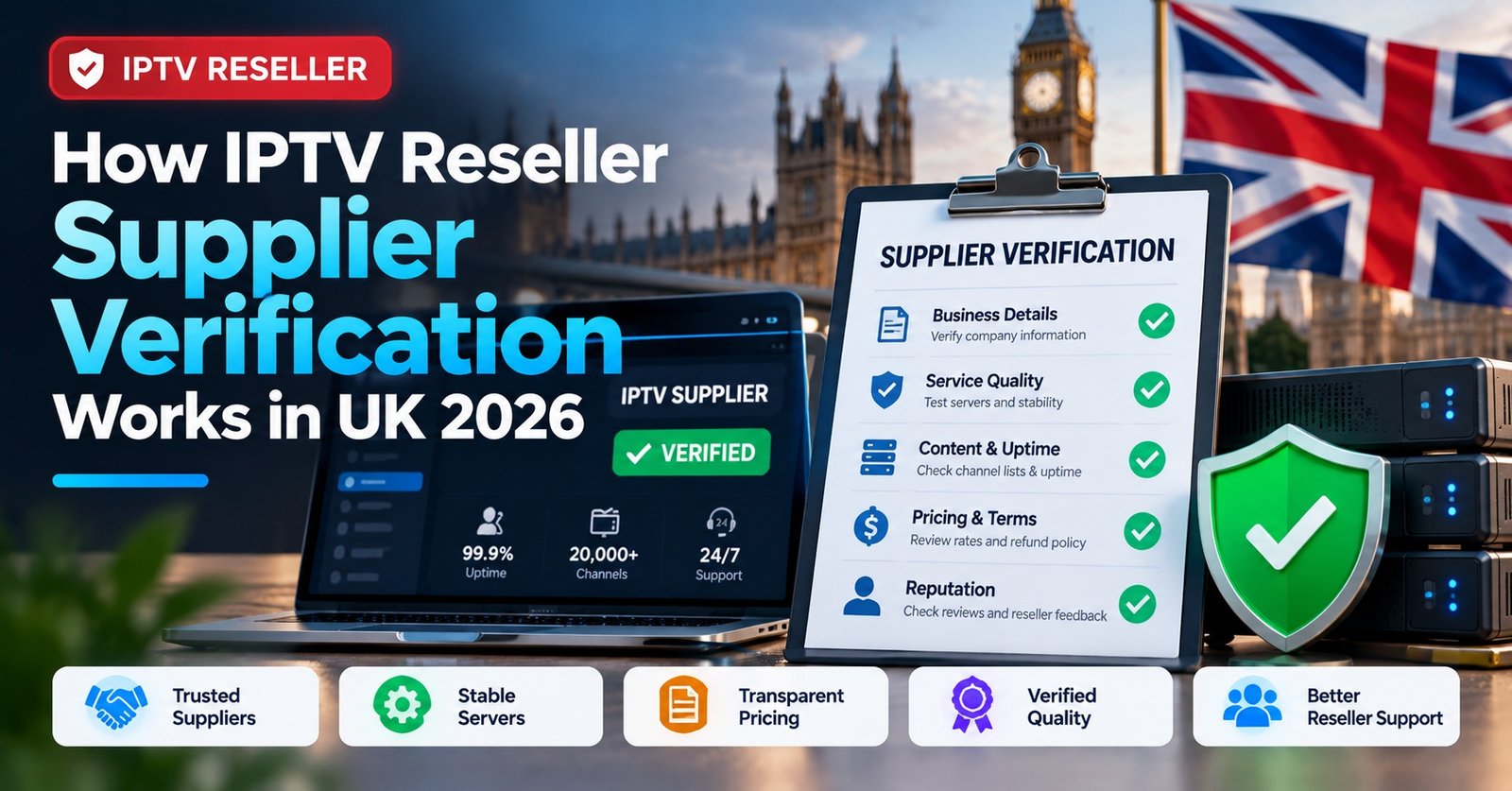
IPTV Reseller Supplier Verification comes down to two separate questions: is the supplier a real, traceable business, and can it prove it holds the rights to distribute the programming it sells you access to? A company number, a working panel and a polished website answer the first question at best. Only written evidence of distribution rights, which you can confirm with the rights holder yourself, answers the second, and in the UK it is the second question that decides whether reselling the service is lawful.
Most suppliers will happily show you their dashboard, their server locations and their credit prices. Far fewer will name a licensor. That gap is where IPTV panel resellers get caught out, because UK copyright law looks at what you knew or had reason to believe, not at how convincing the supplier’s sales page was. A supplier that cannot answer the rights question in writing has, in practical terms, already answered it.
The Problem Verification Is Meant to Solve
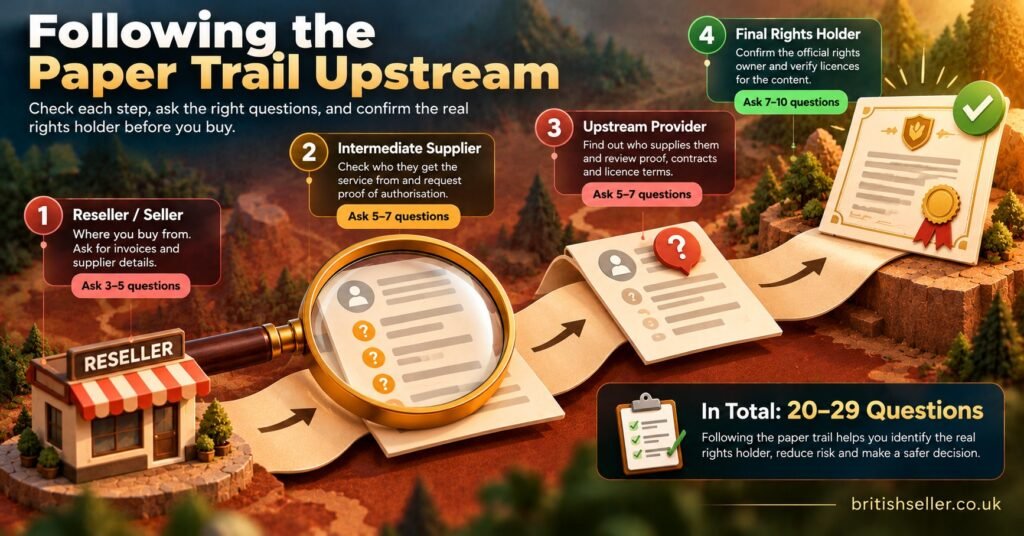
A reseller sits in the middle of a chain. Above you is a supplier, sometimes with its own upstream source. Below you are paying customers who trust that what you sell them is legitimate. When something goes wrong, whether that is a sudden shutdown, a payment dispute or an enforcement action, the reseller is usually the most visible and least protected link.
Verification is not about collecting reassuring documents. It is about separating three things that suppliers often present as one: the technology that delivers streams, the business that operates it, and the permission to distribute the programming carried on it. A supplier can be strong on the first two and have nothing at all on the third. In that situation, the quality of the panel and the professionalism of the company do not make reselling lawful. They simply make the problem harder to spot.
There is also a commercial reason to take this seriously. A supplier without rights can disappear overnight, taking your customers’ service and your unused credits with it. The way unverified sources collapse under pressure is covered in more detail in this look at the risks of relying on Telegram-only IPTV sellers, and the pattern applies to any supplier whose only real asset is a server.
Three Kinds of “Licence” That Suppliers Blur Together
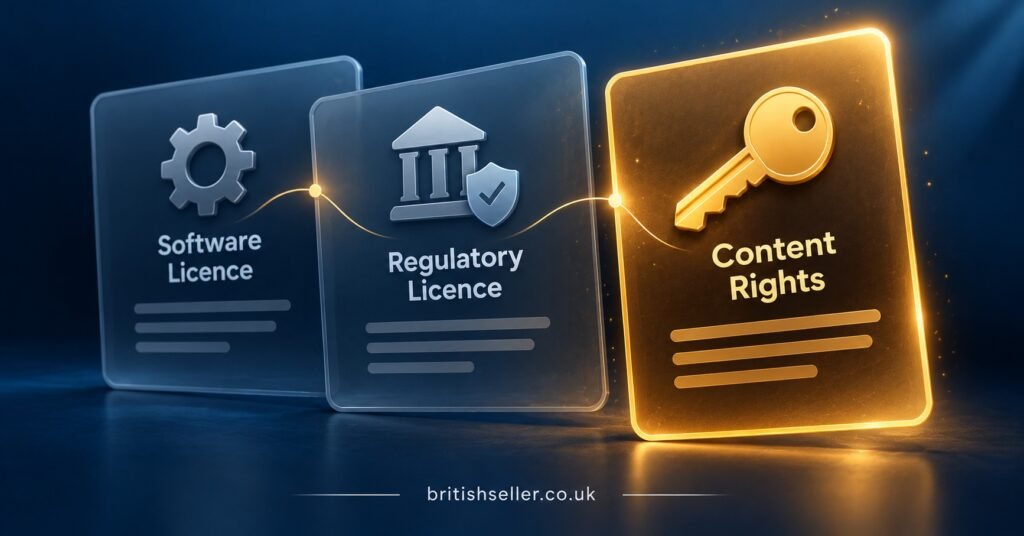
The word licence does a lot of misleading work in IPTV sales conversations. A supplier may truthfully say it is licensed while holding nothing that authorises it to distribute the channels or films on its service. Before you assess any evidence, it helps to know which kind of licence you are looking at.
| Type of licence | What it covers | What it does not authorise |
|---|---|---|
| Software or middleware licence | Use of panel software, apps, players or streaming servers | Any right to the programming those tools deliver |
| Regulatory broadcast licence | Permission to operate a specific television service under UK broadcasting rules | Retransmitting another company’s channels or content |
| Content distribution rights | Permission from rights holders to distribute named programming in a stated territory | Anything outside the agreed channels, territory, term or sublicensing terms |
Only the third row answers the question a IPTV panel reseller actually needs answered. A paid licence for panel software proves the supplier did not pirate its dashboard. It says nothing about whether the streams running through that dashboard are authorised.
The regulatory licence is the one most often misunderstood. In the UK, a television licensable content service is a TV service broadcast from a satellite, distributed using an electronic communications network (including services broadcast over the internet), or a service made available by a radio multiplex, and Ofcom licenses these services. That licence attaches to a specific service run by a specific licensee. It regulates how that broadcaster behaves. It does not hand anyone else permission to rebroadcast the licensee’s output, and a supplier showing you someone else’s Ofcom listing has shown you nothing about its own rights.
What UK Law Says, Taken From the Official Sources
The main statute is the Copyright, Designs and Patents Act 1988. Section 107(2A) creates a criminal offence for communicating a copyright work to the public without permission in certain circumstances. As amended, a person will be criminally liable if they communicate a copyright work to the public and they know or have reason to believe that they are infringing copyright in the work, and either intend to make a gain for themselves or another person, or know or have reason to believe that communicating the work to the public will cause loss to the owner of the copyright work, or will expose the copyright owner to a risk of loss.
Two parts of that wording matter enormously to resellers. The first is “reason to believe”, which means a court can look at the warning signs that were available to you, not only at what you admit to knowing. The second is the gain element. Selling subscriptions for profit is, by definition, intending to make a gain.
The penalty was raised by section 32 of the Digital Economy Act 2017. On 1 October 2017, section 32 of the Act came into force, amending section 107 of the CDPA to raise the maximum custodial penalty for copyright infringement from two to ten years.
Copyright is not the only route prosecutors use. Wrongdoers can be prosecuted for offences under the Copyright, Designs and Patent Act (CDPA) 1988, the Fraud Act 2006, and the common law offence of conspiracy to defraud. The Intellectual Property Office’s 2017 consultation on illicit streaming also referred to s296ZB, covering devices and services designed to circumvent technological measures, which is relevant where a service depends on bypassing protection applied by authorised providers.
The government’s own consumer guidance draws the line plainly. The IPO defines illicit streaming as the watching of content without the copyright owner’s permission by any means, not just via hardware devices, and its illicit streaming devices guidance on GOV.UK explains how to identify such services and where to report sellers. That guidance is written for consumers, but it is also a useful mirror for a reseller: if your customers would recognise your offer from the IPO’s description, so would an investigator.
None of this makes IPTV itself unlawful. IPTV is a delivery method, and plenty of authorised services use it. The legal question is always about the rights behind the programming, not the protocol carrying it. This article is general information rather than legal advice, and anyone building a business on a specific supplier arrangement should take advice from a UK solicitor who handles intellectual property.
IPTV Reseller Supplier Verification in Practice: Four Source Checks
Each check below uses a source the supplier does not control. That is the point. Anything the supplier hands you directly is a claim; anything you confirm independently is evidence.
1. Confirm the business exists on an official register
For UK companies, the Companies House register is free to search. Look at the company status, incorporation date, registered office, directors, filing history and whether accounts are overdue. A company formed a few weeks ago with no filings is not automatically suspect, but it should not be presenting itself as an established wholesaler.
Keep the limits of the register in mind. Companies House itself notes that the fact the information has been placed on the public record should not be taken to indicate that Companies House has verified or validated it in any way. Registration tells you who is accountable. It tells you nothing about content rights.
If the supplier is based outside the UK, use the equivalent official registry in its home country and check that the entity named in its terms matches the registry record. Terms that name the operating company and where it is registered, as the British Seller terms of service do, at least give you something concrete to check. Terms that name no entity at all give you nothing to hold anyone to.
2. Ask for rights evidence and confirm it with the rights holder
This is the check that matters most and the one most IPTV panel resellers skip. Ask the supplier, in writing, for the following:
- The names of the rights holders or authorised distributors it has agreements with
- The territories those agreements cover, specifically whether the UK is included
- The term of each agreement and when it expires
- Whether the agreements permit sublicensing or resale through third parties such as you
Then contact the named rights holder or distributor directly, using contact details you find yourself rather than ones the supplier gives you, and ask whether the arrangement exists. A legitimate supplier will expect this. Rights holders keep track of who is authorised to carry their programming, and a genuine licensee has nothing to lose from you checking.
If the supplier refuses on grounds of confidentiality, note that a legitimate business can usually confirm the existence of an agreement and its territory without disclosing commercial terms. A blanket refusal to name anyone is not confidentiality. It is an absence of evidence.
3. Check any regulatory claims against Ofcom’s own list
If a supplier says it is Ofcom licensed, Ofcom lets you look up TV broadcast licensees and their licensing information. Search for the supplier’s company name, not the channel names it advertises. If the licence belongs to a different company, or covers a single service while the supplier offers thousands of channels, the claim does not support what is being sold.
4. Test the marketing language against the IPO’s warning signs
The IPO guidance identifies sales wording that signals an illicit service, such as devices or subscriptions described as fully loaded, jailbroken or plug and play, alongside subscription gifts. It also offers a simple test: if you are watching television programmes, films or sporting events where you would normally be paying to view them and you have not paid, you are likely to be using an illicit streaming device (ISD) or app.
Apply the reseller version of that test. If a supplier’s channel list includes premium programming that authorised services charge substantial monthly fees for, and the supplier’s wholesale price is a small fraction of that, the arithmetic is evidence. Rights to premium programming are expensive, and nobody passes them on at a loss.
Reading the Answers You Get Back
Suppliers rarely say no outright. More often, the answers are shaped to sound reassuring without committing to anything checkable. Learning to tell a real answer from a deflection saves a great deal of time.
A useful answer is specific and verifiable. It names an organisation, a territory and a date, and it does not object when you say you will confirm it. A deflecting answer tends to substitute a different kind of reassurance for the one you asked about: uptime figures, the number of resellers already signed up, the age of the company, a screenshot of a server invoice, or a statement that the business does not itself host any content.
That last one deserves attention. A statement that a business provides only software or panel access tells you about its role in the chain. It does not tell you whether the streams your customers will watch are licensed by someone further up. If the supplier is purely a technology vendor, the rights question moves upstream to whoever supplies the streams, and you need the same evidence from them. Responsibility does not disappear because it has been moved to a party you cannot see.
Sub-resellers face a version of this problem with an extra layer. If you buy credits from a parent reseller rather than the original supplier, the parent’s assurance is a second-hand claim. You are still entitled to ask for the upstream rights evidence, and if the parent cannot obtain it, that tells you something about how far the chain has been checked.
Keep a dated record of everything: the questions you sent, the replies, the registry searches and any confirmation from rights holders. If your position is ever questioned, a clear file showing what you checked and when is far more persuasive than a recollection that the supplier seemed fine.
Mistakes That Undo an Otherwise Careful Check
Resellers who do attempt verification often get most of it right and then let one assumption carry the whole decision. These are the slips that come up most often.
Treating stream quality as a proxy for legitimacy. A stable picture during a busy evening proves the infrastructure is well built. Unlicensed services can run on excellent servers. Reliability and rights are unrelated questions.
Accepting documents without confirming them. A PDF with a logo and a signature is easy to produce. Unless you have confirmed it with the named party through contact details you found independently, it remains the supplier’s claim.
Ignoring territory. Rights granted for one country do not extend to UK customers. A supplier with genuine agreements elsewhere can still be selling to you without permission to serve your market.
Verifying once and never again. Rights agreements expire, get renegotiated and get narrowed. A supplier that was properly authorised last year may not be now, so revisit the evidence when agreements reach their stated end dates and whenever the channel line-up changes significantly.
Assuming payment acceptance means approval. Being able to pay by card or through a mainstream processor says nothing about content rights. Payment providers are not checking channel licences on your behalf.
Relying on a disclaimer in your own terms. A clause saying customers are responsible for how they use the service does not change what you sold them. If the programming was unlicensed, a disclaimer does not make the sale lawful.
FAQ
Is a supplier’s Companies House registration proof that it is legitimate?
No. It shows the business exists and identifies who is legally accountable for it. Companies House does not verify the information filed, and registration has no connection to whether the business holds content distribution rights.
What should written rights evidence actually contain?
At minimum, the name of the rights holder or authorised distributor, the programming covered, the territory, the term, and whether resale or sublicensing is permitted. Anything less leaves you unable to confirm the arrangement independently.
What if the supplier is based outside the UK?
Its location does not change the position of a reseller selling to UK customers. Check its home-country registry for identity, and ask for rights evidence that specifically covers the UK as a territory.
Does a free trial tell me anything about legality?
A trial tells you about performance, device compatibility and support response. It cannot tell you whether the programming is licensed, so treat it as a technical test only.
Can a supplier be genuinely licensed and still be unsuitable?
Yes. A supplier may hold rights for some programming but not all of what it carries, or rights that exclude resale. Your verification has to match the specific channels and territory you intend to sell, not the supplier’s general reputation.
Where can I report a supplier I believe is selling illicit streams?
The IPO’s illicit streaming devices guidance on GOV.UK includes a section on where you can report sellers of ISDs and where to get further advice.
Action Checklist Before You Buy Credits
- Search the supplier’s company on Companies House or its home-country registry and match it to the entity named in its terms
- Ask in writing for rights holder names, UK territory coverage, agreement end dates and resale permission
- Confirm at least one named agreement directly with the rights holder using contact details you sourced yourself
- Check any Ofcom claim against the supplier’s own company name on Ofcom’s licensee list
- Compare the supplier’s sales wording and wholesale pricing against the IPO’s warning signs
- Save every question, reply and search result in a dated file
- Set a reminder to recheck rights evidence when agreements are due to expire
Only once those checks are complete does it make sense to start comparing IPTV reseller panel credit plans, because price only matters after the supplier has passed the questions that can actually close your business down.
Where This Leaves You
IPTV Reseller Supplier Verification is not a box you tick after you have already chosen a supplier on price and picture quality. It is the decision itself. The checks that confirm a business is real are quick and free; the check that confirms it holds distribution rights takes longer and depends on the supplier’s willingness to name names. If that willingness is missing, no amount of uptime, customer numbers or professional branding fills the gap, and the safest commercial and legal choice is to walk away and keep looking. A supplier worth building on will expect your questions and answer them in writing.