Book Appointment Now
IPTV Reseller Consumer Rights UK: Who Owes What 2026
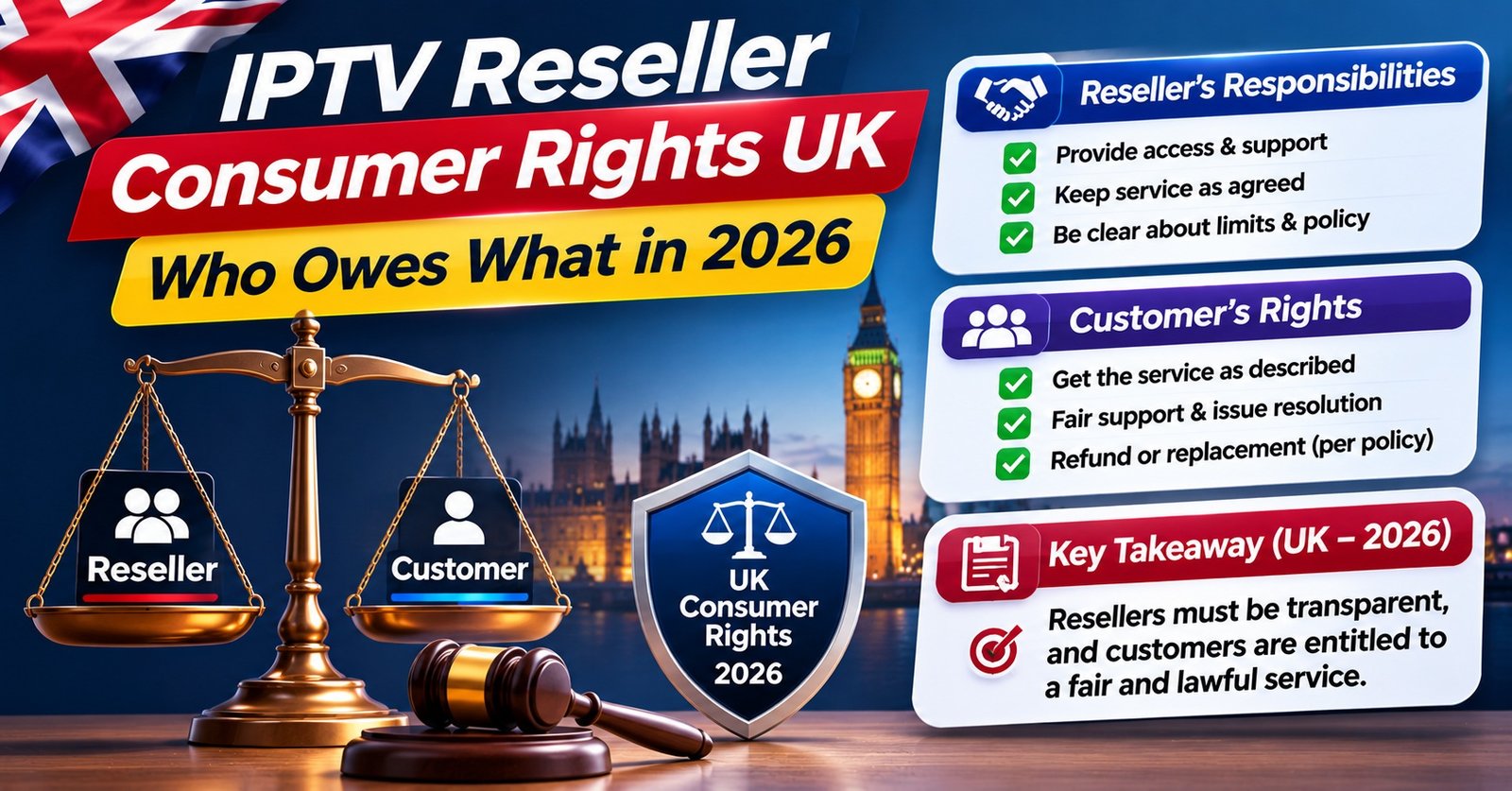
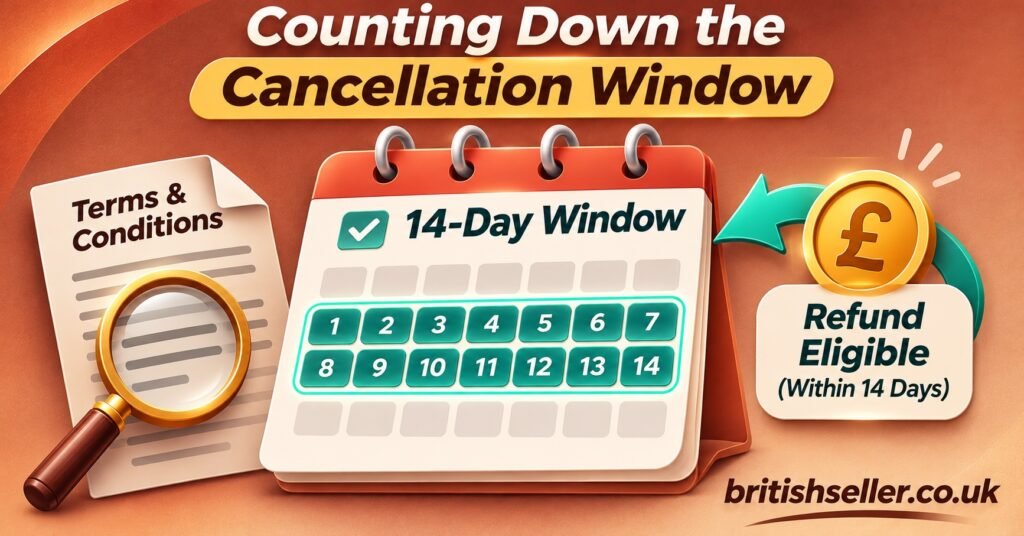
IPTV reseller consumer rights UK law comes down to one fact that surprises many sellers: when you sell a subscription to a household customer, you are the trader, and the statutory duties sit with you rather than with the panel provider behind you. Your customer is entitled to a service carried out with reasonable care and skill, to digital content that matches its description and works as it should, to a 14-day cancellation window on most online sales, and to a refund paid within 14 days when they cancel properly. A refund policy that says otherwise doesn’t remove any of that.
The protection only runs one way, though. When you buy credits from a wholesale panel for your business, you aren’t a consumer, so most of those rights don’t follow you up the chain; your remedy against the provider depends on the contract you agreed with them. And consumer law describes how lawful trade should be conducted. It offers nothing to anyone selling programming that nobody holds the rights to distribute, so the licensing question has to be settled before refund wording is worth polishing.
Who Counts as the Trader When a Subscription Passes Through Three Hands
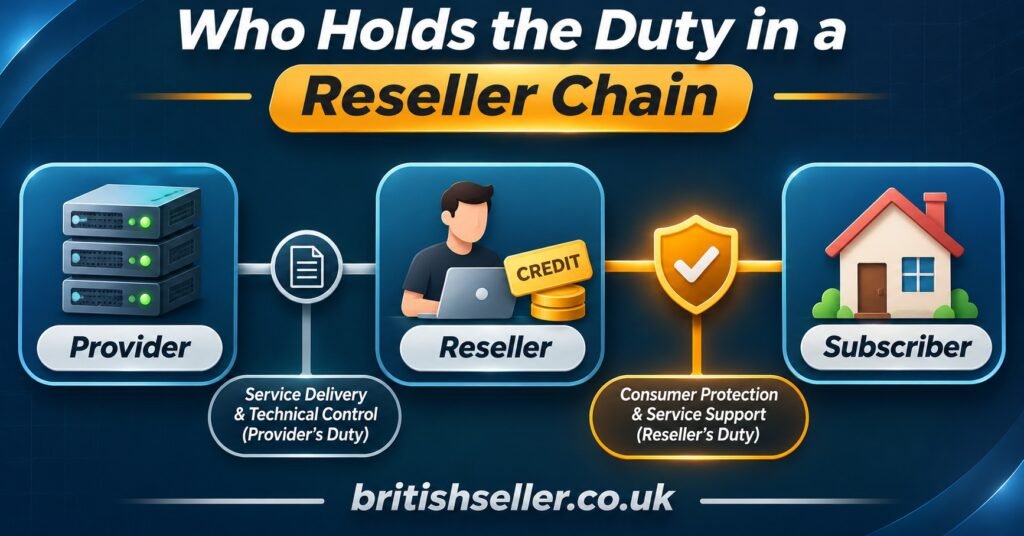
The usual arrangement has three parties. A wholesale IPTV reseller panel provider runs the infrastructure and sells credits. A reseller buys those credits, sets retail prices, takes payment and sends the customer their login. The customer pays the reseller and may never know the provider exists.
The Consumer Rights Act 2015 treats a consumer as an individual acting wholly or mainly outside their trade or business. Only the last link in that chain fits the definition, which makes the person who took the customer’s money the trader.
| Relationship | Who is protected as a consumer | Main legal footing |
|---|---|---|
| Wholesale provider to reseller | Neither party | The written B2B terms and general contract law |
| Reseller to sub-reseller | Neither party | Whatever the two agree, ideally in writing |
| Reseller or sub-reseller to household subscriber | The subscriber | Consumer Rights Act 2015, Consumer Contracts Regulations 2013, DMCC Act 2024 |
The practical consequence is easy to underestimate. If streams fail for a week because the upstream provider had a bad patch, the customer’s complaint is with you. You might well have a claim against your supplier, but that’s a separate argument, and the customer doesn’t have to wait for it to be resolved. This is why the supplier’s terms deserve a careful read before you start selling: compare what they promise you with what you are promising your customers. If you’re assessing a supplier, their published terms, such as British Seller’s reseller terms of service, are the document that defines your fallback position when something breaks upstream.
Sub-resellers sit in the same position as resellers for their own customers. Buying credits through a parent account doesn’t push the consumer duties back onto the parent.
The Rights a UK Subscriber Can Actually Rely On
The service standard
Under section 49 of the Act, a service must be performed with reasonable care and skill. Section 50 goes further than many sellers realise: what you say or write about the service becomes binding where the customer takes it into account before buying. That covers the sales page, but it also covers a WhatsApp reply saying the subscription “works on any smart TV” or supports three devices at once. If the customer relied on it, it’s part of the deal.
Where no time for performance was agreed, the service must be carried out within a reasonable time. For a subscription, that bears directly on activation delays and slow support responses.
When the subscription behaves like digital content
An IPTV subscription doesn’t sit neatly in one category. Access to a streaming service looks like a service, while an app or player you supply looks more like digital content. The Act deals with mixed contracts by applying each set of rules to the relevant element, and the digital content chapter of the Consumer Rights Act requires content to be of satisfactory quality, fit for any particular purpose the customer made known, and as described.
The same chapter also implies a term that the trader has the right to supply the digital content, and breaching it gives the customer a right to a refund. In other words, content rights aren’t an abstract issue separate from consumer law. They form part of what the trader promises.
The remedies, in the order the law expects
For services, the first remedy is repeat performance: putting the problem right free of charge, within a reasonable time and without significant inconvenience to the customer. If that’s impossible or doesn’t happen, the customer can claim a price reduction, which in serious cases can reach the full price. For digital content, the sequence is repair or replacement first, then a price reduction. The customer generally has to show the fault, so clear records on your side help both parties reach a fair outcome quickly.
IPTV Reseller Consumer Rights UK: The Cancellation Window Explained
Most IPTV panel reseller sales are distance contracts, made online, over messaging apps or by phone, so the Consumer Contracts Regulations 2013 apply. For services and for digital content not supplied on a physical medium, the customer has 14 days from the day the contract is made to cancel without giving a reason. Once they cancel, the refund is due within 14 days.
Starting the service immediately doesn’t end that right automatically. The regulations handle it differently depending on how the supply is classified.
For a service, you may only begin within the 14 days if the customer expressly asks you to. They can still cancel, but you can charge a proportionate amount for what they received before cancelling. The right to cancel disappears only once the service has been fully performed, and only if the customer acknowledged that this would happen. A monthly or annual subscription is never fully performed inside 14 days.
For digital content, the right to cancel is lost once supply begins, but only if the customer gave express consent and acknowledged that they would lose the right, and you then confirmed that in a durable form such as an email.
Take a hypothetical case. A customer buys a 12-month plan on a Monday, asks for instant activation, and cancels the following Saturday because the player app won’t install on their television. If your checkout recorded their express request for an early start and gave the required cancellation information, you can usually keep a sum reflecting six days of use and refund the rest. If your checkout did neither, you may owe the full amount. Leaving out the cancellation information altogether is worse still, because the window can then be extended by up to 12 months.
Pro tip: Add an unticked checkbox at checkout stating that the customer wants the subscription to start immediately and understands how this affects their right to cancel, then repeat the same wording in the confirmation email. Two lines of text decide most cancellation disputes.
What Changes for Rolling Subscriptions from 1 January 2027
The Digital Markets, Competition and Consumers Act 2024 contains a subscription regime that was delayed several times. The government’s subscription contracts guidance and draft regulations, published in October 2026, set 1 January 2027 as the start date for contracts entered into on or after that day, subject to parliamentary approval. Subscriptions agreed before then remain under the existing rules.
For plans that auto-renew unless the customer acts, the new rules require clear pre-contract information, reminder notices before certain renewal payments, a 14-day cooling-off period on sign-up, a second 14-day renewal cooling-off period after a trial or discounted period ends or when a longer contract renews, and a straightforward way to leave. The initial cooling-off right can be waived for contracts that supply only digital content, provided the familiar consent and acknowledgement steps are followed.
The definition matters for resellers. Many sell prepaid lines that simply expire unless the customer pays again. On the published definition, a plan that does not renew automatically sits outside this particular regime, although the Consumer Rights Act and the 2013 Regulations still apply in full. If you take card details and renew automatically, the new rules will apply to every contract you take from January.
Enforcement has also sharpened. Since 6 April 2025, the Competition and Markets Authority has been able to decide breaches of consumer law for itself and impose fines of up to 10% of global turnover, or £300,000 where that figure is higher. The CMA’s unfair commercial practices guidance explains what counts as misleading or aggressive selling, including hidden fees and fake reviews.
Where the Rights Stop: Licensing, Business Buyers and Card Protection
Licensing comes first
Consumer law assumes the thing being sold can lawfully be sold. The Intellectual Property Office’s guidance on illicit streaming is clear that watching content without the copyright owner’s permission is illegal, whatever device is used. IPTV itself is simply a delivery method; whether a particular service is lawful depends on whether the distribution rights exist. A polished dashboard, a business bank account or a UK address proves nothing about content rights, and a customer who relies on statutory refund rights for a service that should never have been sold is on far weaker ground than they might expect.
Your own purchases
Credits bought for resale are a business purchase. The 14-day cancellation right doesn’t apply, and refunds on credits depend on the supplier’s written terms. Check what happens to unused credits, who handles upstream outages and how disputes are raised before you commit money. The credit model is set out on pages such as British Seller’s IPTV reseller credit plans, but the governing document is always the contract, not the sales copy.
How subscribers can claw money back
Section 75 of the Consumer Credit Act 1974 makes a credit card issuer jointly liable for a breach of contract or misrepresentation, but only where a single item costs more than £100 and no more than £30,000. A monthly plan rarely qualifies; an annual plan sometimes does. Chargeback is a card scheme rule rather than a statute, has no minimum value, and is usually time-limited. Both routes mean a reseller with unclear terms or poor records can lose a dispute they might otherwise have won.
Policy Wording That Wouldn’t Survive a Complaint
Part 2 of the Consumer Rights Act makes unfair terms unenforceable against consumers, and some liabilities can’t be excluded at all. These are the clauses most likely to cause problems:
- “No refunds under any circumstances.” Statutory remedies can’t be contracted away, so the clause misstates the customer’s rights and may itself be treated as a misleading practice.
- “Refunds only before activation.” This ignores the proportionate refund available for services and fails entirely where the consent and acknowledgement steps were never recorded.
- “Server problems are our provider’s responsibility.” To the customer, you are the trader. Your recourse against the provider is your own concern.
- “We may change prices or terms at any time.” Broad unilateral variation rights are on the grey list of potentially unfair terms, and from January they sit badly with the renewal notice requirements.
- Device or connection promises the service can’t keep. Under section 50, pre-sale statements the customer relied on become contract terms.
A fairer clause states what happens on cancellation, how the proportionate charge is calculated, how long refunds take and how the customer can raise a complaint. Plain wording also satisfies the Act’s transparency requirement, which a dense wall of legal language often doesn’t.
Checking the Law Yourself
Summaries go out of date, including this one. For the primary text, use legislation.gov.uk and read the status banner at the top of each page, which states how recent the consolidated version is. For the new subscription regime, use the GOV.UK guidance rather than third-party summaries, because the start date moved three times before settling. The CMA publishes guidance on unfair contract terms and commercial practices, Citizens Advice runs the consumer service that refers cases to Trading Standards, and the British Seller news and guides section covers the operational side of running a IPTV panel reseller account.
Before You Take the Next Payment
- Confirm in writing that the service you resell has the distribution rights it claims
- Rewrite your refund policy so it reflects the 14-day cancellation right and proportionate charges
- Add an express early-start request and acknowledgement to checkout, and repeat it in the confirmation email
- Show your business name and a geographical address before the customer pays
- Remove device or connection claims you can’t support consistently
- Keep activation dates, support tickets and refund decisions together for each customer
- Decide whether any of your plans auto-renew, and prepare reminder notices before 1 January 2027
Frequently Asked Questions
Can a customer cancel after watching for a week?
Usually, yes, within 14 days of the contract. If they expressly asked for an immediate start and you gave the required information, you can deduct a proportionate amount for the days used. Without those steps, a full refund may be due.
Does a free trial change the cancellation rules?
Not under the current regulations, which count the 14 days from the paid contract. From 1 January 2027, a trial that rolls automatically into a paid plan triggers a renewal cooling-off period under the new regime.
Am I protected as a consumer when I buy reseller credits?
No. Credits bought for resale are a business purchase, so the supplier’s terms decide refunds. A sole trader paying by credit card may still be able to use Section 75 in some cases, but a limited company cannot.
My business is based outside the UK. Do these rules still apply?
If you sell to consumers in the UK, UK consumer protections apply to those customers in principle. Enforcement across borders is harder, but that doesn’t change what the customer is entitled to, and the January 2027 subscription regime is expected to reach overseas traders who target UK buyers.
Who handles a complaint I can’t resolve?
The customer can go to the Citizens Advice consumer service, which can refer the case to Trading Standards. Card disputes go to the card issuer and, failing that, the Financial Ombudsman Service.
Getting the Basics Right on IPTV Reseller Consumer Rights UK
The core of IPTV reseller consumer rights UK law is ownership: whoever sells to the household carries the duties, whatever sits upstream. That means honest descriptions, a checkout that handles the 14-day window properly, refunds that arrive on time and terms written to inform customers rather than deter them. None of it substitutes for confirming that the service is properly licensed in the first place. If your plans auto-renew, the most useful job this month is mapping every renewal you take against the rules that start on 1 January 2027.