Book Appointment Now
IPTV Reseller Terms of Service: UK Clause Guide 2026
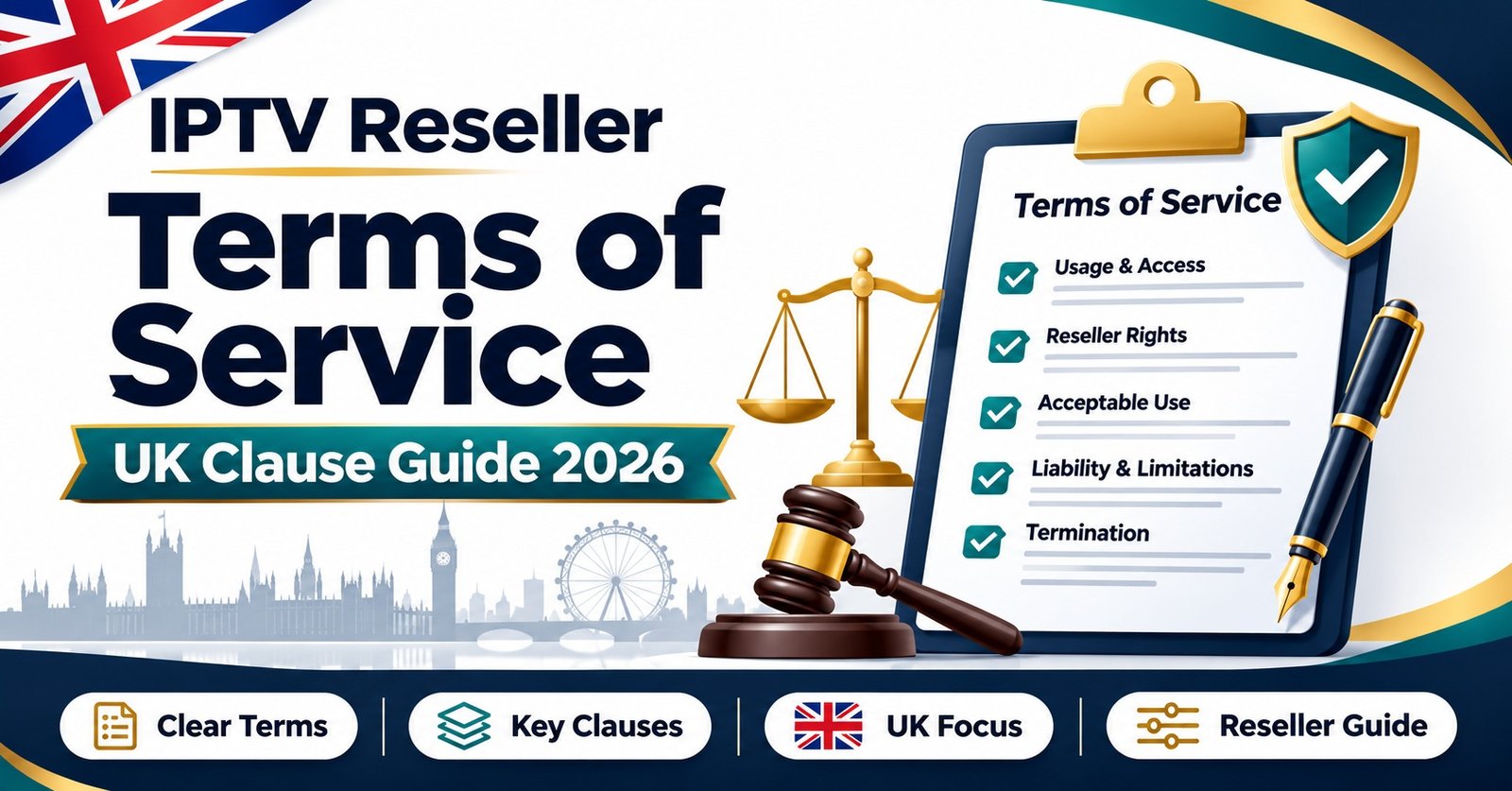
An IPTV Reseller Terms of Service is the written agreement that decides what you are allowed to sell, how your credits, refunds and suspensions work, and what you can safely promise the people who buy from you. Before reading anything about pricing or panel features, find the clause that says who holds the distribution rights to the content and what evidence the provider can show for it. If that clause is missing, vague, or simply pushes every risk onto you, the rest of the document is built on sand.
Most IPTV panel resellers actually work under two sets of terms that share the same name. One is the agreement you accept from your upstream provider when you open a panel account, a business contract where the law gives you comparatively little protection. The other is the set of terms you publish for your own subscribers, and that one sits squarely under UK consumer law. Your customer terms can never safely promise more than your provider’s terms give you, so the order in which you read them is not a detail.
One Name, Two Contracts
The upstream agreement governs your relationship with the provider. It usually covers how credits are bought and priced, whether they expire, which territories you may sell into, whether you can create sub-reseller accounts, when the provider may suspend or close your panel, how subscriber data is handled, and which country’s law applies if something goes wrong.
The downstream terms govern your relationship with subscribers. They explain what a subscription includes, how many connections or devices are allowed, how trials and renewals work, how cancellation and refunds are handled, what support looks like, and what customers must not do with their login.
Problems start in the gap between the two. Suppose your provider reserves the right to change or withdraw service with little notice, while your website tells customers they will receive uninterrupted access for twelve months. When the provider exercises that right, your customers have a claim against you, not against a company they have never heard of. Reading both documents side by side, clause against clause, is the simplest way to spot promises you cannot back up.
Licensed Technology Is Not the Same as Licensed Content
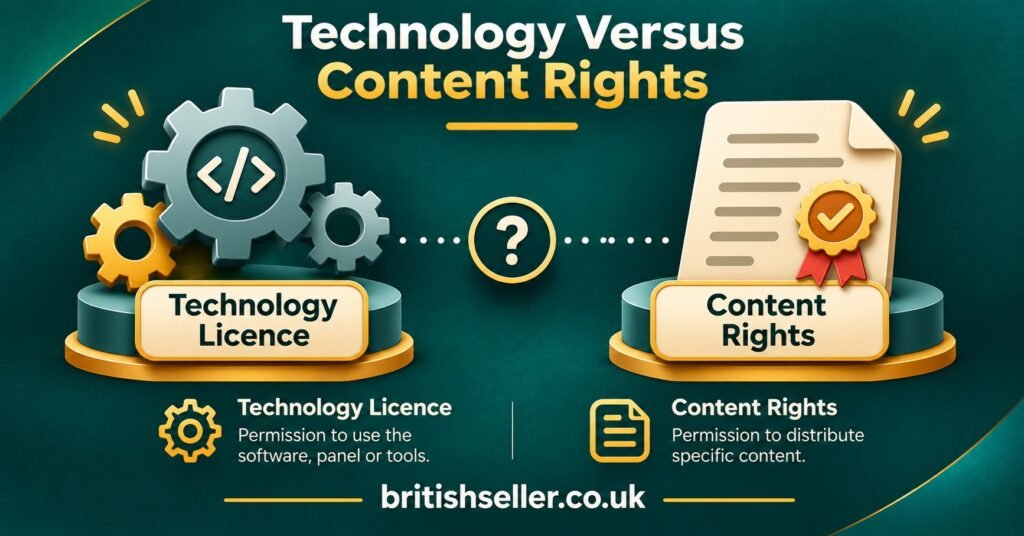
IPTV is a delivery method. Panel software, middleware, player apps, programme guide tools and billing integrations can all be licensed perfectly legitimately, and none of that tells you whether the streams carried through them are authorised. A common pattern in weaker agreements is a detailed licence for the software followed by near silence on the content itself.
That silence matters because UK copyright law treats unauthorised distribution seriously. Under section 107(2A) of the Copyright, Designs and Patents Act 1988, the maximum sentence for the criminal offence of communicating copyright works to the public was raised to ten years by the Digital Economy Act 2017, with that change taking effect on 1 October 2017. You can read the amending provision on legislation.gov.uk.
A clause stating that the provider is “a technology supplier only” or that the IPTV panel reseller “accepts full responsibility for all content” does not make anything lawful. It only records who the provider would prefer to hold responsible. The same applies to a polished website, a registered company number or an established payment processor: none of these establishes that distribution rights exist.
What a trustworthy agreement tends to include instead:
- A clear warranty that the provider holds, or is authorised under, the licences needed for the content in the territories you sell into
- The name of the entity that holds those rights, rather than a generic reference to “partners”
- A commitment to tell you promptly if any licence is lost or restricted
- A right for you to terminate and recover the value of unused credits if the rights position changes
If a provider will not put any of this in writing, treat that as information about the service rather than an oversight.
The UK Law an IPTV Reseller Terms of Service Has to Respect
Your customer-facing terms are a consumer contract, which means several pieces of UK law apply whether or not your terms mention them. The table below maps each source to the place it usually shows up in a reseller’s terms.
| Source | What it covers | Where it shows up in your terms |
|---|---|---|
| Consumer Rights Act 2015, Part 2 | Fairness and transparency of consumer terms | Refunds, service changes, liability limits |
| CMA37 unfair terms guidance | How the regulator reads those rules | Every clause that favours you over the customer |
| Consumer Contracts Regulations 2013 | Pre-contract information and the 14-day cancellation right | Trials, sign-up wording, early access |
| Digital Markets, Competition and Consumers Act 2024 | Enforcement powers and subscription rules | Renewals, reminders, how customers leave |
| UK GDPR and Data Protection Act 2018 | Handling of personal data | Privacy notice, record keeping |
| Copyright, Designs and Patents Act 1988 | Content rights and related offences | Provider warranties, acceptable use |
The fairness test is the one most resellers underestimate. Under the Consumer Rights Act, a term is unfair if it shifts the balance of rights and responsibilities too far in the trader’s favour. The Competition and Markets Authority refreshed its guidance on this recently: the revised CMA37 document is dated 22 July 2026, although the underlying law has not changed since 2015, so traders’ obligations are the same. The new version is still worth reading, because it explains how the regulator approaches clauses such as one-sided variation rights and blanket refund exclusions.
Enforcement has also sharpened. Since April 2025 the CMA has had enhanced consumer enforcement powers, including penalties that can reach 10% of global annual turnover. On top of that, a dedicated subscription regime is coming. The government confirmed on 9 August 2026 that the subscription contracts regime will come into force in January 2027, earlier than the spring 2027 date previously expected. Most auto-renewing consumer subscriptions are within scope, including those that start with a free or discounted trial, and the rules require clearer contract information, renewal reminders and simpler cancellation. No exact day has been named yet, and the detailed regulations and CMA guidance are still awaited, so check for updates before you finalise any renewal wording.
For data, the ICO offers a free privacy notice generator aimed at sole traders and small organisations, which is a sensible starting point for the privacy section your terms should link to.
Your upstream agreement is different. As a business buyer you are generally not a “consumer”, so the consumer fairness rules above do not protect you. Exclusion clauses in business contracts are usually judged on reasonableness instead, which gives far less room to challenge a one-sided term after you have accepted it. This is general information rather than legal advice; if your business depends on a single upstream agreement, a short review by a solicitor is money well spent.
Reading the Provider’s Agreement Clause by Clause
Credits, expiry and unused balances
Check whether credits expire, whether an expired balance is lost or can be extended, and what happens to unused credits if the provider closes your account or stops trading. An agreement that lets the provider keep prepaid balances in every scenario places all of the business continuity risk on you.
Suspension, bans and changes to the service
Look for the grounds on which your panel can be suspended and whether you receive notice first. Vague grounds such as “any reason at the provider’s discretion” make it impossible to plan. Compare this clause directly with what you promise subscribers about service continuity.
Liability caps and indemnities
Many agreements cap the provider’s liability at a small amount while asking you to indemnify the provider against almost everything. An indemnity that covers claims arising from content you had no control over deserves particular attention, because it means the provider’s licensing failures could become your financial problem.
Who controls subscriber data
Your customers’ names, emails and payment references are personal data. The agreement should say whether the provider accesses that data, where it is stored, and whether it can be used for anything beyond running your accounts. If the provider uses your customer list for its own marketing, you will struggle to describe that honestly in your privacy notice.
Sub-reseller rights
If you plan to sell downward, confirm that the agreement allows it and on what conditions. Your sub-resellers will need their own terms that are consistent with yours, and you remain answerable for what they promise in your name.
Governing law and disputes
An agreement governed by the law of a distant jurisdiction can be very hard to enforce. Your UK customers keep their UK consumer rights against you regardless, so a mismatch here leaves you exposed on both sides.
Writing Terms Your Own Subscribers Can Actually Read
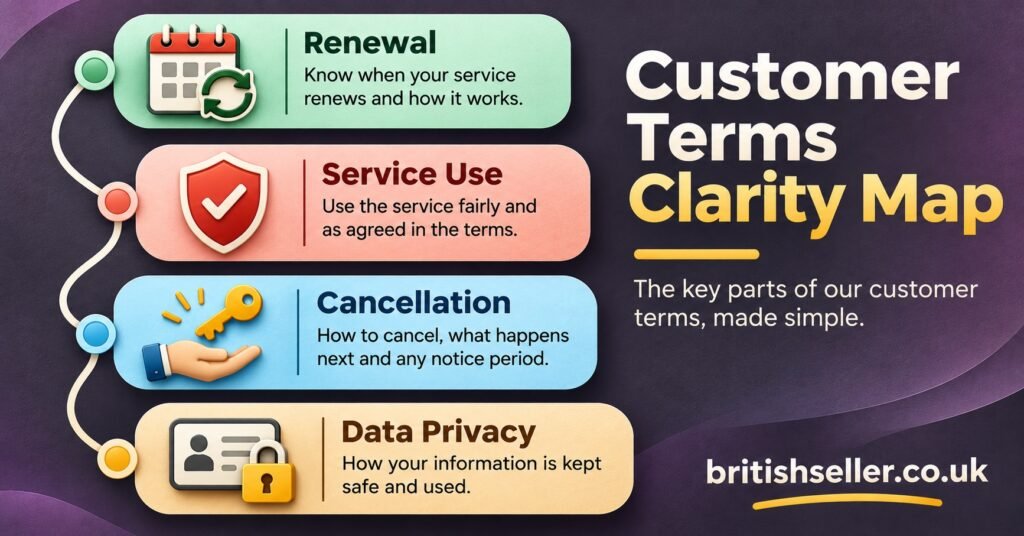
The CMA’s guidance places weight on transparency as well as fairness, which in practice means plain language, a sensible structure and nothing important tucked into a paragraph nobody will reach. Short sections with clear headings (what you get, how payment works, how to cancel, what we can change, how we use your data) usually serve customers better than a dense legal block.
Trials need careful wording. If you offer one, state its length, what happens when it ends, and whether payment details are taken in advance. If you are refining how trials lead into paid lines, our guide to turning free trials into paying customers covers the commercial side; the terms simply need to match whatever process you actually run.
Cancellation is where many IPTV panel reseller terms go wrong. For distance contracts, the cancellation period for digital content not supplied on a tangible medium ends 14 days after the contract is made, and the consumer loses that right where supply starts during the period, provided they acknowledged that the right would be lost. Streaming access may be classed as a service or as digital content, and the mechanics differ slightly, but in both cases you need the customer’s express request to start immediately, captured at sign-up, rather than a line buried in your terms. A tick box with clear wording at checkout does far more work than any clause.
Renewals deserve their own section. State whether lines renew automatically or only when the customer pays again, how and when reminders are sent, and how to stop a renewal. If you do run automatic renewals, plan now for the January 2027 rules rather than rewriting everything in December. Clear reminder habits also support retention, which our UK customer retention playbook discusses in more depth.
Other clauses worth stating honestly:
- Connection and device limits: how many simultaneous streams a line allows and what happens if that is exceeded
- Support: the channels you use and realistic response windows, rather than promises of instant help you cannot staff
- Acceptable use: no sharing or reselling of credentials, no attempts to circumvent account limits
- Changes to the service: what you may change, how much notice customers receive, and their right to leave if a change materially affects them
Finally, make the terms visible before payment. Sending them as a message after the customer has paid does not give them a fair chance to read what they are agreeing to. Building this into the first contact with a customer is easier than adding it later, a point our guide to structuring customer onboarding makes from the operational side.
Pro tip: Give every version of your terms a date and version number, archive the old ones, and record which version each customer accepted at sign-up. When a dispute arises months later, that record answers the first question anyone will ask.
Mistakes That Quietly Undermine Trust
Copying the provider’s terms and changing the logo. Upstream terms are written for a business relationship and often protect the provider against you. Republished to consumers, they tend to contain clauses that fail the fairness test and promises you never intended to make.
Relying on a blanket “no refunds” line. Consumers have statutory rights that a contract term cannot remove. A clause claiming otherwise is unenforceable and signals to any regulator or payment provider that the rest of the document may be unreliable too.
Treating a content-responsibility clause as protection. Asking customers or sub-resellers to “accept responsibility for content” does nothing about whether the content is licensed. It can make a business look as though it knows there is a problem.
Reserving unlimited rights to change the service. A term that lets you change anything at any time without notice tilts the balance heavily in your favour. Balanced wording sets out what can change, how much notice is given, and what the customer can do about it.
Leaving terms undated and unversioned. Without dates you cannot show what a customer agreed to, and you cannot prove when a change took effect.
A Verification Checklist Before You Sign or Publish
Before accepting a provider’s agreement
- Find the content rights clause and confirm it names a rights holder or licensing entity
- Ask whether the provider will notify you if any licence is lost, and get the answer in writing
- Check what happens to unused credits on suspension, closure or provider shutdown
- Read the indemnity and liability cap together, not separately
- Confirm sub-reseller permissions if you plan to sell downward
- Note the governing law and assess whether you could realistically enforce it
- Save a dated copy of the agreement you accepted
Before publishing your own terms
- Compare each customer promise against the matching provider clause
- Make terms available before payment, not after
- Capture the customer’s express request to start immediately within the 14-day period
- State renewal, reminder and cancellation steps in plain language
- Remove any wording that excludes statutory rights
- Link a privacy notice that matches how data is actually handled
- Date and version the document, and log which version each customer accepted
Questions Resellers Ask About Their Terms
Can I use a free online template for my customer terms?
A template can be a starting point, but it will not reflect your actual trial, renewal and support process, and generic templates often include clauses written for physical goods. Edit it until every sentence describes something you really do.
Do my customer terms need to mention credits?
Usually not. Credits are part of your business arrangement with the provider. Customers buy a subscription period or a line, so your terms should describe what they receive, not how you source it.
Will the January 2027 subscription rules apply to me?
They are aimed at auto-renewing contracts, including those that begin with a trial. If customers must actively pay again for each period, your position may differ, but the detailed regulations are not yet published. Review your renewal model once the final rules and guidance appear.
Does registering a UK company protect me if the provider’s content is unlicensed?
No. A company structure affects how liability is organised, not whether distribution is authorised. Content licensing is a separate question that only the rights position can answer.
How often should I review my terms?
Review them whenever your provider changes its agreement, when you change how trials or renewals work, and when relevant law or regulator guidance changes. The CMA guidance update in 2026 and the subscription regime in 2027 are both reasonable triggers for a review now.
Getting the Contract Chain Right
A sound IPTV Reseller Panel Terms of Service is really two documents working together: an upstream agreement that tells you honestly what you are buying and on what rights basis, and customer terms that promise no more than that agreement supports. The legal framework is not obscure. Consumer fairness rules, cancellation regulations, data protection and copyright law are all published, and the regulator’s guidance was refreshed this year.
If you do one thing this week, put your provider’s agreement and your own customer terms side by side and mark every promise you make that the provider does not back. That list is where your real risk sits, and it is also where a reviewing solicitor can help most efficiently. For more practical reading on running the business behind those terms, the British Seller news and guides hub collects related articles in one place.