Book Appointment Now
IPTV Reseller Privacy Notice UK and the 2026 Complaint Rule
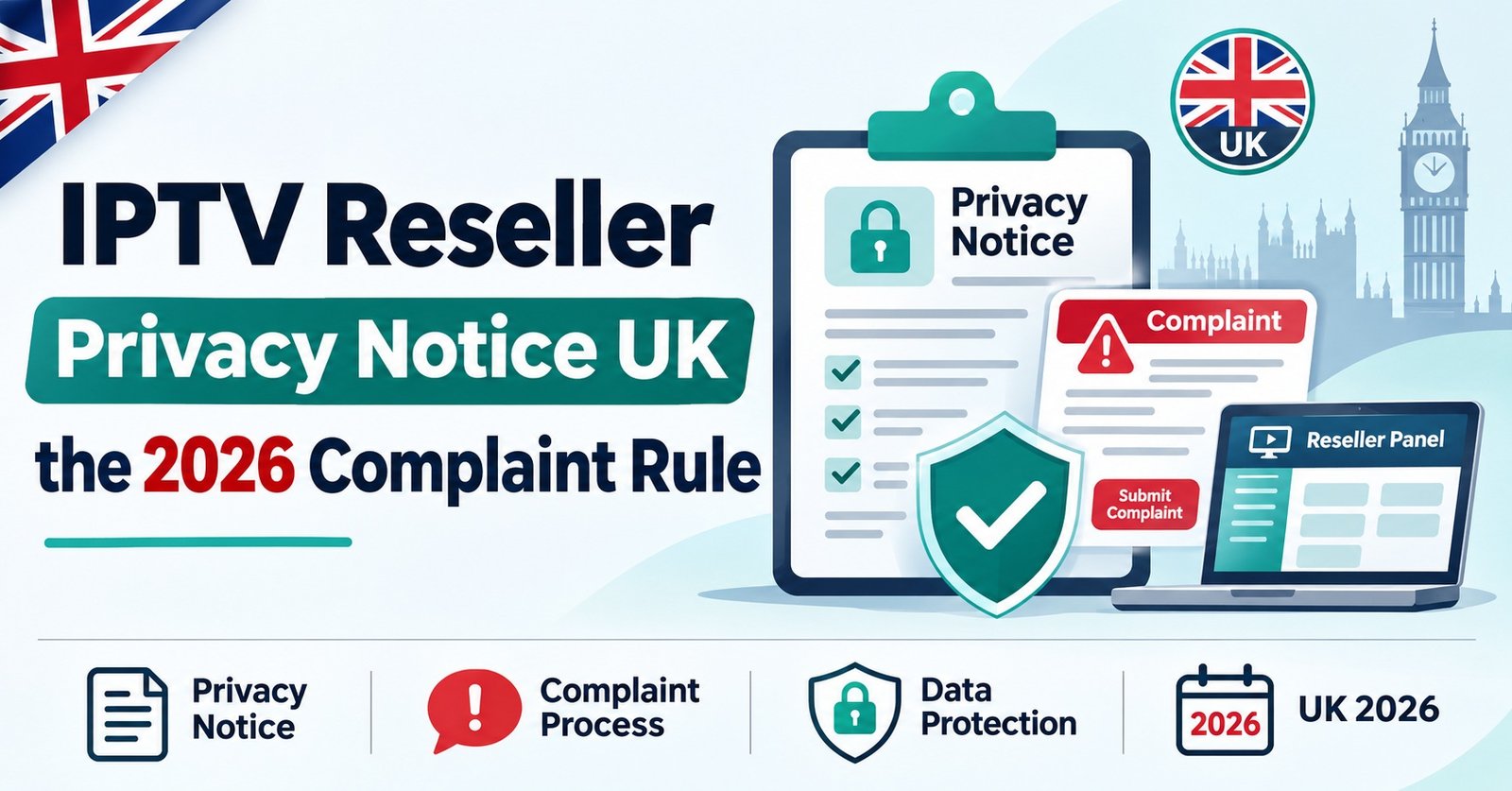
An IPTV Reseller Privacy Notice UK subscribers can rely on is built from a fixed legal list, not from wording borrowed off another reseller’s site. Under Articles 13 and 14 of the UK GDPR, it has to say who you are and how to reach you. It has to explain what you collect when someone enquires, pays, receives a line and contacts support, and link each of those uses to a lawful basis. It has to name who else receives the data, including panel hosts and payment firms based outside the UK. Finally, it has to state how long you keep each type of record and set out the customer’s rights, including how to complain.
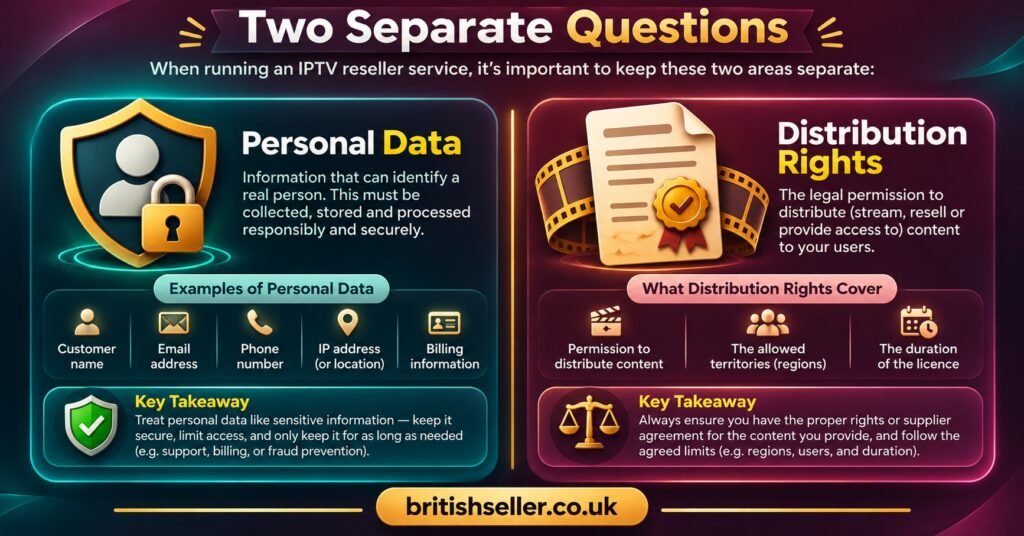
Two things catch resellers out this year. Since 19 June 2026, organisations have been legally required to handle data protection complaints under the Data (Use and Access) Act 2025, so a notice that simply points unhappy customers at the regulator is now incomplete. The second is easy to overlook: a privacy notice covers personal data and nothing else. It cannot confirm, imply or stand in for any right to distribute programming, however carefully the surrounding page is worded. Keep those two jobs apart and most of the drafting becomes straightforward.
Start With One Customer, Not a Template
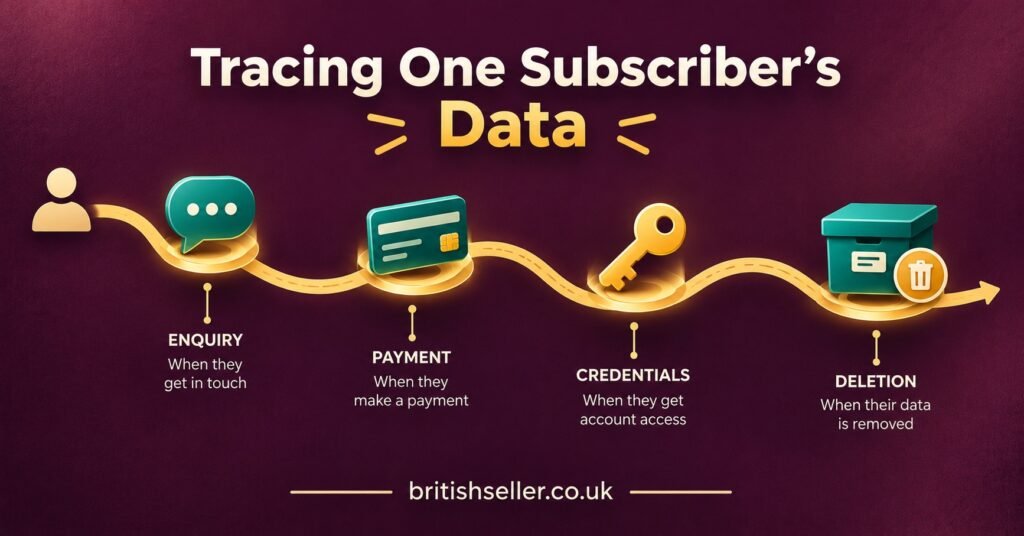
A notice copied from a template describes a business that does not exist. The quicker route is to follow a single subscriber from their first message to the day their records are deleted. Write down every piece of information that changes hands and every system it passes through. The finished notice is that trace, rewritten in plain language.
The enquiry and the trial
Most UK IPTV panel resellers first hear from a customer through a messaging app, an email form or a trial request. At that point you are already holding a name, a phone number or handle, possibly an email address, and usually some detail about the device they plan to use. If you issue a trial line, you also create credentials and, through the panel, connection records.
Processing at this stage normally relies on steps taken at the person’s request before a contract. That is the contract basis in UK GDPR terms. The detail the notice needs is what happens to trial data when the customer never buys. “Deleted after 30 days if no order is placed” is something a reader can check. “Kept as long as necessary” is not.
Payment
If you take payment through a hosted checkout or a payment provider, the card details usually never reach you. What you receive is a transaction reference, a name, an email address and the amount. Say exactly that, but only if it is true for your setup. Bookkeeping records then sit under a different lawful basis, because tax law requires you to keep them. That is a legal obligation rather than a contract, and the retention period is set by that law rather than by your preference.
Creating the line inside the panel
This is the stage resellers most often leave out, and it matters most. Creating a line generates a username, password, package, expiry date and connection limit. Depending on the panel, it may also record a MAC address or device identifier. The server side typically logs IP addresses when the line connects.
Customers rarely realise that the panel is often run by a different company, sometimes in another country. That fact turns two abstract items on the legal list, recipients and international transfers, into something concrete. In a past enforcement decision, the ICO took the view that third countries receiving personal data should generally be named in the privacy notice so that people can make informed choices. If your panel host’s servers are outside the UK, the notice should say where, and on what safeguard the transfer relies.
Support conversations
Support creates more personal data than most UK IPTV panel resellers expect. There are chat histories, voice notes, and screenshots of a customer’s television menu that may show other accounts or household details. Remote help sessions add more. The notice should explain which channels you use for support, how long conversations are kept, and whether staff or contractors outside the UK read them.
This is also where the new complaints duty connects to everyday operations. If you already run a structured customer support process, a data protection complaint can travel through the same queue. It just needs to be recognised for what it is.
Renewals, reminders and marketing
A reminder that someone’s subscription expires on Friday is part of servicing their contract. A message announcing a discount on a longer plan is marketing. Electronic marketing falls under the Privacy and Electronic Communications Regulations (PECR) as well as the UK GDPR. Existing customers can receive marketing about similar services under the “soft opt-in” rule, but only if they were given a simple way to refuse at the point of sale and in every message afterwards. The notice should describe both kinds of message separately so nobody mistakes one for the other.
After the customer leaves
Expired lines tend to sit in panels indefinitely because nobody deletes them. Decide what happens instead. Some records are worth keeping for a defined period to deal with chargebacks or disputes, which should match whatever your refund terms promise. After that period, delete or anonymise them. Whatever you decide, the notice should state it as a period or a rule a customer could apply to their own situation.
Summarised, a typical trace looks like this. Your own version should reflect your actual suppliers and choices.
| Stage | Typical data involved | Lawful basis usually considered |
|---|---|---|
| Enquiry and trial | Name, contact handle, device type, trial credentials | Steps before a contract |
| Payment and bookkeeping | Transaction reference, name, email, amount | Contract; legal obligation for tax records |
| Line creation and use | Username, expiry, package, device ID, connection IPs | Contract; legitimate interests for security logs |
| Support | Chat history, screenshots, call notes | Contract; legitimate interests |
| Promotional messages | Email or phone number, opt-out status | Soft opt-in or consent under PECR |
| After cancellation | Dispute and accounting records | Legal obligation; legitimate interests |
The Legal Sources Behind an IPTV Reseller Privacy Notice UK
The core requirements come from Articles 13 and 14 of the UK GDPR. The ICO’s guidance on what privacy information to provide is the most practical way to read them. The ICO describes the required items, including your purposes, your retention periods and who the data is shared with, collectively as “privacy information”. Article 13 covers data you collect directly from the customer. Article 14 matters in reseller chains, because customer details sometimes arrive second-hand, for example from a sub-reseller or through a parent panel. Article 14 applies whenever personal data comes from somewhere other than the person it describes. In that situation, the information must reach the individual within a reasonable period and no later than one month after you obtain it.
Expect this guidance to move. The ICO has said its right to be informed guidance is under review following the Data (Use and Access) Act becoming law on 19 June 2025. Check the page each time you revise your notice rather than relying on what it said last year.
The complaints duty is the change most notices still miss. Organisations must now acknowledge a data protection complaint within 30 days of receiving it and investigate without undue delay. Existing complaints tools can be adapted, but complaints must be accepted through any channel, including when raised with any member of staff. In practice, a complaint about a reseller might arrive as a voice note in a support chat, so the people answering messages need to recognise one. The ICO’s guidance on handling data protection complaints was published on 12 February 2026. Your notice should give a direct route to complain to you and still explain the right to go to the ICO.
Cookies and similar tracking technologies on your website fall under PECR rather than the UK GDPR alone. The ICO published its final guidance on storage and access technologies on 29 April 2026, covering when consent is needed for cookies, tracking pixels, local storage and device fingerprinting. The 2025 Act added exceptions for statistical purposes, website appearance or functionality, and emergency assistance. These exceptions are narrower than many site owners hope: if data collected under one of them is used for a secondary purpose, the exception no longer applies and consent is required. The stakes are higher than they used to be, because PECR penalties can now reach £17.5 million or 4% of global turnover.
Finally, there is registration. Most businesses that handle customer data pay an annual data protection fee to the ICO unless an exemption applies. The three-tier structure was kept when fees rose by 29.8%, taking the tiers to £52, £78 and £3,763. Paying it is not the same as being compliant. Registration does not make a business data protection compliant, and it does not allow the ICO logo to be used to suggest it does.
Pro tip: Keep a one-page internal record of the trace from the first section, listing each supplier, its country, what it receives and your retention rule. When a supplier changes, update that page first and the public notice second. The two then stay in step.
Who Is the Controller When a Panel Sits in the Middle?
A IPTV panel reseller who decides who to sell to, what to charge, how to contact customers and when to delete their records is acting as a controller for that customer relationship. The panel operator’s role depends on what it actually does with the data. If it only stores line data and runs connections on your instructions, it is likely a processor. If it also uses connection logs for its own purposes, such as its own security monitoring, fraud detection or product decisions, it may be a controller for those uses as well.
Sub-reseller arrangements add another layer. A sub-reseller who runs their own customers is normally a controller for that relationship and needs their own notice. They cannot simply rely on yours, and you should not imply that yours covers them.
You cannot describe arrangements you have not verified. Before publishing, ask your supplier in writing:
- where its servers and staff are located
- which logs it keeps and for how long
- whether it uses customer data for its own purposes
- which sub-processors it relies on
A supplier that cannot answer basic questions about where your customers’ data goes raises a wider concern. That concern belongs in your process for checking a supplier before committing credits, not just in your privacy drafting.
Where Data Protection Stops and Content Rights Begin
A privacy notice answers one question: what happens to my personal information? It does not answer a different one: is this service permitted to show what it shows? The two are regularly blurred on reseller websites, and the blur works against the business.
The UK Intellectual Property Office draws the line clearly in its guidance on illicit streaming. It defines illicit streaming as watching content without the copyright owner’s permission by any means, not only through dedicated hardware. The technology itself is not the problem. The same guidance notes that devices can be used legally once the infringing software is removed. IPTV is a delivery method, and whether a particular service is lawful depends on distribution rights held for the programming it carries.
Those rights come from agreements with rights holders. A privacy notice, a terms page, a footer disclaimer or the fact that a payment went through cannot create them. Disclaimers that place copyright responsibility on the viewer describe who the operator hopes will carry the risk. They do not establish that any content is authorised.
For drafting, that leads to three practical rules:
- Describe the service as account management, credentials and technical delivery.
- Do not use the words “licensed” or “authorised” anywhere unless you hold documents that prove it.
- Keep copyright statements, takedown procedures and service terms on their own pages, linked from the notice but not mixed into it.
A privacy notice that sticks to the data is easier to keep accurate. It is also more believable to the customers and regulators who read it.
Testing the Notice Before You Publish It
Reading your own notice is not much of a test, because you know what you meant. Check it against the trace from the first section and against what your systems actually do:
- Confirm the controller name and address match your registered company details exactly, including any trading name customers know you by.
- Confirm every stage in your trace appears with its purpose and lawful basis stated together, not in separate lists the reader has to match up.
- Name the panel host, payment provider, email tool, website host and messaging platform, or describe each as a clear category, with the country where each one processes data.
- State the safeguard relied on for every transfer outside the UK.
- Give each record type a period or a rule a customer could apply to themselves.
- Provide a complaints route (an email address or form), say who handles complaints, and commit to acknowledging them within 30 days.
- Include the right to complain to the ICO, with its contact details.
- List the individual rights, and explain how to withdraw consent wherever consent is the basis.
- Mark which form fields are mandatory and explain what happens if a customer leaves them blank.
- Open your site in a private browser window and compare the cookies and trackers that load with what the notice and cookie banner describe.
- Remove any sentence that suggests content licensing, permission or approval you cannot prove.
- Link the notice from the trial form, the checkout and the footer, and check it reads properly on a phone.
- Add a “last updated” date and a version number, and note the events that trigger a review.
Phrases That Read Well and Say Nothing
Some sentences appear in almost every reseller notice and fail almost every review. “We may share your information with trusted partners” tells the reader nothing about who those partners are. “We keep your data for as long as necessary” gives them nothing to hold you to. “Your data is 100% secure” is a claim no business can support.
The regulator has been specific about this. In a major enforcement decision, the ICO found that many general statements about lawful bases, recipients, international transfers and retention were not detailed enough to meet transparency requirements. Broad references to contractual and legal obligations as the basis for retention were not considered meaningful to individuals. That case involved a far larger business, but the reasoning applies equally to a small reseller. Specific sentences are shorter and easier to keep true: “Your trial details are deleted 30 days after the trial ends unless you place an order.”
Keeping the Notice True After Launch
An IPTV Reseller Privacy Notice UK customers can trust is only as accurate as its last update. Adding a new panel supplier, messaging channel, support contractor or analytics tool changes the data story, so the notice should change before the new arrangement goes live, not afterwards. Its limits stay the same however carefully it is written: it explains how personal data is handled and cannot settle any question about content rights, which have to be resolved separately and on evidence.
The most useful next step is to run the one-customer trace this week, compare the result with the checklist above, and fix the gaps before your next customer arrives. For related operational guides covering suppliers, support and renewals, the IPTV reseller panel guide section collects them in one place. This article is general information rather than legal advice, so take professional advice if your setup involves several companies or countries.