Book Appointment Now
IPTV Reseller Trial Conversion: What Actually Works 2026
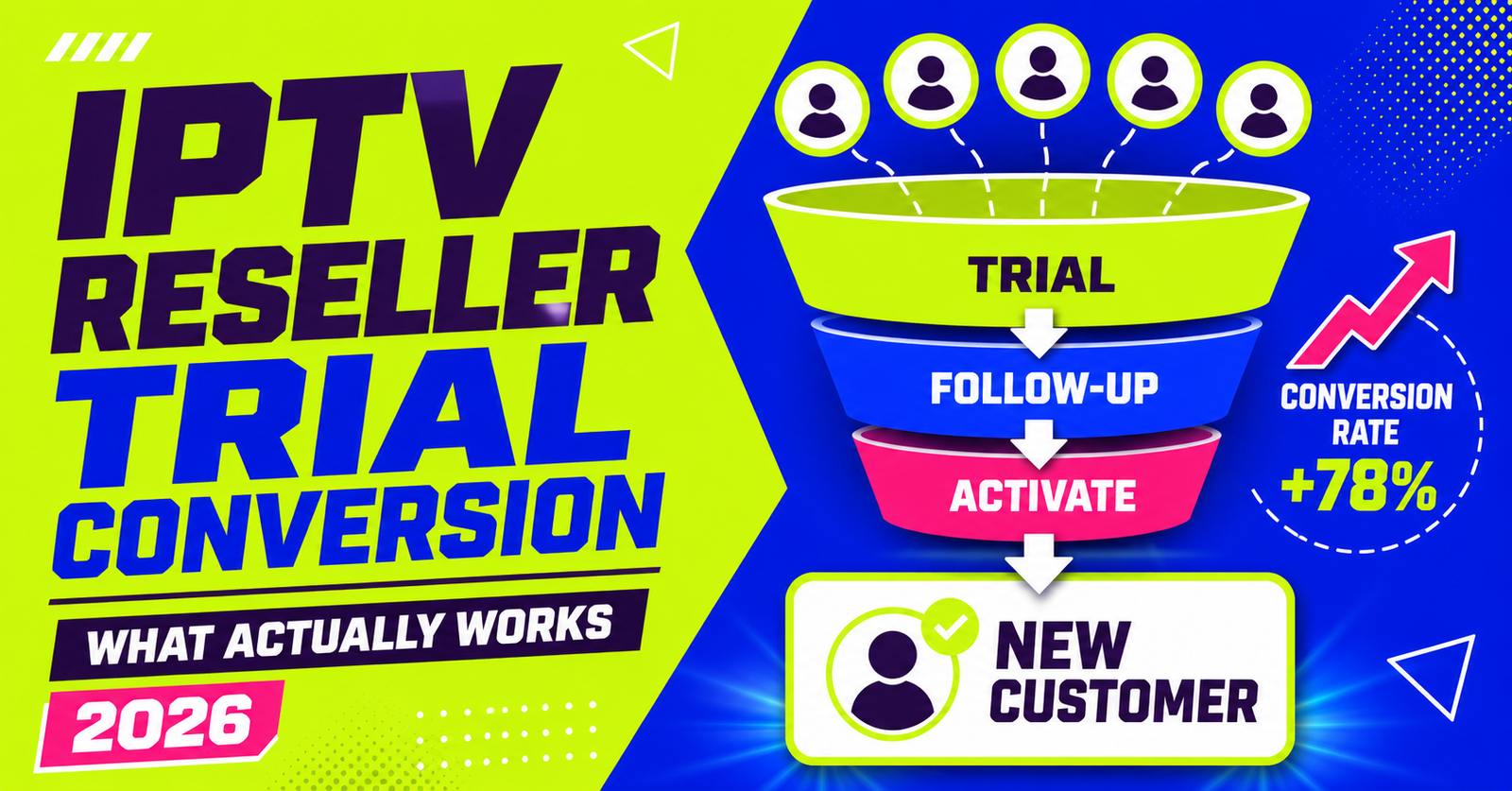
IPTV Reseller Trial Conversion comes down to three things: how long the trial runs, how you follow up while it’s active, and whether you’re ready to take payment the moment someone says yes. Most resellers lose customers not because the stream buffered, but because the trial ended and nobody followed up until it was too late. Getting this right is less about the panel you use and more about the sequence you run between the first message and the first payment.
What decides whether a trial buyer converts
A trial line proves the service works. It doesn’t, on its own, convince anyone to pay for it. The gap between “this streams fine” and “I’ll give you my card details” gets closed by whatever you do during those trial hours, not by the stream quality alone.
Three things separate resellers who convert most of their trials from those who convert a fraction of them. The first is timing: reaching out near the end of the trial window rather than only at the start. The second is proof: showing the customer their own device working properly rather than describing features in text. The third is friction: having a price, a payment method and a line ready to activate within minutes of a yes, rather than making the customer wait while you sort out logistics.
Resellers who treat the trial as a sales conversation, not just a technical test, consistently see more of their trial users convert into paying customers.
Trial length and timing that shift conversion rates
Trial duration matters more than most new resellers expect. A trial that’s too short doesn’t give the customer enough time to test it properly on their actual setup. A trial that’s too long gives them time to lose interest, or to test a competitor’s trial in parallel.
A 24-hour window tends to be the middle ground most resellers settle on: long enough to cover a normal evening of viewing, short enough that the customer still remembers why they asked for it. Whatever length you choose, the follow-up message matters more than the number of hours on the clock.
Pro tip: Send the follow-up message with two to three hours left on the trial, not after it expires. A live trial creates urgency; an expired one just creates an apology.
Why trial customers go quiet
Most lost trial customers don’t say no. They just stop replying. A few patterns come up again and again.
The customer never actually installed the app properly, so the “trial” they judged the service on was really a broken setup, not the service itself. Some resellers send login details with no setup guidance at all, assuming the customer will work it out. Plenty won’t bother, and they’ll blame the service rather than the instructions.
Another common one: the reseller goes silent during the trial and only reappears once it’s expired, asking “so, did you want to continue?” By then the moment has passed. The customer has either forgotten, found something else, or simply lost the sense of urgency that made them ask for a trial in the first place.
Price shock is the third pattern. If pricing was never mentioned until the trial ended, some customers assume it’s either free or unrealistically cheap, and the actual number feels like a jump rather than confirmation of what they expected.
How to structure the follow-up sequence
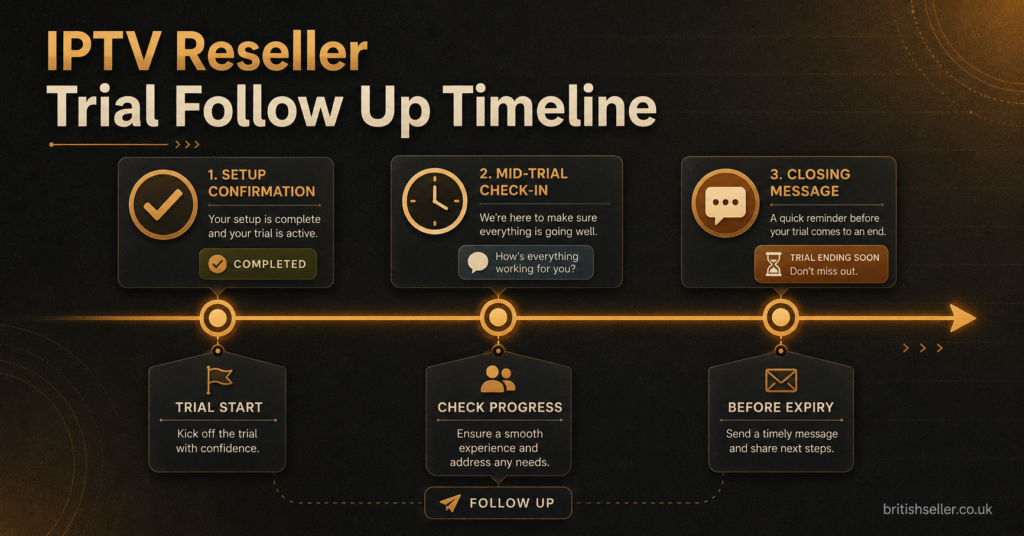
A short, planned sequence during the trial period consistently outperforms a single message sent at the end.
- Send setup confirmation within the first hour, checking the app installed and the stream is playing
- Check in once midway through, asking specifically about picture quality or a channel they wanted to test
- Send the closing message with two to three hours remaining, including the price and how to pay
- If there’s no reply, send one final short message the next day, not a repeated sales pitch
This isn’t about messaging someone five times in a day. It’s about being present at the two or three points where a decision is actually likely to happen: right after setup, midway through testing, and right before the line expires.
Pro tip: Ask one specific question in your check-in message, such as “how’s the football channel looking?” rather than a generic “how’s it going?” Specific questions get replies; generic ones get ignored.
Getting pricing and payment ready before the trial starts
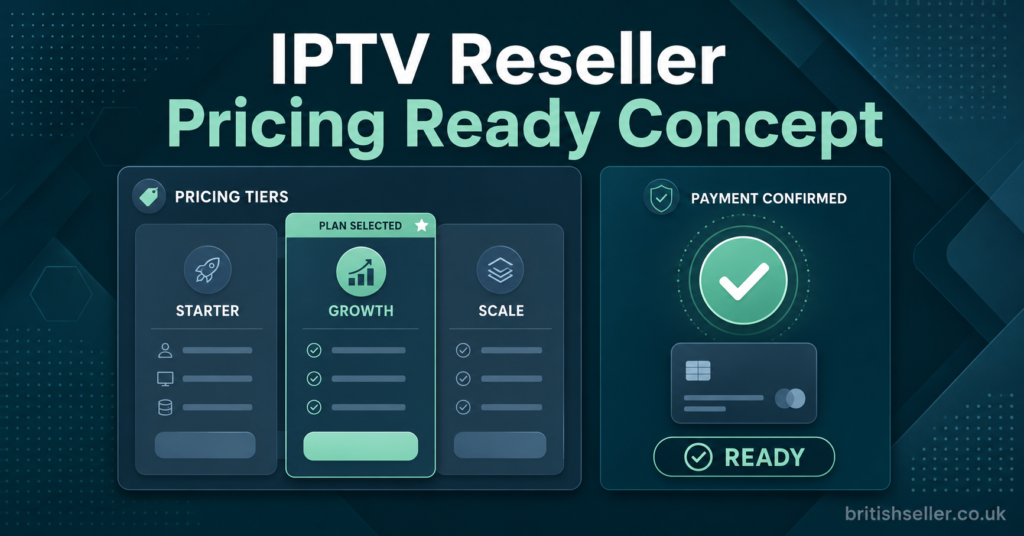
Nothing kills a warm trial customer faster than a reseller who has to go and “check on pricing” once the customer is ready to pay. If you’re running trials regularly, your pricing structure and payment method should already be decided before you send a single trial link.
That means knowing your monthly, quarterly and yearly rates in advance, having a payment method ready to share on request, and being able to create the paid line within minutes of receiving payment. Resellers using a panel like the one behind IPTV Reseller Plans can usually activate a paying customer in under a minute once credits are in the dashboard, which matters more than it sounds; a customer who says yes and then waits ten minutes for a login has time to reconsider.
If you’re still working out what your margins actually look like at different pricing points, it’s worth reading through how IPTV reseller profit margins are typically structured before you commit to a number you’ll regret undercharging on.
Pro tip: Have your yearly price ready even for customers who only asked about a monthly plan. Some trial customers will take the better annual deal if it’s offered clearly, and yearly customers are the ones who stop you from chasing renewals every four weeks.
What separates a good sign from a bad one during the trial
Not every quiet customer is a lost one, and not every talkative one converts. A customer asking detailed questions about channel packages or device compatibility is usually closer to buying than one who just says “looks good” and disappears. Genuine engagement, screenshots of what they’re watching, questions about specific content, requests to add another device, tends to predict conversion far better than polite enthusiasm.
On the other hand, a customer who asks for the trial to be extended more than once without giving a reason is often shopping around rather than deciding. Extending indefinitely rarely converts them; it just delays the point where they either commit or move on.
Reseller Trial Conversion Checklist
- Confirm the customer’s device and app before sending trial credentials
- Send setup confirmation within the first hour of the trial starting
- Check in once during the trial with a specific, not generic, question
- Have monthly, quarterly and yearly pricing ready before the trial begins
- Send the closing message with time still left on the trial, not after
- Be able to activate a paid line within minutes of receiving payment
- Send one final short follow-up the next day if there’s no response
Frequently asked questions
How long should an IPTV trial last for the best chance of converting?
Twenty four hours works well for most first-time customers, giving them enough time to test a normal evening of viewing without the trial dragging on long enough for urgency to fade.
Should I ask for payment details before starting a trial?
Most resellers don’t, since asking for payment upfront defeats the point of a trial and can put off customers who simply want to test the service first. Focus instead on qualifying the customer with a few quick questions about their device and what content they want to see.
What’s the biggest mistake resellers make with trial customers?
Going silent during the trial and only reappearing once it’s expired. By that point the customer’s attention has usually moved on, and the message reads as a sales pitch rather than a genuine check-in.
Should I extend a trial if the customer asks?
A single short extension is reasonable if there’s a clear reason, such as a device issue on their end. Repeated open-ended extensions with no explanation tend to signal browsing rather than genuine interest.
Does the app or device the customer uses affect conversion?
Yes. Customers who struggle with setup often blame the service itself rather than the installation process. Confirming the app is working properly in the first hour removes this as a reason to drop off before deciding.
Is a longer trial always better for conversion?
Not necessarily. Longer trials give more testing time but also more time for the customer’s interest to fade or for them to test a competing provider in parallel, so length needs to match the customer, not default to the maximum.
Conclusion
IPTV Reseller Trial Conversion isn’t really about the trial itself. It’s about what happens around it: getting setup right early, checking in with something specific to say, closing while the trial is still live, and being ready to take payment and activate a line without delay. None of this requires a bigger panel or a longer trial window. It requires a sequence you actually run every time, rather than a trial link you send and hope pays off on its own. Start with your next trial customer and work through the timing before worrying about anything else; the conversion rate tends to follow from there.
If you’re setting up your reseller side from scratch, it’s worth checking the basics covered in IPTV Panel reseller requirements so your trial process sits on top of a properly configured account from day one.