Book Appointment Now
IPTV Setup Guide for Beginners: 8 Best Ways to Start in 2026

Most people who fail at IPTV don’t fail because the technology is hard. They fail because nobody told them what actually happens inside a panel when 200 users go live at the same time. This IPTV setup guide for beginners exists to fix that gap, not with theory, but with real operational logic that most resellers only learn after their first disaster.
Whether you’re buying a family subscription or eyeing your first 30-credit reseller panel, what you read here will save you weeks of confusion and possibly hundreds in wasted credits.
Why Your First Choice of IPTV Panel Defines Everything
Before you touch a single setting, the IPTV setup guide for beginners needs to establish one truth: your panel provider is your business partner, not just a vendor. The infrastructure sitting behind that dashboard, load balancers, uplink redundancy, HLS latency controls, determines whether your customers buffer or stream cleanly at 11pm on a Saturday.
Providers like Autven, accessible through BritishSeller.co.uk, operate with multi-server failover that switches in under 3 seconds when a primary server drops. That’s not marketing. That’s the difference between 40 angry WhatsApp messages and zero. When evaluating any panel, ask one question: how many backup uplink servers are running, and what’s the automatic failover time?
Pro Tip: Never launch with a provider that can’t answer the failover question specifically. Vague answers like “we have backup servers” means they probably have one that someone manually switches over at 2am.
If the answer is unclear, keep moving. In 2026, AI-driven ISP blocking has accelerated dramatically, DNS poisoning events that used to happen quarterly now happen weekly in certain regions. A panel without redundant uplinks will fail you publicly, and in IPTV reselling, reputation is everything.
The Credit System Explained: What Every Beginner Gets Wrong
This section of the IPTV setup guide for beginners gets skipped constantly, which is exactly why so many new resellers overspend in month one. Credits are simple: one credit equals one customer’s one-month subscription. But the mistake isn’t buying credits, it’s buying them without understanding your margin structure first.
At BritishSeller.co.uk, the entry point is 30 credits for around £50, putting you at approximately £1.50 to £1.67 per credit. If you’re selling each subscription at £8 to £10/month, your margin per customer per month is around £6.30 to £8.50. Multiply that across 30 customers and you’re looking at a clear, scalable model.
Here’s where beginners go wrong:
- They buy 100 credits before testing with 10
- They price subscriptions too low trying to compete on cost
- They don’t account for 1 to 2 trial credits used for setup and device testing
- They forget to factor in customer churn, typically 15 to 25% in the first 90 days
Pro Tip: Start with your Family or Growth pack, use 3 to 5 credits for internal testing across your own devices, then activate paying customers. Never go live on a device you haven’t personally tested the stream quality on.
The no-expiry credit model matters more than people realise. Credits that expire in 90 days force panic buying and poor decisions. Permanent credits mean you move at your own pace.
Device Compatibility Is Not Optional (Here’s Why It Trips Up Beginners)
Here’s something no generic IPTV setup guide for beginners tells you: the same stream can perform completely differently across device types, not because of the stream itself, but because of how each device handles HLS latency and buffer caching.
| Device type | Typical performance | Common issues |
|---|---|---|
| Firestick (Gen 3+) | Excellent | Occasional DNS issues |
| Android TV Box | Very good | Varies by RAM (2GB min recommended) |
| Smart TV (built-in app) | Good | App update dependencies |
| iPhone/Android mobile | Good | Background app refresh limitations |
| Windows/Mac (Smarters) | Excellent | Firewall conflicts on some networks |
Before telling a customer their setup is complete, run the stream on at least two device types. A customer who buffers on their Firestick but streams fine on their phone has a device issue, not a service issue, but if you haven’t tested it yourself, you’ll spend an hour troubleshooting the wrong thing.
What Load Balancing Actually Means for Your Customer Base
This is the part of the IPTV setup guide for beginners that separates operators from hobbyists. Load balancing isn’t just a technical term to nod at, it’s the mechanism that determines whether your entire customer base suffers when 60% of them try to watch the same premium sports stream simultaneously.
Poor load balancing means all those requests hit one server. That server chokes. Buffering spreads across your customer base like a cascade. Your phone fills with complaints. You panic, contact support, wait.
Good infrastructure distributes concurrent streams across multiple nodes, with each node monitored in real time. The Autven panel does this by design, 3+ backup servers with automatic rerouting means a single node failure doesn’t cascade into a customer service nightmare.
Pro Tip: During major sporting events, your concurrent stream count can spike 300 to 400% above your average. If your provider can’t articulate how they handle that load, test it yourself, activate 10 streams simultaneously on different devices and watch for degradation.
ISP Blocking in 2026: The Part Most Beginner Guides Skip
The enforcement landscape has changed significantly. In 2026, ISP-level blocking has moved from basic URL blacklisting to AI-driven pattern recognition that identifies IPTV traffic based on stream behavior signatures, not just domain names. DNS poisoning events, where ISPs redirect IPTV streams to dead IPs, are now a weekly occurrence in some UK regions.
This IPTV setup guide for beginners has to be honest: no provider is immune. But there are operational steps that dramatically reduce your exposure:
- Use providers with rotating server IPs and encrypted stream delivery
- Enable VPN-ready infrastructure where the panel supports it
- Educate customers to use DNS-over-HTTPS on their routers
- Monitor your stream URLs, if a URL stops resolving, it’s likely DNS poisoned rather than a server failure
The British IPTV Reseller platform includes built-in privacy protection and VPN-ready architecture specifically because of this threat environment. It’s not a feature to skim past, it’s increasingly the difference between consistent uptime and weekly damage control.
Managing Customer Churn Without Losing Your Margin
No IPTV setup guide for beginners talks honestly about churn. Here it is: you will lose customers. In the first 90 days, expect 15 to 25% of your initial base to drop off. Some will find a cheaper provider. Some will lose interest. Some will have payment friction. That’s normal.
What kills resellers isn’t churn itself, it’s having no system to respond to it:
- Renewal reminders: Contact customers 5 days before expiry, not on expiry day
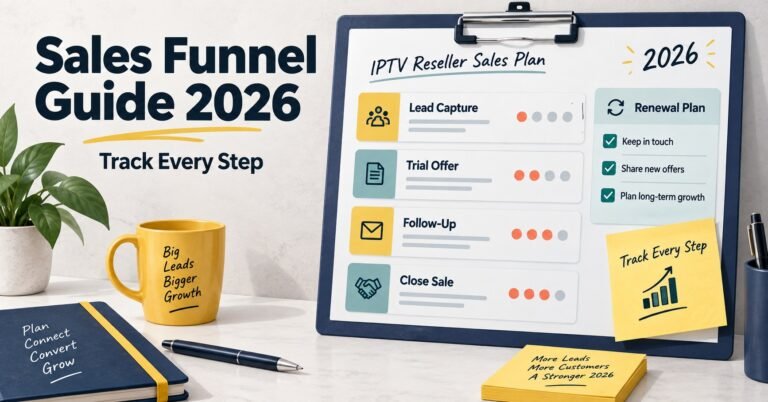
- Trial-to-paid conversion: Follow up with trial users at day 3 and day 6, not just day 7
- Complaint response time: Resolve buffering complaints within 2 hours during peak viewing windows
- Loyalty pricing: Offer 3-month and 12-month options at a slight discount, it locks revenue and reduces monthly churn friction
The UK IPTV resellers who scale past 100 customers aren’t the ones with the cheapest prices. They’re the ones with the fastest response times and the clearest renewal workflows.
Weekly Panel Management Once You’re Live With Customers
Once you’re live with customers, the IPTV setup guide for beginners shifts from setup to operations. Weekly panel hygiene is non-negotiable if you want to avoid preventable support floods:
| Task | Frequency | Why it matters |
|---|---|---|
| Check expiring subscriptions | Weekly | Proactive renewal = retained customers |
| Test 3 to 5 random streams | Weekly | Catch channel issues before customers do |
| Review EPG accuracy | Weekly | Inaccurate EPG generates complaints disproportionate to its severity |
| Confirm backup server status | Weekly | Know your failover is actually ready |
| Monitor concurrent stream count vs capacity | Weekly | Identify growth ceiling before you hit it |
The Autven panel provides channel quality monitoring tools and real-time stream status checks, use them. A channel that’s degraded at 2am Tuesday will still be degraded at 8pm Friday when your customer tries to watch it.
Pro Tip: Set a recurring calendar reminder every Monday morning for your 15-minute panel audit. Resellers who do this consistently have 60 to 70% fewer reactive support incidents than those who only log in when something breaks.
The 7-Day Launch Sequence: Your Actual Starting Point
The best IPTV setup guide for beginners ends with execution, not theory. Here’s the realistic week-one sequence:
Day 1: Contact your panel provider, request a trial line, test on Firestick + one mobile device across at least 4 content types (live sports, news, VOD, international channels).
Day 2: Purchase your starter credit pack. Create your first 3 customer lines, yourself, a family member, a trusted friend willing to give honest feedback.
Day 3-4: Set your pricing structure. Research what local competitors charge, then position slightly above the absolute cheapest, you’re selling reliability, not just access.
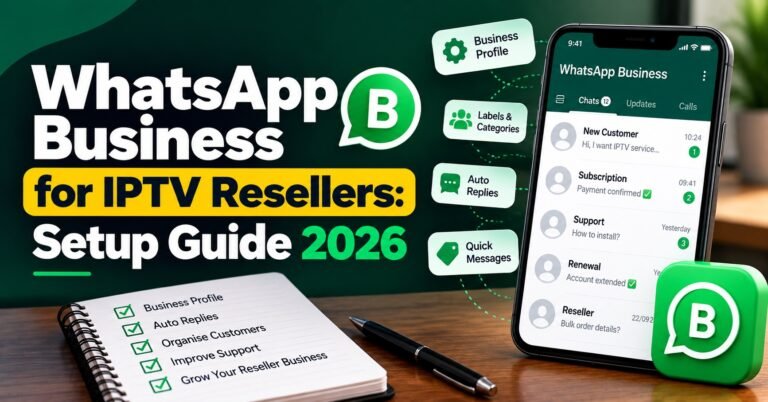
Day 5: Build your support workflow. WhatsApp Business, a simple Google Sheet for tracking customers and expiry dates, and a response template for the most common issues (buffering, app login, EPG errors).
Day 6: Activate your first paying customer. Walk them through setup personally, it builds trust and teaches you exactly where new users get confused.
Day 7: Review everything. What questions came up? What took longer than expected? Refine before scaling.
Reseller Success Checklist
- Panel provider confirmed with multi-server failover under 5 seconds
- Tested streams on minimum two device types before going live
- Credit margin calculated, know your cost per customer per month
- Renewal reminder system built (5 days before expiry)
- Weekly panel audit scheduled in calendar
- VPN-ready infrastructure confirmed with provider
- DNS-over-HTTPS guidance ready to share with customers
- Response time target set for buffering complaints (under 2 hours, peak hours)
- Trial-to-paid follow-up sequence planned (Day 3 and Day 6 touchpoints)
- Pricing structure finalised, not the cheapest, but defensibly better
This IPTV setup guide for beginners isn’t a starting point, it’s the foundation most people never build. The UK IPTV resellers who hit 50, 100, 200 customers aren’t operating differently in terms of the technology. They’re operating differently in terms of discipline, systems, and the choices they made in week one. Get those right, and the scaling takes care of itself.