
Book Appointment Now
How to Run an IPTV Reseller Referral Programme in 2026

An IPTV Reseller Referral Programme rewards the people already paying you, usually with free subscription time, when someone they recommend becomes a paying customer. For a small reseller it is one of the cheapest ways to grow, because the reward is paid out of your own credit balance rather than an advertising budget, and you only pay it when a real sale has happened.
Before you announce anything, work out two things: what one reward actually costs you in credits, and at what point the reward is released. Most referral schemes that lose money do so because the reward was handed over the moment a new line was created, before the new customer had paid for anything beyond a trial. Get those two decisions right and the rest of the programme is mostly admin.
Price the Reward in Credits, Not in Retail Pounds
When you tell a subscriber “refer a friend and get a free month”, it sounds like you are giving away a month at your retail price. You are not. On a credit-based IPTV reseller panel, a one-month line normally draws a fixed number of credits from your balance, so the true cost of that free month is whatever you paid for those credits. That gap between what the reward looks like to the customer and what it costs you is the entire reason referral schemes suit resellers so well.
Put simply, the maths runs like this. The referred customer pays your full retail price. You spend credits to activate their line, and you spend credits again to extend the referrer’s line as a reward. Your profit on that sale is the retail price minus both lots of credit cost. As long as your retail margin is comfortably above your credit cost, one referral reward still leaves you well ahead of what a paid advert would typically cost to win the same customer.
Two things can quietly change that sum. First, check how your panel counts credits for longer lines, because some providers structure multi-month packages differently from single months. Second, remember that credits you bought at volume pricing are cheaper per unit than a small top-up. If you plan to reward generously, calculate your reward cost using the credit price you actually pay, not the headline rate on a plans page.
Pro tip: Offer the reward as extra time rather than cash or a discount on a future payment. Time is paid from credits you already hold, it keeps the referrer’s line active, and it cannot be withdrawn and spent elsewhere.
Who Should Be Allowed to Refer?
“Referral programme” means different things depending on who is doing the referring, and mixing them up causes most of the confusion around the term. Some panel suppliers run a scheme where existing resellers earn something for introducing new resellers. That is the supplier’s programme, and its terms are set by them. What most small resellers actually want is their own subscriber referral scheme, where customers bring in other customers. You may also have sub-resellers who want to recommend your service to their contacts.
Each group needs a different reward and carries a different risk.
| Referrer type | Reward that usually makes sense | What to watch |
|---|---|---|
| Existing subscriber | Extra time added to their own line | Self-referrals using a second account |
| Sub-reseller | Bonus credits on a qualifying top-up | Them undercutting your own retail prices |
| Another reseller (supplier-run scheme) | Whatever the supplier’s terms state | Rewards depending on the new reseller’s spend |
For most small operations, starting with subscribers only is the sensible choice. It is easy to explain, easy to track, and the reward comes straight out of the credits you already manage every day. Sub-reseller referrals can come later, once you are confident your pricing tiers and support boundaries are clear enough that a new seller will not create problems downstream.
When the Reward Is Released Matters More Than Its Size
A generous reward paid at the wrong moment is far more expensive than a modest one paid at the right moment. The release point is where you protect the scheme from abuse and from customers who never intended to stay.
The weakest release point is “when the friend signs up”. That invites people to create lines for friends who take a trial, never pay, and disappear, while the referrer collects free months. A far safer rule is to release the reward once the referred customer has paid for their first full period and that period has run past your refund window. Some resellers go further and wait until the first renewal, which is stricter but filters out almost everyone who was only curious.
You also need a short list of disqualifying cases, written down before launch rather than decided in an argument later. Typical ones include a referral where the “friend” shares the referrer’s address or payment details, a new account created by an existing customer who simply let their old line expire, and any referred line that ends in a refund or chargeback. Put a monthly or yearly cap on rewards per person as well, so one enthusiastic referrer with a large group chat cannot drain your balance faster than the new revenue arrives.
Pro tip: Tell referrers exactly when their reward will land (“added to your line after your friend’s first paid month completes”). Clear timing prevents most of the chasing messages that make referral schemes feel like extra support work.

Setting Up an IPTV Reseller Referral Programme on a Credit Panel
You do not need special software to run a referral scheme at small scale. You need a consistent way to identify who referred whom, a record you can check when a reward falls due, and a simple routine for applying it.
Give every subscriber a code they can say out loud
A referral code works best when it is short and human, such as a first name plus a few characters, rather than a random string. The new customer quotes it when they buy, you record it at the point of sale, and the referrer is linked to that order from day one. Codes that are easy to say work in conversation, which is where most IPTV recommendations actually happen.
Keep the link visible where you manage lines
If your reseller dashboard has a notes or remarks field against each line, record the referrer’s code there when you create the new customer’s account. If it does not, a plain spreadsheet with the new customer’s username, the referrer’s username, the date of first payment and the date the reward becomes due is enough. What matters is that you can answer “who referred this person, and has the reward been paid?” in a few seconds, without searching old messages.
Apply rewards on a fixed day
Rather than extending lines the moment each reward falls due, pick one day a week or one day a month to process them. Batching keeps your credit spending predictable, gives you a natural moment to check for refunds or chargebacks first, and stops referral admin interrupting ordinary support work. If you are still deciding how many credits to hold for this, look at the credit-based IPTV panel reseller plans on British Seller and size your purchase so that expected referral rewards sit inside your normal balance rather than forcing an emergency top-up.
Referrals Keep Customers, Not Just Win Them
Most resellers think of referrals purely as a way to find new customers, but the scheme does quiet work on retention as well. A subscriber who has recommended you to a friend or relative has put a little of their own reputation behind your service. They are more inclined to message you when something goes wrong instead of quietly switching provider, because leaving would mean admitting the recommendation was poor.
The reward itself helps too. Because it is paid as extra time on the referrer’s line, their renewal date moves further out, and a customer with credit already sitting on their account has less reason to shop around. That is a very different effect from a one-off discount code, which is often used once and forgotten.
The referred customer needs attention of a different kind. They arrive with expectations set by a friend, not by your own description of the service, so the first few days matter. Send your usual setup instructions, check in once they have had a chance to use the service properly, and correct any expectation that does not match what you actually provide. A referred customer who has a smooth first week is the one most likely to refer someone else, which is how a small scheme starts to compound.
Where Referral Schemes Go Wrong
The most common problem is not fraud. It is referrers overselling. Your customers are not trained in what you can and cannot promise, and in their enthusiasm they may describe availability, picture quality or reliability in terms you would never use yourself. Give referrers a short, accurate description of your service that they can copy if they want to, and never encourage them to make claims about specific content. IPTV is a delivery technology, and what a service can lawfully carry depends on rights and permissions, so neither you nor your referrers should be promising anything that implies otherwise.
The second problem is how the message is sent. In the UK, the Information Commissioner’s Office treats a business as responsible for referral messages it encourages customers to send. Its guidance says that if you encourage people to send your electronic mail marketing to friends or family, you are likely to be instigating those messages and must comply with PECR, and you do not need to offer an incentive for it to count as instigating. The ICO’s own example of a problem scheme is one where the business automatically creates a marketing email for the customer to send to their friends. Later clarification suggests actively encouraging referrers will not be a breach if the referrer controls how the message is sent, for example by advising referrers to pass promotional links only to people with a genuine interest in receiving them. How do we comply with the PECR electronic mail marketing rules?
In practice, that points to a simple rule. Give customers their code and let them decide whether and how to mention it. Do not ask for their friends’ phone numbers or email addresses, and do not send pre-written blasts on their behalf. Canada, Australia and the United States each have their own anti-spam and endorsement rules, so if you sell across English-speaking markets, the same cautious approach is the safest default. If a referrer posts publicly about your service in exchange for a reward, advertising rules in most of these countries expect that reward to be made clear. None of this is legal advice, and if referrals become a major part of your marketing it is worth checking the rules that apply where your customers live.
The third problem is scale arriving before the service is ready. A referral scheme multiplies whatever your customers are already experiencing. If support is slow or stability is patchy, a successful scheme simply sends more people into that experience, and several of them will be friends of your existing customers. That damages two relationships at once.

Is Your Business Ready to Launch One?
A referral programme is worth running when three conditions are already true. Your customers renew without much persuasion, which tells you the service itself is holding up. You can answer support messages within a reasonable time on most days, including evenings when usage peaks. And your credit supply is dependable, so that a sudden run of new customers does not leave you waiting on a top-up.
If any of those are shaky, fix them first. It is also worth knowing who sits behind your supply, since your referrers are indirectly vouching for them too. Reading about the team running British Seller or any other supplier you use gives you a clearer picture of what you are putting your customers’ names behind. When the foundations are in place, a referral scheme is one of the few growth methods that becomes cheaper per customer as it succeeds, because every reward is paid in credits and only after money has come in. For resellers still choosing a panel, the Autven IPTV reseller panel for UK sellers is one credit-based option to compare against your requirements.
Frequently Asked Questions
Should the referred customer get a reward as well?
A two-sided reward, where the new customer also receives something, usually converts better because the friend has a reason to act on the recommendation. Keep the new customer’s reward small, such as a few extra days added to their first paid period, and release it on the same qualifying rule as the referrer’s reward.
Can a sub-reseller run its own referral scheme?
Usually yes, but the rewards come out of the sub-reseller’s own credits, and their scheme must fit within whatever terms their parent reseller sets. If you have sub-resellers, agree in advance whether they may run schemes, and make sure their rewards cannot be used to undercut your retail prices.
What happens if a referred customer asks for a refund?
If your reward is only released after the refund window has passed, there is nothing to reclaim. That is the main reason to delay release. If you reward earlier, state in your terms that a refunded or charged-back referral cancels the associated reward.
Is there a sensible limit on how many rewards one person can earn?
A cap protects your credit balance from a single referrer with a large network. The right number depends on your margin and how many credits you can comfortably allocate each month, so set it from your own figures and review it after the first few months.
Do I need dedicated software to track referrals?
Not at small scale. A notes field in your dashboard or a simple spreadsheet recording who referred whom, when the first payment was made and when the reward is due is enough. Dedicated tools only become worthwhile once manual checks start taking a noticeable share of your week.
Making Referrals Pay Their Way
A well-run IPTV Reseller Referral Programme costs you credits rather than cash, rewards only customers who have actually paid, and gives your existing subscribers another reason to stay. The decisions that matter most are made before launch: what a reward costs at your real credit price, when it is released, who may refer, and how referrers are allowed to spread the word. It will not rescue a service with weak support or unreliable supply, and it needs to respect marketing rules in the countries you sell to. Start with subscribers only, write the rules down, process rewards on a fixed day, and review the numbers after your first couple of reward cycles before widening the scheme.
Reseller Checklist Before Launching Referrals
- Calculate one reward’s cost using the credit price you actually pay, not the headline rate
- Decide the release point, ideally after the first paid period clears your refund window
- Write down disqualifying cases, including self-referrals, refunds and chargebacks
- Set a per-person cap on rewards each month or year
- Create short, easy-to-say codes for every subscriber who wants one
- Choose where each referral is recorded, whether a dashboard notes field or a spreadsheet
- Give referrers an accurate service description and ask them not to make content claims
- Let customers share their code themselves rather than collecting their friends’ contact details
- Pick a fixed day for applying rewards and checking refunds first
- Confirm your credit balance and support capacity can handle a jump in new customers
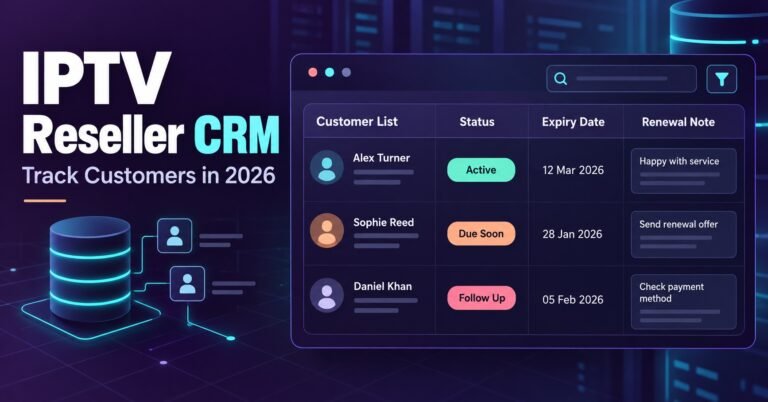

[…] workable set for most IPTV panel resellers is something like New enquiry, Trial active, Awaiting payment, Active, Renewal due and Support […]