Book Appointment Now
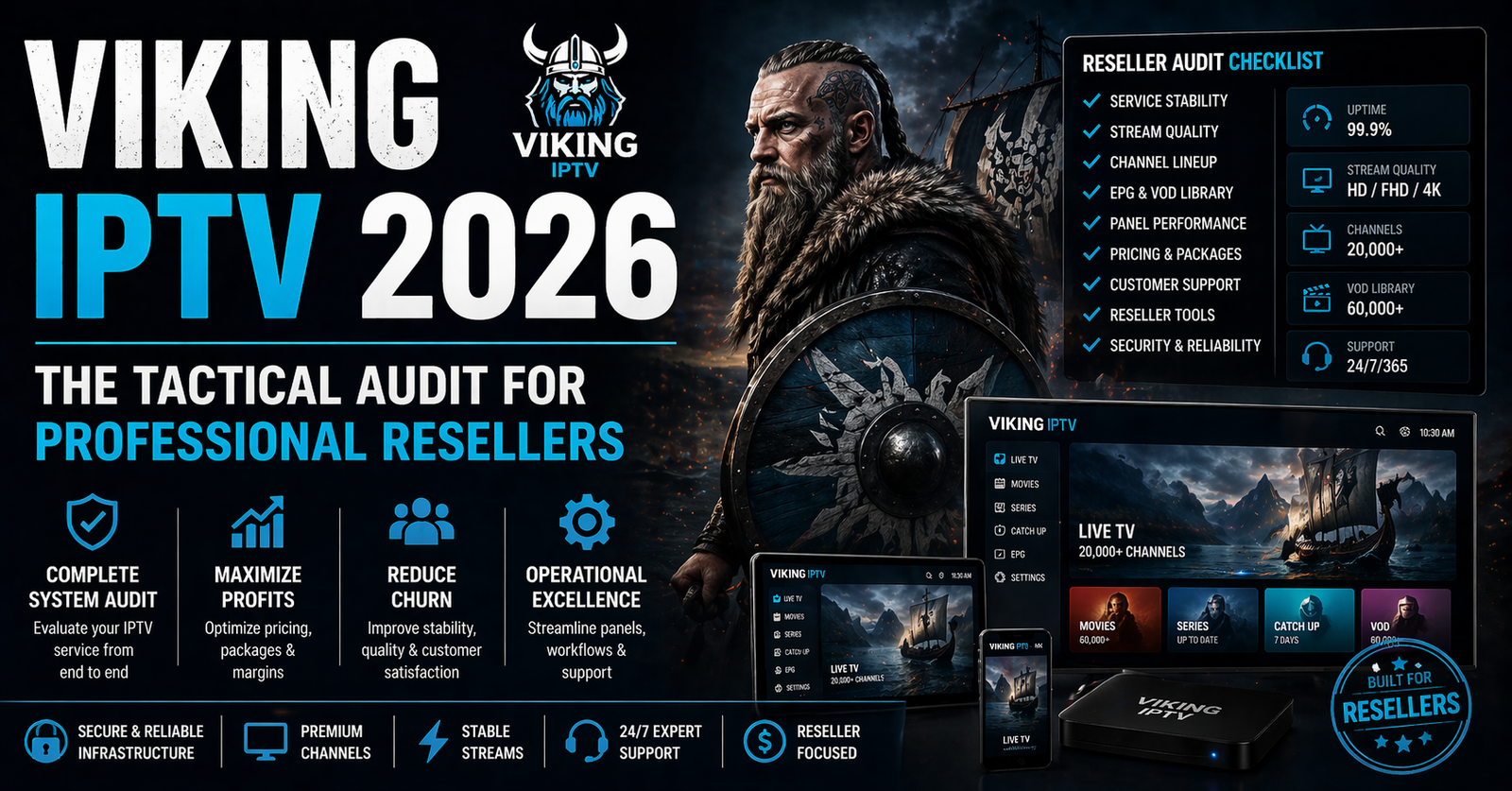
Viking IPTV 2026: The Tactical Audit for Professional Resellers
Viking IPTV UK Reseller Guide: How to Build an Operation That Doesn’t Collapse Under Pressure
It was a Saturday. weekend. Roughly 340 active subscribers, all hammering the same stream simultaneously. Then the panel froze.
No warning. No failover. Just a cascading timeout that spread from the primary server into the backup within four minutes. Viking IPTV UK resellers who were running lean setups without load-balanced redundancy watched their ticket queues explode. Refund requests piled up. Chargeback threats followed by Monday morning.
That afternoon wasn’t a freak event. It was infrastructure debt coming due, exactly the kind of scenario that separates operators who survive from those who quietly disappear from reseller Telegram groups six months later.
This guide is written from the other side of that chaos. Not theory. Not a vendor pitch. Real patterns from real operations.
Why Viking IPTV Resellers Underestimate Concurrent Load
Most resellers calculate server capacity based on average daily usage, which is almost always wrong. Peak concurrency during premium sports streams can spike 4x to 6x your baseline. If your Viking IPTV provider’s uplink is sitting on a shared 1Gbps pipe, you will buffer. Guaranteed.
The formula that actually matters for capacity planning:
A 4K HEVC stream at 25Mbps with 200 concurrent viewers demands 6,500Mbps minimum, before overhead. Anything less and buffer-bloat becomes your subscribers’ default experience, not an exception.
Pro Tip: Always ask your Viking IPTV wholesale provider for their uplink capacity documentation, not what’s on the sales page, but the actual rack specs. If they hesitate, treat that hesitation as your answer.
The Panel Credit Trap Most Resellers Walk Straight Into
Here’s something that doesn’t get discussed enough in Viking IPTV reseller communities: panel credit structures are often designed to lock cash before infrastructure is proven. You purchase 500 credits. You onboard 80 subscribers. Then the provider gets hit with an enforcement wave, and suddenly those credits are worthless because the panel domain is dead.
This isn’t speculation. It’s a recurring cycle.
Smarter credit management looks like this:
- Never prepay more than 30 days of projected subscriber credits
- Maintain at least two active Viking IPTV panel relationships simultaneously
- Keep a spreadsheet tracking credit-to-subscriber ratios weekly
- Set a hard rule: if a provider goes dark for more than 6 hours without communication, activate your backup panel immediately
- Document every transaction. Chargebacks need evidence trails.
The operators who scaled past 500 subscribers didn’t do it with loyalty to one provider. They built redundant supplier chains quietly, the same way any serious business manages vendor risk.
HLS Latency and Why Your Stream Quality Isn’t Actually Your Provider’s Fault
Counterintuitive take: a significant portion of buffering complaints that Viking IPTV resellers receive aren’t caused by the provider’s servers. They originate at the subscriber’s ISP, specifically through DNS poisoning and deep packet inspection throttling.
As of 2026, AI-driven ISP blocking has become considerably more sophisticated. Machine learning models now identify HLS stream patterns based on bitrate consistency, packet timing, and header signatures, then throttle or reroute them automatically without any human review triggering the block.
What this means for your operation practically:
| Issue | Subscriber Thinks | Actual Cause |
|---|---|---|
| Buffering at 8PM | Provider server down | ISP throttling HLS traffic |
| Stream drops after 20 mins | Weak signal | Session timeout from DNS poisoning |
| 4K downgrades to 720p | Bad stream quality | Bandwidth shaping by ISP |
| App crashes on load | App bug | DPI packet rejection |
Understanding this distinction matters enormously for your support workflow. Resellers who can diagnose ISP-side issues, and walk subscribers through DNS switching or VPN configuration, retain customers that every less-informed reseller loses.
Viking IPTV Infrastructure: The 10Gbps Threshold Nobody Wants to Talk About
Mid-tier Viking IPTV wholesale providers typically run on 10Gbps uplink servers. Premium-tier operations run 40Gbps or higher with geographic load balancing across multiple data centre regions. The price difference between these tiers is real, and so are the consequences of choosing wrong.
Pro Tip: A provider offering unlimited connections at suspiciously low credit pricing is almost certainly overselling a single server. Do the maths on their subscriber capacity before you commit any volume.
The infrastructure quality gap shows up most clearly during simultaneous global events, when every IPTV UK reseller on the same provider node is competing for the same pipe. FTTP-optimised routing, which prioritises fibre-to-premises traffic shaping, becomes the deciding factor between who streams cleanly and who sends mass apology messages.
Resellers who have scaled Viking IPTV operations past 1,000 active lines typically follow an unwritten rule: pay for the tier above what you currently need, not the tier that matches your current subscriber count. You’re buying headroom for growth, not just capacity for today.
Customer Churn Psychology: The Silent Revenue Killer
Churn in Viking IPTV reselling rarely happens because of one catastrophic failure. It accumulates. A subscriber buffers twice during a match. They mention it to their partner. They try a competitor’s free trial link from a Facebook group. By the time they cancel, the decision was made three weeks earlier.
The psychological trigger isn’t frustration. It’s eroded trust. And trust erodes incrementally through small moments of friction that resellers often aren’t even tracking.
Three churn patterns resellers consistently ignore:
- Silent churners: subscribers who stop renewing without complaining. They’re the majority. You’ll never get feedback from them unless you proactively survey before renewal.
- Comparison shoppers: subscribers who maintain two active subscriptions simultaneously, waiting to see which performs better before dropping the weaker one.
- Event-triggered droppers: subscribers who churn immediately after a single high-stakes buffering incident during a match they cared about deeply.
- Each of these requires a different retention response. Silent churners need proactive check-in messages. Comparison shoppers need value reinforcement, not price cuts. Event-triggered droppers need immediate acknowledgment and a service credit within hours of the incident, not days.
Scaling Viking IPTV Beyond 500 Lines Without Breaking Your Operation
At sub-100 subscribers, Viking IPTV reselling is manageable with a single panel and responsive manual support. Past 500 active lines, the operation requires a fundamentally different approach, one that most resellers aren’t prepared for when they hit that threshold.
Automation becomes non-negotiable. Manual renewals, manual reactivations, and manual support responses simply cannot keep pace with the volume of queries, expirations, and technical issues that arrive simultaneously at scale.
Pro Tip: Before you hit 300 subscribers, invest time building templated responses for every common support query. Not copy-paste text, actual decision trees that your future self (or a part-time support assistant) can follow without needing your expertise for every ticket.
The resellers who fail at scale are almost always those who tried to maintain a personal-touch operation structure past the point where it was operationally viable.
Viking IPTV Reseller Success Checklist
Execute these before you onboard your next 50 subscribers:
- Audit your provider’s uplink capacity: request documented server specs, not marketing claims. If they can’t provide rack-level uplink data, find a secondary supplier immediately.
- Cap prepaid panel credits at 30-day projections: never allow more than one month’s operating credit to sit with a single Viking IPTV provider at any time.
- Build your DNS troubleshooting script: document a step-by-step process for walking subscribers through DNS switching to bypass ISP-level HLS blocking. This single resource will save more renewals than any discount offer.
- Implement a churn tracking spreadsheet: log every cancellation with a reason code. After 20 data points, patterns emerge that directly inform your infrastructure and support investments.
- Establish a failover activation threshold: define in advance the exact conditions (hours of downtime, number of affected subscribers) that trigger automatic migration to your backup Viking IPTV panel. Make the decision before the crisis, not during it.
- The difference between a Viking IPTV reseller who is still operating in 18 months and one who isn’t usually isn’t luck. It’s whether they built systems before they needed them.