Book Appointment Now
SmartOne IPTV: The UK Reseller’s 2026 Survival Guide
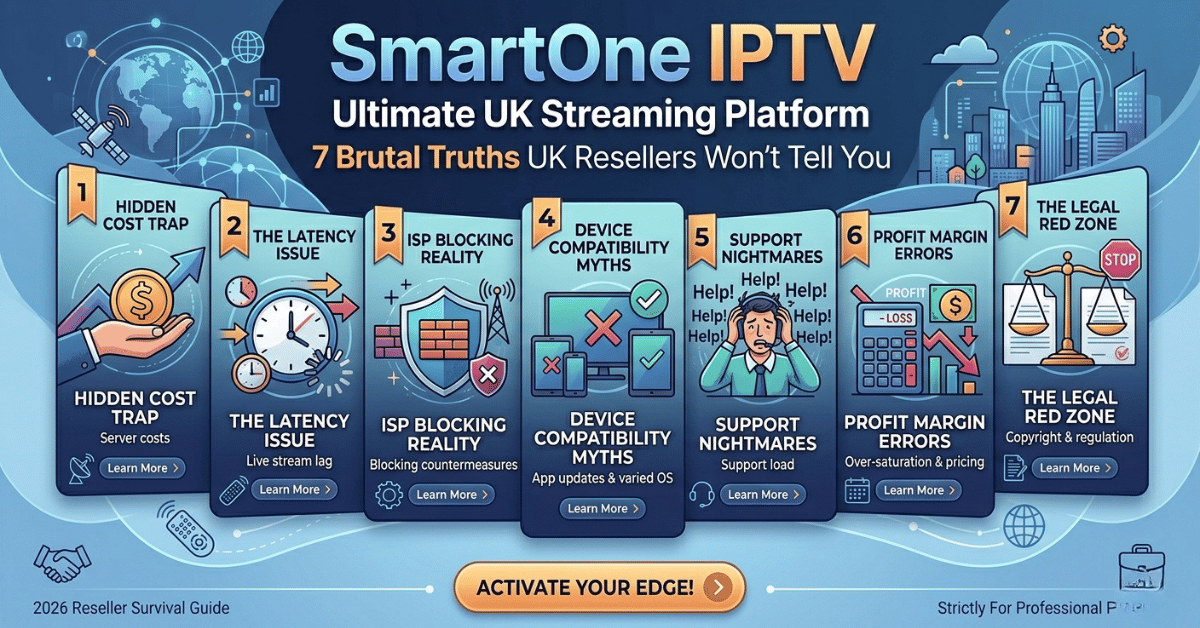
SmartOne IPTV Reseller Guide for UK Operators in 2026
It was 5:47 PM on a freezing Saturday in February. A major League fixture had just kicked off, and 340 customers hit play simultaneously. Within four minutes, the support tickets were pouring in. Buffering. Freezing. Black screens. The upstream provider, one trusted for eight months, had oversold their capacity by a factor of three. Nobody knew that yet. What was clear was that a UK IPTV reseller reputation was dissolving in real time, one angry WhatsApp message at a time.
That evening taught more about SmartOne IPTV infrastructure than any forum post ever could. If you’re running a SmartOne IPTV operation in 2026 without understanding the mechanics beneath your panel, you’re flying blind with paying customers on board.
Why SmartOne IPTV Resellers Are Getting Caught Off-Guard in 2026
The UK enforcement landscape shifted dramatically between 2024 and 2026. AI-driven ISP blocking now operates on behavioural pattern recognition rather than simple IP blacklisting. That means your SmartOne IPTV streams can be disrupted not because your IP was flagged, but because your traffic pattern matched a known IPTV signature. Consistent packet intervals, predictable HLS request sequences, and static CDN endpoints are all detectable signals.
What worked in 2023, a single robust server, a clean panel, a reliable upstream, no longer guarantees uninterrupted delivery. The resellers still winning have adapted their architecture to look less like IPTV infrastructure and more like enterprise-grade streaming traffic.
- HLS segment randomisation reduces pattern-match accuracy by ISP deep packet inspection tools
- Rotating DNS resolution across multiple resolvers defeats DNS poisoning at the subscriber level
- Multi-CDN failover means a block on one endpoint doesn’t kill the entire stream
Pro Tip: If your SmartOne IPTV upstream uses a single static CDN endpoint for all UK traffic, you’re one enforcement wave away from a catastrophic outage. Push your provider for geo-distributed delivery or start evaluating alternatives immediately.
The Infrastructure Equation Most SmartOne IPTV Resellers Get Wrong
Let’s talk about the maths resellers ignore until it’s too late. Bandwidth allocation is not simply a question of “how many streams can my server handle.” It’s a function of concurrent load, bitrate consistency, and buffer-bloat tolerance under contention.
Here’s the formula every IPTV operator should have pinned to their wall:
Required Uplink Bandwidth (Mbps) = N x R(avg) x (1 + O(f))
Where N is the number of concurrent SmartOne IPTV streams, R(avg) is the average bitrate per stream (typically 8 to 12 Mbps for 4K HEVC), and O(f) is the overhead factor (recommend 0.25 to 0.35 for UK peak-time headroom).
So for 300 concurrent SmartOne IPTV streams at 10 Mbps average with a 30% overhead:
300 x 10 x 1.30 = 3,900 Mbps (approximately 4 Gbps uplink minimum)
If your provider is running you on shared 1Gbps infrastructure, you already know why Saturday evenings feel like firefighting.
Cheap vs Premium: What SmartOne IPTV Infrastructure Actually Looks Like
The difference between these two columns isn’t just technical. It’s the difference between retaining customers and watching your churn rate climb every month. Budget infrastructure looks fine on a Tuesday afternoon. It collapses on a Saturday at half-time.
| Feature | Budget Infrastructure | Premium Infrastructure |
|---|---|---|
| Uplink Speed | Shared 1Gbps | Dedicated 10Gbps+ |
| Server Location | Unspecified EU | UK-based data centres |
| Failover | Manual | Automatic load balancing |
| 4K HEVC Support | Inconsistent | Stable, low-latency |
| ISP Block Response | Days | Hours or real-time |
| Panel Credit Rollover | Rarely offered | Standard practice |
| Support Response | Ticket queue | Dedicated account manager |
Customer Churn Psychology: What SmartOne IPTV Subscribers Actually Tolerate
Here’s something most IPTV Panel resellers underestimate: your customers don’t leave after one bad stream. They leave after the pattern of bad streams destroys their confidence. Perceived reliability matters more than average uptime. A single three-hour outage during a major sporting event causes more churn than six hours of 3 AM downtime across a week.
This means your SmartOne IPTV quality assurance strategy needs to be event-aware, not just uptime-aware.
- Map your IPTV load spikes against UK sporting calendars
- Pre-scale server resources 48 to 72 hours before predicted high-demand events
- Send proactive status updates to customers before issues escalate. It reframes perception from “broken service” to “transparent provider.”
- Offer credit compensation immediately for confirmed outages rather than waiting for complaints
Pro Tip: The SmartOne IPTV resellers with the lowest churn aren’t necessarily running the most stable streams. They’re running the best communication alongside reasonably stable streams. Customers forgive downtime far more readily when they feel informed.
Read More: IPTV Reseller Panels
Panel Management Discipline That Separates Professionals from Amateurs
Running IPTV at scale means your panel is not just an admin interface. It’s your operational nerve centre. Most resellers treat it as a passive tool. The ones scaling past 500 active lines treat it like a live trading dashboard.
Specifically, watch these panel metrics in real time during peak hours:
Active stream count vs. licensed capacity: exceeding 85% capacity without failover triggers buffer-bloat across all active SmartOne IPTV lines simultaneously
HLS latency spikes: a latency increase above 800ms on live channels is your early warning signal, not your crisis signal
Connection timeout rates: anything above 2% suggests upstream degradation, not customer-side issues
What most IPTV resellers don’t configure is automated alerting. Set threshold alerts at 70% capacity, not 95%. That 25% gap is your response window.
BritishReseller.com builds panel environments with these thresholds pre-configured, giving SmartOne IPTV resellers the kind of operational visibility that used to require custom DevOps infrastructure to achieve.
FTTP Optimisation and Why UK Broadband Infrastructure Changes Everything
The rollout of FTTP (Fibre to the Premises) across the UK has changed SmartOne IPTV delivery dynamics in ways most resellers haven’t fully absorbed yet. FTTP connections deliver genuinely symmetrical speeds, which sounds like good news, and it is for customers. But it also means ISP deep packet inspection operates with far greater precision on FTTP lines than it did on FTTC.
Your IPTV streams travelling over FTTP infrastructure are subject to more sophisticated traffic analysis. The mitigation strategies that worked on older copper-hybrid connections are less effective here.
The practical response for SmartOne IPTV operators:
- Ensure your upstream provider supports encrypted stream delivery (not just HTTPS, but full transport-layer obfuscation)
- Use multi-path delivery where possible. Splitting stream data across more than one network path reduces the coherence of traffic signatures.
- Evaluate whether your IPTV customer base is concentrated in FTTP-heavy regions like Manchester, Bristol, or parts of London. If so, your ISP blocking risk profile is higher than the UK average.
SmartOne IPTV Scaling Checklist: Five Steps That Actually Matter
These aren’t aspirational goals. These are operational requirements for any IPTV reseller intending to still be trading in twelve months.
Audit your upstream’s server location: UK-based 10Gbps+ uplink is non-negotiable for peak-time SmartOne IPTV stability. EU-hosted servers add latency and remove you from UK-specific failover routing.
Implement the bandwidth formula: calculate your actual concurrent IPTV stream requirements with the overhead factor before your next busy period, not during it.
Configure panel alerting at 70% capacity: not 90%, not when customers start complaining. Seventy percent is your action threshold.
Map your events calendar: every major UK sporting fixture, pay-per-view event, and national broadcast moment should be flagged 72 hours in advance in your SmartOne IPTV operational schedule.
Evaluate BritishSeller.co.uk as your infrastructure backbone: IPTV Panel resellers using premium UK-hosted infrastructure with automated failover, dedicated uplinks, and real-time panel management tools are not playing the same game as those on shared budget servers. The gap in 2026 is not closing, it’s widening.
SmartOne IPTV is a competitive space. The operators who treat it like a business, not a side hustle, are the ones still standing when the enforcement waves hit.