Book Appointment Now
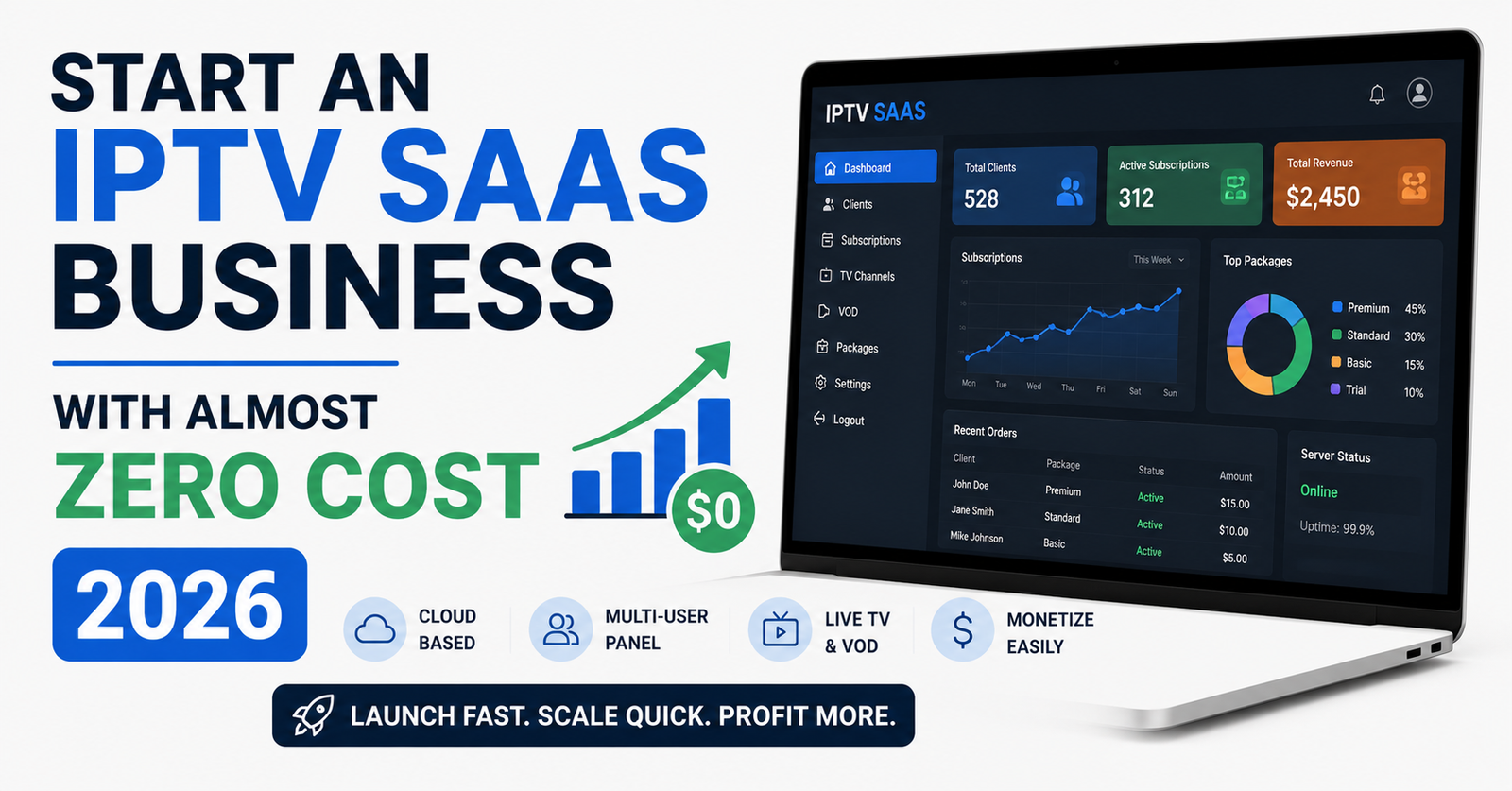
Start an IPTV SaaS Business With Almost Zero Cost 2026
Everyone Thinks Launching an IPTV SaaS Is Hard. It Isn’t.
A man messaged us last winter, half-apologising before he even asked his question. He assumed building a white label IPTV SaaS meant renting servers in three countries, hiring a developer, and learning how streaming protocols worked. He’d budgeted thousands. He’d blocked out two months. By the end of that same week, his branded panel was live and he’d sold his first subscription.
That gap, between what people imagine and what’s actually required, is the single biggest reason most would-be operators never start. They overestimate the infrastructure and underestimate themselves. So let’s clear the fog. A white label IPTV SaaS is simply a streaming service that runs on someone else’s backend while wearing your name, your logo, your prices. You sell. We carry the weight underneath.
This isn’t a sales pitch dressed as a guide. It’s a walk through what the business actually involves, where the easy parts are, where the genuinely hard parts hide, and what a decade of watching people succeed (and fail) at this has taught us.
The Part Nobody Believes: It Really Is Easy to Start
Here’s the uncomfortable truth for everyone selling “exclusive” launch programs: getting a white label IPTV SaaS off the ground is not the difficult part. The technology that scared people in 2017 has been productised. You don’t provision servers. You don’t configure load balancing. You don’t fight DNS routing at 2 a.m. during a League fixture. Someone already did all of that, and they did it years ago.
What you actually do is buy a block of credits, brand your storefront, set your retail prices, and start taking customers. That’s it for the launch. We’ve onboarded operators who went from “I’m curious” to “I made my first sale” inside seven days, with almost no upfront capital. The barrier to entry collapsed a long time ago, most people just never got the memo.
Pro Tip: The lowest-risk way to test this business is to launch before you build a website. Sell to your existing WhatsApp and Telegram contacts first with a simple price list. If five people pay, you have a business. Then build the brand around proven demand instead of guessing.
What You’re Actually Buying With White Label
The phrase gets thrown around loosely, so let’s be precise about what changes hands. In a white label IPTV SaaS arrangement, the supplier’s infrastructure stays invisible to your customer. Your subscriber sees your name on the login screen, your support channel when something breaks, your invoice in their inbox. They never know, and never need to know, whose servers are pushing the stream.
What you’re really renting is reliability you didn’t have to engineer. Years of failover work, backup uplinks, monitoring systems, and capacity planning sit underneath your brand for a fraction of what building it would cost. You inherit the hard-won lessons without paying the tuition.
Here’s how the layers split in a typical white label IPTV SaaS setup:
| Layer | Who handles it | What it means for you |
|---|---|---|
| Streaming servers & uplinks | Supplier | No hardware, no hosting bills |
| Load balancing & failover | Supplier | Stays online during peak traffic |
| Panel software & updates | Supplier | No development, no maintenance |
| Branding & storefront | You | Your name, your identity |
| Pricing & profit margin | You | You keep the spread |
| Customer support | You | Your relationship, your retention |
Notice where the line falls. Everything technical is handled. Everything commercial, the part that actually earns money, stays in your hands. That division is the entire appeal of a white label IPTV SaaS model.
Why Packages Aren’t One-Size-Fits-All
We deliberately don’t sell a single fixed bundle, and there’s a reason. The person testing the waters with twenty customers needs something very different from the operator scaling past a thousand. A rigid package forces one of them to overpay and the other to outgrow it within a month.
So the white label IPTV SaaS offering scales with you. Some people take a lean entry tier, credits and basic branding, and handle their own support. Others want the full turnkey arrangement where branding, billing, and panel are configured for them and they simply walk in and sell. Most land somewhere in between and shift up as they grow.
Just testing demand? Start with credits and a simple branded storefront. Minimal spend, fast launch. Building a real brand? Layer in custom domain, logo integration, and a polished panel. Scaling seriously? Move toward turnkey, where infrastructure, billing, and onboarding are largely done for you.
A UK IPTV reseller we worked with last year started on the leanest tier almost as a hobby. Within four months he’d moved up twice, not because we pushed him, but because his customer base forced the upgrade. That’s the right way round, let the business pull you into bigger packages, never the other way.
The Easy Part Ends Where Support Begins
Now the honest section. If launching is the simple bit, keeping customers is where most new operators quietly fall apart. We’ve seen it more times than we can count: someone nails the launch, racks up forty subscribers in a fortnight, then watches half of them vanish by month three. The product worked fine. The support didn’t exist.
This is the most expensive lesson in the entire white label IPTV SaaS business, and almost nobody anticipates it. People prepare to sell. Hardly anyone prepares to answer. When a customer’s stream stutters during a big match and they message you at kickoff, a four-hour reply time isn’t slow, it’s a cancelled subscription.
Pro Tip: Response speed beats server uptime for retention. We’ve watched operators with marginally worse infrastructure crush competitors purely because they answered within minutes instead of hours. A customer forgives a brief glitch they were told about. They do not forgive silence.
After reviewing hundreds of support exchanges across multiple operators, one pattern is brutally clear: churn rarely comes from the stream itself. It comes from the customer feeling abandoned when the stream hiccups. Those are different problems. The first is technical and largely handled for you. The second is human, and it’s entirely yours.
A Quick Field Story on Churn
One operator came to us frustrated that customers kept leaving despite “everything working.” We asked to see his support setup. There wasn’t one, just a personal number he checked when he remembered. We had him do one thing: set up a dedicated channel and commit to replying within thirty minutes during evenings and weekends. Nothing about the white label IPTV SaaS backend changed. His three-month retention jumped noticeably within the next billing cycle. Same product. Different attentiveness.
Why Renewals Are Where the Real Money Sits
New operators fixate on the first sale. Experienced ones obsess over the second renewal. This is the quiet maths that separates a side hustle from a business.
When a customer renews, you spent nothing to acquire them again, no ads, no outreach, no convincing. The margin on a renewal is almost pure profit. So a white label IPTV SaaS with a strong renewal rate and modest new-customer flow will out-earn a flashy operation that bleeds subscribers every month and constantly chases replacements.
Run the difference yourself: Operator A signs 30 new customers a month, loses 25. Net growth: 5. Operator B signs 15 new customers a month, loses 3. Net growth: 12.
Operator B does half the marketing work and grows more than twice as fast. The variable isn’t sales skill, it’s retention. And retention, as we covered, is mostly about being reachable. The infrastructure underneath a white label IPTV SaaS is identical for both operators. The outcome isn’t.
Checklist for protecting your renewal income:
- Message customers a few days before their subscription expires, not after
- Keep a simple record of every customer’s renewal date
- Offer a small loyalty discount for long-term subscribers
- Notify users proactively about any maintenance windows
- Make renewing frictionless, same payment method, one message
What to Ask Before You Pick a Backend
Because your customer only ever sees you, every outage is your reputation, never the supplier’s. This is why the cheapest backend is so often the most expensive decision in disguise. A budget supplier that saves you a little each month can erase your business in a single bad weekend during peak traffic.
When evaluating who powers your white label IPTV SaaS, the questions worth asking aren’t about price first: how does the network behave during major sporting events, when load spikes hardest? Are there backup uplinks and failover systems, or a single point of failure? What’s the realistic uptime, not the marketing claim? How fast does the supplier respond when you, the operator, hit a problem? Can capacity scale quickly when your customer base suddenly grows?
That last point catches people off guard. Growth is supposed to be good news, but an unprepared backend turns a surge of new subscribers into a wave of buffering complaints. The infrastructure you build on should make scaling boring, that’s the whole point of paying someone else to handle it. If you want to see how a properly resourced backend handles all this, it’s worth looking at how an established UK IPTV Reseller panel provider like britishreseller.com structures its operator support before you commit your brand to anyone.
The First 30 Days, Realistically
So what does a sane launch actually look like? Not the fantasy timeline, not the panic budget, the real one.
| Phase | Timeframe | What happens |
|---|---|---|
| Setup | Days 1-3 | Acquire credits, brand the storefront, set prices |
| Soft launch | Days 4-7 | Sell to existing contacts, take first payments |
| Refine | Week 2 | Fix pricing, set up a real support channel |
| Stabilise | Weeks 3-4 | Establish renewal tracking, request testimonials |
Notice there’s no month of server configuration, because there’s no server configuration. That’s the structural advantage of a white label IPTV SaaS, the heavy engineering is already finished before you arrive. Your time goes into the things that actually compound: relationships, pricing, and a reputation for answering quickly.
Pro Tip: Your first ten customers are research, not revenue. Talk to every one of them. Ask what device they use, what they watch, what frustrated them about their last provider. Those conversations will teach you more about positioning your white label IPTV SaaS than any guide, including this one.
Frequently Asked Questions
What exactly is a white label IPTV SaaS business?
It’s a streaming service that runs on a supplier’s infrastructure but operates entirely under your own brand. Your customers see your name, pay your prices, and contact your support, they never interact with the backend provider. You handle the commercial side; the technical heavy lifting stays invisible and managed for you.
How much money do I need to launch one?
Far less than most people assume. A white label IPTV SaaS can be launched with a small block of credits and basic branding, often the same week you decide to start. There’s no server rental, no software development, and no large upfront commitment. You can scale your spending up only as your customer base grows.
Do I need technical skills to run it?
No. The infrastructure, servers, load balancing, failover, routing, is handled by the supplier. Your job is sales, pricing, and customer support. If you can manage a WhatsApp group and a simple price list, you have the core skills needed to start. Technical complexity is exactly what the white label model removes.
Why do new operators lose customers so quickly?
Almost always because of weak support, not bad streams. New operators prepare to sell but not to answer questions. When a customer’s service hiccups and nobody replies quickly, they cancel. Retention is mostly about being reachable and proactive, which is entirely within your control regardless of the backend.
How fast can I actually go live?
Many operators launch within a week. Setup and branding take a couple of days, and you can begin selling to existing contacts almost immediately. A full polished brand with a custom domain takes a little longer, but you don’t need to wait for that to start earning. Demand first, polish second.
Is the streaming quality something I control?
Indirectly. Stream stability comes from the supplier’s infrastructure, so choosing a reliable backend matters enormously. What you control is how you communicate during any disruption. Customers tolerate rare glitches far better when they’re informed quickly, which is why your support responsiveness often matters more than raw uptime numbers.
Can I switch packages as I grow?
Yes, and most successful operators do. Many start lean, credits plus basic branding, and move up to fuller turnkey arrangements as their subscriber count climbs. Let the business pull you into a bigger package rather than overcommitting on day one. Scaling should be a response to real demand.
What’s the most profitable part of this business?
Renewals. Acquiring a customer the first time costs effort; renewing them costs almost nothing, making renewal income nearly pure margin. An operator with strong retention and modest new sales will outperform a high-churn operation every time. This is why support and proactive renewal reminders matter more than aggressive marketing.
Your Launch Checklist
If you’re a subscriber considering becoming an operator:
- Test the service yourself as a customer before reselling it
- Note how quickly the provider responds to your own questions
- Confirm it works on the devices your future customers use
If you’re launching as a new operator:
- Acquire a small block of credits to start lean
- Brand your storefront before chasing volume
- Set up a dedicated support channel before your first sale
- Sell to existing contacts first, then build outward
- Track every customer’s renewal date from day one
If you’re scaling as an established UK IPTV reseller or sub-reseller:
- Move up packages in response to real demand, not ambition
- Audit your support response times monthly
- Build proactive renewal reminders into your routine
- Pressure-test your backend’s behaviour during peak events
- Recruit sub-resellers only once your own support is solid
Launching a white label IPTV SaaS was never the hard part, staying reachable, tracking renewals, and choosing a backend that won’t embarrass your brand is where the real work lives. Start small, answer fast, and let the business grow into bigger packages on its own terms. That’s the whole game.