Book Appointment Now
IPTV German Channels in UK 2026: What Actually Matters
Nobody calls support to say their stream is working.
That single fact shaped everything I learned about IPTV German channels in UK. The tickets only arrive when something breaks, and after sorting through years of them, a pattern emerged that has almost nothing to do with what most buyers think they’re paying for. People assume the problem is “the service.” Nine times out of ten, it’s geography, routing, and a German broadcaster doing exactly what German law tells it to do.
Let me walk you through what genuinely happens behind the screen, the stuff nobody selling you a subscription will mention.
The Bundesliga Problem Nobody Warns You About
Here’s where most expat households get blindsided. A family moves from Munich to Manchester, signs up for IPTV German channels in UK, and the picture is flawless, until a Saturday afternoon in autumn when Bayern are playing. Suddenly the stream that ran perfectly for weeks turns into a slideshow.
This isn’t your provider being lazy. German sports rights are some of the most aggressively protected in Europe. When live football hits, two things happen at once: traffic on those specific channels spikes hard, and rights-holders ramp up enforcement against unauthorized redistribution. The combination strangles weak infrastructure.
During one particularly brutal Saturday a few seasons back, we watched a single mid-tier panel buckle because every German household on it tried to load the same Deutschland feed within the same ten-minute window. The servers weren’t undersized for normal use. They were undersized for correlated use, everyone wanting the identical thing at the identical second.
Pro Tip: If your IPTV German channels in UK work fine all week but collapse during live sport, the issue is almost never your home internet. It’s the source server’s capacity during demand spikes. Test by streaming a non-sports German channel at the same moment, if that holds, you’ve diagnosed it.
Why “German” Channels Aren’t Always German
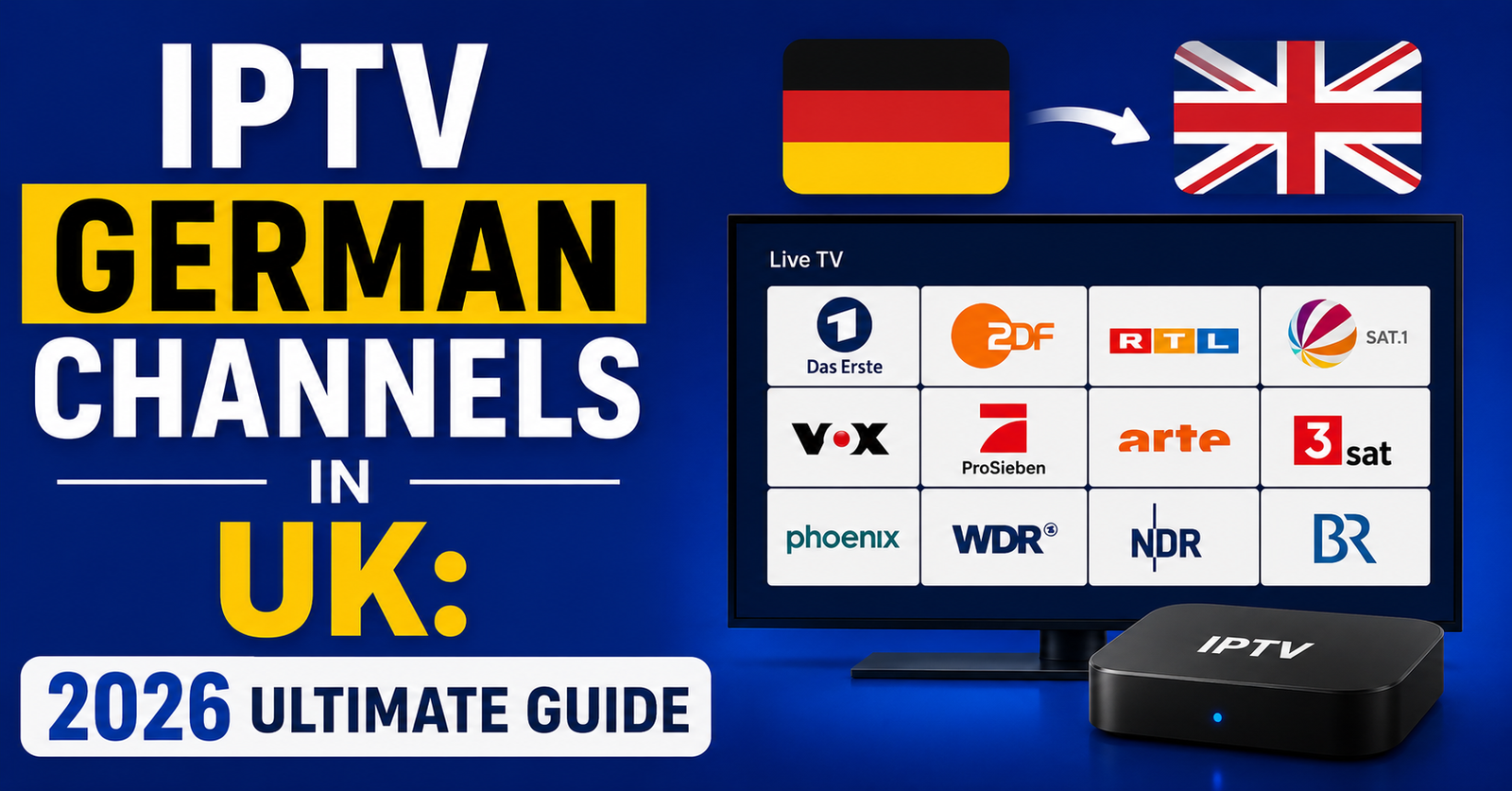
This trips up newcomers constantly. A channel labelled Das Erste in a playlist isn’t necessarily pulling from Germany. It might be relayed through a server in the Netherlands, France, or somewhere further afield, then routed to your Firestick in Leeds.
That routing chain matters more than the channel name. Every additional hop between the original broadcast and your living room is another place latency creeps in and another point that can fail.
| What buyers think matters | What actually matters |
|---|---|
| Number of German channels listed | How many are live and stable |
| Provider’s marketing claims | Server location and routing path |
| Price per month | Capacity during peak German viewing hours |
| 4K labels everywhere | Real bitrate after compression |
| “10,000 channels” | The 30 you’ll actually watch |
The households happiest with their IPTV German channels in UK are usually the ones who stopped counting channels and started caring about which specific feeds stay rock-solid at 8pm German prime time, which is 7pm your time.
The Evening Wall
Speaking of timing, there’s a window almost nobody anticipates.
German prime time runs roughly 7pm to 11pm Central European Time. Because the UK sits one hour behind, that maps to your 6pm-10pm. That overlap is significant: it lands squarely in British evening viewing too, so the underlying servers are handling a German demand peak and broader European load simultaneously.
After reviewing hundreds of support requests over the years, I can tell you complaints cluster almost violently in that window. The same setup that streams beautifully at 2pm chokes at 8pm. Buyers interpret this as “the service got worse.” It didn’t. The service met the wall it was always going to meet.
Pro Tip: Ask any provider, before paying, what happens to their German feeds between 7 and 10pm CET. A vendor running serious infrastructure will talk about load balancing and backup uplinks without hesitation. One who goes quiet or pivots to channel counts is telling you everything.
What ISP Behaviour Is Actually Telling You
British ISPs have grown noticeably more active around streaming traffic, and this affects IPTV German channels in UK in ways that feel random until you understand them.
We noticed unusual ISP behaviour during a stretch a couple of years back where customers on one particular broadband provider reported identical mid-evening drops, while customers on other ISPs sailed through untouched. Same panel. Same channels. Different network path.
What’s often happening: DNS-level interference, where your ISP’s default DNS quietly fails to resolve certain streaming endpoints. Throttling of sustained high-bandwidth connections during congested hours. Routing decisions that send your traffic down a slower path to the source server. Deep packet inspection flagging continuous video streams for shaping.
The fix for the first one is often embarrassingly simple, switching to a neutral public DNS resolver restores channels that appeared “dead.” The household assumed the provider failed. The provider was fine. The path to it was poisoned.
How DNS Poisoning Quietly Kills Streams
Let me explain DNS poisoning in plain English, because it sits behind a huge share of “it just stopped working” complaints.
Every time your device loads a German channel, it first asks a DNS server: “where do I find this stream?” DNS poisoning is when that answer gets corrupted, your device is handed a wrong or dead address, so the stream simply doesn’t load. Nothing’s wrong with the actual feed. Your device just got bad directions.
Here’s the step-by-step of how it tends to unfold: your IPTV German channels in UK run perfectly for weeks. An ISP or upstream network updates its DNS filtering. The address for one source server gets corrupted or blackholed. Specific channels go dark while others stay fine. You blame the provider; the provider blames your connection. Switching DNS resolvers often brings the channels straight back.
This is why a serious operator doesn’t rely on a single routing path. The good ones build failover, if one DNS route gets poisoned, traffic reroutes through a clean path automatically, and the viewer never notices. That redundancy is invisible when it works, which is precisely why cheap services skip it.
What the Cheapest Option Actually Costs You
I won’t pretend price doesn’t matter. But the £2-a-month German package and the £8-a-month one aren’t the same product wearing different price tags.
A mini case study makes this concrete. Two households, both Düsseldorf transplants now living near Birmingham, both wanting reliable IPTV German channels in UK. One chased the rock-bottom price. The other paid roughly four times as much through a properly run reseller.
The cheap household spent the football season restarting their box, switching DNS, messaging an unresponsive seller, and eventually churning out entirely, three months, gone. The other household barely thought about their service because it simply worked. When their feed wobbled once during a League night, support answered within the hour.
The difference wasn’t the channels. Both lists looked identical on paper. The difference was everything behind the list: server capacity, failover routing, and an actual human who answered tickets. If you want to understand what separating a stable German setup from a frustrating one actually looks like, a well-run UK IPTV reseller operation like britishseller.co.uk is built around exactly that invisible infrastructure rather than the channel-count theatre.
Pro Tip: When comparing two providers offering IPTV German channels in UK, ignore the channel lists entirely, they’re nearly always copied from the same source. Compare response times. Message both with a question before buying and see who replies, how fast, and whether they actually answer.
EPG: The Detail That Separates Amateurs from Operators
Here’s something subscribers rarely think about until it annoys them daily. The EPG, electronic programme guide, is what tells your app what’s showing now and next on each German channel.
For German channels specifically, EPG is a recurring headache because the data has to be in the right language, the right timezone, and synced to the right channel ID. Get any of those wrong and Tagesschau shows up as a blank slot, or your guide claims a show airs at the wrong time because nobody adjusted for the CET-to-GMT offset.
A mistake we repeatedly see: providers bolt on a generic English EPG, and German channels end up with mismatched or empty guide data. To the viewer it feels broken even though the stream plays perfectly.
What a properly configured German EPG should deliver: programme names in German, not auto-translated mush. Correct timezone handling for the UK’s one-hour offset from CET. Accurate now/next data that actually matches what’s playing. Working catch-up markers where the channel supports replay.
If your guide is consistently wrong, that’s a tell. It usually means the operator is reselling someone else’s feed without doing the configuration work themselves, which tends to predict how they’ll handle bigger problems too.
Why Your Device Might Be the Real Bottleneck
Not every device handles German channels equally, and the mismatch causes grief that gets blamed on the service.
A quick checklist of what tends to work smoothly versus what fights you: Fire TV Stick 4K Max is reliable, the default for good reason. Android TV boxes are strong, especially with TiviMate handling German EPG well. Samsung Tizen / LG webOS native apps are workable but fussier with timezone-sensitive guides. Older Firesticks (Gen 1/2) struggle under load during peak German hours. Smartphones/tablets are fine for casual use, weak as a household’s main screen.
During one setup with an expat family, every “buffering problem” they’d complained about for a month vanished the moment we moved them off a four-year-old Firestick onto a current 4K Max. Same subscription. Same wifi. The hardware had been the bottleneck the whole time, throttling itself under the sustained demand that German prime time creates.
Pro Tip: If your IPTV German channels in UK buffer only on one device but stream fine on another in the same house, stop blaming the provider. You’ve found a hardware limitation, and no amount of subscription-switching will fix it.
For Resellers: Where German Packages Quietly Lose You Money
If you’re selling rather than watching, German channels carry a specific risk profile worth understanding.
German-focused customers are demanding in a particular way, they expect their channels to behave like German broadcast TV, because that’s what they grew up with. The tolerance for buffering is lower than with general entertainment buyers. That means churn hits faster when things wobble.
One reseller lost a cluster of customers because every German account sat on the same uplink, and when that single route degraded during a Bundesliga weekend, the entire German cohort experienced the outage together, then complained together, then left together. Correlated customers churn in correlated waves.
The lesson, learned expensively: distribute your German-heavy customers across multiple routes and uplinks. Don’t let one failure point take out your most demanding segment in a single afternoon. The UK IPTV resellers who survive treat their German base as a high-expectation niche that needs redundancy, not as just another line item on a channel list.
FAQ
Are IPTV German channels in UK legal to watch?
It depends entirely on whether the service holds proper distribution rights. Plenty of legitimate, licensed ways exist to watch German programming in Britain. The legal grey area sits with unlicensed redistribution. If you want certainty, verify a provider’s licensing rather than assuming, and when in doubt, official German broadcaster apps and licensed platforms are the safe route.
Why do my German channels buffer only in the evening?
Because German prime time (7-11pm CET, so 6-10pm in the UK) creates a sharp demand spike on the source servers. If the infrastructure can’t load-balance that surge, weak feeds choke during exactly those hours while running fine all day. It points to server capacity, not your home connection.
Will changing my DNS really fix dead German channels?
Often, yes. When channels go dark suddenly while others work, ISP-level DNS interference is a common culprit. Switching to a neutral public DNS resolver frequently restores channels that appeared broken. It’s the first thing to try before assuming the provider failed.
What makes IPTV German channels in UK stable for one provider but not another?
Almost never the channel list, those are usually identical. The difference is invisible infrastructure: server capacity during peak German hours, failover routing when a path gets poisoned, and responsive support. Two providers can advertise the same channels and deliver completely different reliability.
As a reseller, why do German customers churn faster?
Because they hold their channels to broadcast-TV standards and tolerate buffering poorly. They also tend to share uplinks and demand peaks, so a single route failure during live football can make an entire German cohort experience an outage, and leave, simultaneously. Distribute them across routes to reduce this.
Do I need an expensive device for German channels?
Not expensive, but current. A Fire TV Stick 4K Max or a recent Android TV box handles German prime-time load comfortably. Older Firesticks throttle under sustained demand, which gets misdiagnosed as a service fault. Hardware is the silent cause of a surprising share of buffering complaints.
Why is my German programme guide always wrong?
Almost always an EPG configuration problem, wrong timezone, wrong language, or mismatched channel IDs. The UK’s one-hour offset from CET trips up lazily configured guides. A consistently wrong guide usually signals an operator reselling feeds without doing the proper setup work themselves.
How many German channels do I actually need?
Far fewer than providers advertise. Most households watch the same dozen or so, the main public broadcasters, a couple of news channels, and sport. A stable list of 30 reliable feeds beats a list of 300 where half are dead. Judge by what stays live, not what’s counted.
Execution Checklist
For subscribers:
- Test a non-sports German channel during live football to isolate whether the issue is capacity or your connection
- Switch to a neutral public DNS resolver before blaming your provider for dead channels
- Run your main viewing on a current device, not a four-year-old Firestick
- Message a provider with a real question before paying and judge the reply speed
- Watch how German feeds behave specifically between 6 and 10pm UK time
German TV in Britain isn’t really a channel problem, it’s a routing, timing, and infrastructure problem wearing a channel-list costume. Once you stop counting feeds and start watching how a service behaves at 8pm on a Bundesliga Saturday, the good operators separate themselves from the rest within a single evening. That’s the whole game with IPTV German channels in UK: the list is theatre, the infrastructure is the show.