Book Appointment Now
IPTV Reseller UK Copyright Due Diligence: UK Law Basics 2026
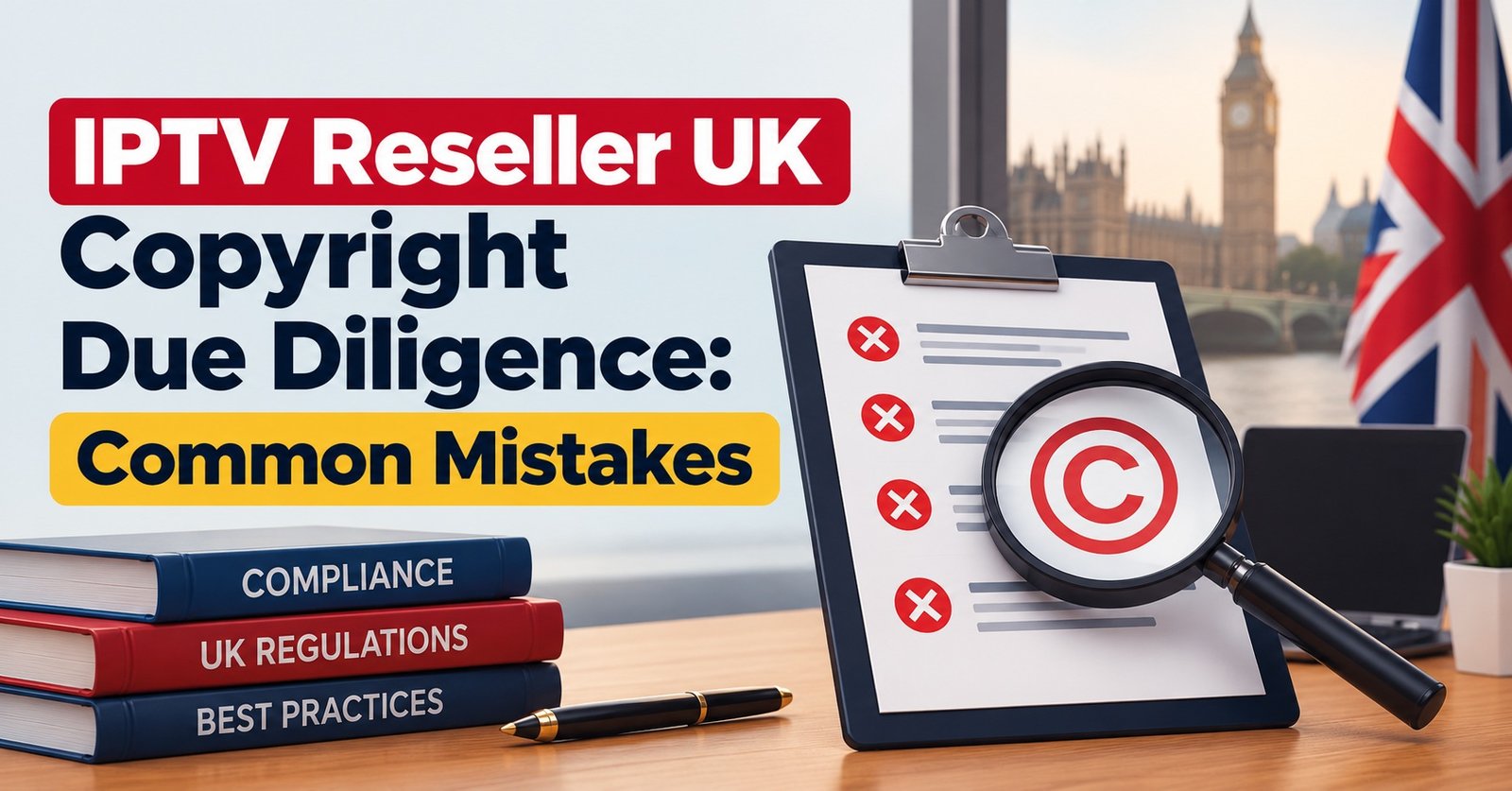
IPTV Reseller UK Copyright Due Diligence is the habit of checking, before you sell a single line, that whoever supplies the content is entitled to distribute it to UK viewers. A working panel, a tidy invoice and a professional website do not show that, because they describe the software and the seller rather than the programmes. The reseller who takes the payment and hands out the login is the visible link in the chain, so the evidence should sit with you rather than with someone upstream.
Nothing inside a reseller dashboard reveals what you are actually handling. IPTV is only a delivery method, and credits, expiry dates and activation buttons behave identically whether the streams are authorised or not. The checking therefore has to happen outside the panel, through documents and written answers, ideally before credits are activated, since activated credits are often non-refundable. This is general information rather than legal advice, and a solicitor with intellectual property experience should review your own arrangement.
Two Licences That Get Mixed Up
A panel vendor normally sells a software licence: the right to use a dashboard, create lines and manage customers. Content rights are a different matter. They are the permissions that allow programmes to be communicated to the public, and they are usually granted by territory, so authority to distribute in one country does not automatically cover UK viewers.
A line such as “we provide software and do not host content” can be perfectly true. It also means the content question has not been answered, only moved to whoever supplies the streams. Someone upstream must hold the rights, and as a reseller you need to know who that is and on what basis.
Panel terms tend to say the same thing from the other direction. The terms published on britishseller.co.uk, for example, state that the reseller is solely responsible for the legality of their activities in their own jurisdiction. That is a common arrangement, and it is the reason this checking cannot be outsourced to the panel provider.
What UK Law Looks At: Knowledge, Gain and Reason to Believe
The central provision is section 107(2A) of the Copyright, Designs and Patents Act 1988, which you can read in full on legislation.gov.uk. As substituted by section 32 of the Digital Economy Act 2017, it makes it an offence to infringe copyright by communicating a work to the public where the person knows or has reason to believe they are infringing. The person must also either intend a gain for themselves or another, or know or have reason to believe the act will cause loss, or risk of loss, to the owner. The same Act raised the maximum prison term on conviction on indictment from two years to ten for offences committed after it came into force.
The phrase “reason to believe” matters for due diligence. It reaches beyond actual knowledge, so a IPTV panel reseller who noticed obvious warning signs and carried on is in a weaker position than one who asked questions and kept the answers. That is a reading of the statutory wording, not a prediction about any particular case.
Separate offences exist around unauthorised decoders under section 297A, as amended by the Conditional Access (Unauthorised Decoders) Regulations 2000. They cover commercial dealing and advertising, with a defence where the person did not know and had no reasonable ground for believing the decoder was unauthorised. That provision targets equipment that unlocks encrypted transmissions, so it will not describe every IPTV arrangement. It does show Parliament returning to the same question of what a seller knew. For a plain summary of the offences, the government’s intellectual property offences page and its IP crime and enforcement guidance for businesses are the sensible starting points.

IPTV Reseller UK Copyright Due Diligence: The Evidence Worth Asking For
Start with identity. Ask for the full legal name, registered number and address of the business that actually supplies the streams, then check those details against the public company register yourself. A trading name on a website is not a legal entity.
Next, ask a plain question in writing: on what basis is this service authorised for distribution to UK viewers, and who is the licensor? A useful answer is specific. It names a counterparty, describes the territory covered and can be repeated consistently a month later. “Everything is fully legal” is an assertion, not evidence.
Then ask for something documentary. That might be a redacted licence extract, an authorisation letter, a signed warranty or a letter from the provider’s solicitor. Commercial confidentiality is a fair reason to redact prices and terms, but it is not a reason to show nothing. Where a document names a rights holder or licensing body, contact that organisation using the details on its own website rather than those supplied by the provider, because documents can be outdated or simply wrong.
Finally, ask how complaints are handled: who receives a rights holder’s notice, how quickly it is acted on, and how you will be told. A provider with a real answer here has probably thought about rights before. One without it probably has not.
Claims You Will Hear, and What They Actually Prove
Most reassurance in this market is true as far as it goes. The problem is that it answers a different question from the one you need answered.
| Claim | What it shows | What it does not show |
|---|---|---|
| “We are a registered company” | The business exists and can be traced | That it holds distribution rights |
| “We only sell software” | An honest description of the product | Who supplies the streams, or on what authority |
| “We have a DMCA policy” | A complaints route exists (the DMCA is a US statute) | That any given programme is authorised in the UK |
| “Thousands of resellers use us” | Popularity | Licensing status |
| “Pay by card or bank transfer” | Ordinary payment processing | Anything about content rights |
Pro tip: Put your rights question to the provider in writing twice, about a fortnight apart. Consistent, specific replies are worth more than a single polished one.
Where Resellers Talk Themselves Into Trouble
Treating a low price as a licence. A price far below what authorised services charge for comparable content proves nothing by itself. It is, though, exactly the sort of warning sign that should prompt a question rather than a shrug.
Advertising by channel, match or title. Naming specific broadcasters or events in sales copy implies an authority you cannot evidence, and it can raise trade mark problems on top of copyright ones. Describe the service you can substantiate.
Pasting someone else’s disclaimer. Copying “we do not host content” onto your own site and calling it compliance mistakes a statement for a check.
Judging legitimacy by a trial. A trial shows that streams load. It says nothing about whether anyone had the right to send them.
Relying on verbal assurances. A reassurance in a messaging chat, with no date and no named person, will not help you reconstruct what you asked or why you carried on.
Ignoring a complaint. Once a rights holder or a customer raises a concern, claiming you had no reason to believe anything was wrong becomes much harder to maintain.

A Verification File to Keep Before Activating Credits
- Legal name, registered number and address of the supplying business, with the date you checked the public register.
- A written statement of the rights basis for UK distribution, naming the licensor and the territory covered.
- A redacted licence extract, authorisation letter or solicitor’s letter, dated.
- Written answers on how rights complaints and takedown notices are handled, and who contacts you.
- A dated copy of the provider’s terms as they stood when you signed up.
- Invoices and receipts that match the legal entity you checked, stored as described in this guide to keeping invoices and receipts in order.
- A log of each question you asked and each reply, including any refusals or silences.
- A review date, plus triggers for an earlier one: a change of supplier, a complaint, or a sudden shift in what the service offers.
- A recorded decision where answers are still missing. Some providers allow unused credits to be returned within a set period, and how the 30-day credit refund window works on this site is a useful example to compare against, so finish the file before you activate anything.
Questions Resellers Ask About Rights Checks
Does a DMCA policy mean the provider is licensed?
No. It describes how complaints are received and handled. The DMCA is a US statute, and UK rights are governed by the Copyright, Designs and Patents Act 1988, so the policy tells you about process rather than permission.
Can I be responsible if the provider supplies the streams?
The offence in section 107(2A) turns on what a person knew or had reason to believe, together with gain or loss. Being downstream does not settle the question, so take advice from an intellectual property solicitor about your own position.
What if the provider will not share any licence paperwork?
Treat it as an unanswered question rather than a neutral one. Redacted extracts, a signed warranty or a solicitor’s letter are reasonable substitutes for a full contract. Refusing all of them is information you should record.
Is a reseller panel itself unlawful?
A panel is management software for accounts, credits and customers. Whether what you sell through it is lawful depends on the distribution rights behind the content.
How often should the checks be repeated?
There is no statutory interval. A yearly review, plus a fresh check after any change of supplier, complaint or marked change in the service, is a sensible working practice.
What to Do This Week
IPTV Reseller UK Copyright Due Diligence does not need a legal department. It needs specific questions put in writing, answers checked against independent sources, and a file you could hand to a solicitor or Trading Standards officer without embarrassment. Send your provider the rights questions this week, record whatever comes back, and let any silence inform your decision about whether to keep selling. For more practical operating guidance, browse the wider IPTV reseller Panel guides section.