Book Appointment Now
IPTV Headend: 7 Secrets That Separate Pros From Amateurs in 2026
You bought the panel credits. You set up the reseller account. You even got your first five subscribers paying on time. Then, one Saturday night during a major match, everything dies. Streams freeze. WhatsApp blows up. You’re frantically pinging your supplier while your customers are walking out the door.
The problem wasn’t your panel. It wasn’t your pricing. It was the IPTV headend sitting three layers above you, and you had zero visibility into it.
Most resellers treat the headend like a black box they never need to understand. That’s exactly why most UK IPTV resellers plateau, or get burned entirely. This guide is for operators who want to understand what they’re actually selling, and build something that lasts.
What an IPTV Headend Actually Does (Not the Wikipedia Version)
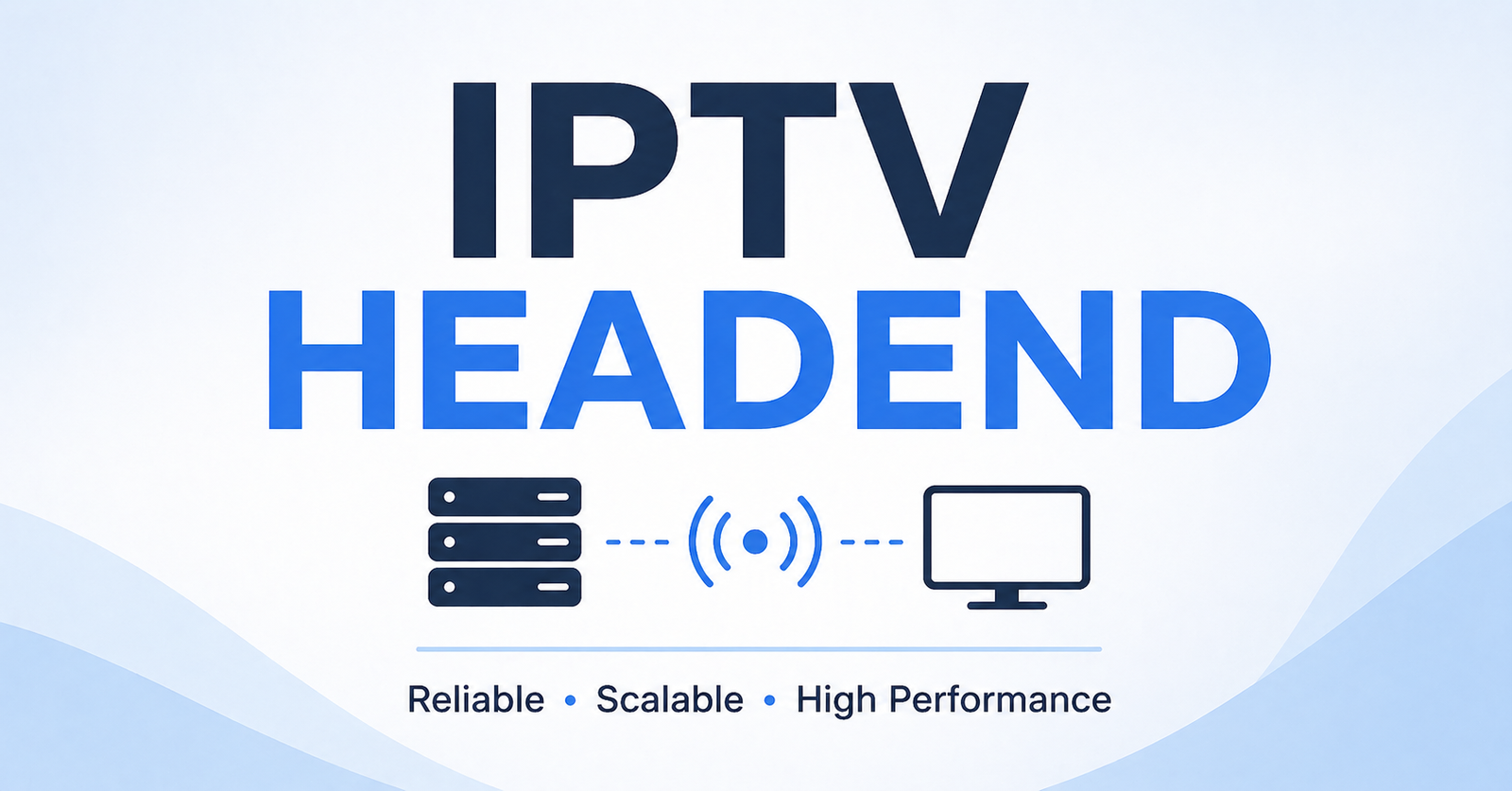
An IPTV headend is the origination point of every stream in your ecosystem. It receives raw broadcast signals, satellite feeds, fiber inputs, encoded file sources, processes them, transcodes them into digital formats, and pushes them downstream to middleware and then to end devices.
Think of it as a television studio and a data center had a child. It handles:
- Signal acquisition from multiple uplink sources
- Encoding and transcoding (typically H.264/H.265)
- Multiplexing streams into deliverable packages
- Feeding the CDN or direct delivery network
- EPG (Electronic Programme Guide) data injection
Every piece of content that reaches your subscriber’s screen passed through an IPTV headend first. Its stability, redundancy, and processing capacity determine whether your business looks professional or amateur.
Pro Tip: When vetting a new supplier, ask directly: “How many uplink sources does your headend maintain?” A serious operator runs at least two independent satellite feeds plus a fiber backup. One-source headends are ticking time bombs.
Why This Upstream Layer Is Your Actual Business Risk
As a reseller, you’re selling trust. Your subscriber doesn’t care about the infrastructure chain, they care that the stream works. But you need to care deeply about the IPTV headend sitting above your panel, because that’s where your reputation actually lives.
The failure cascade looks like this:
- Headend uplink drops (ISP issue, satellite weather, hardware fault)
- Encoding pipeline stalls
- Streams freeze or buffer at scale across all connected panels
- Sub-resellers report mass outages
- You’re blamed, even though you own nothing at headend level
This is the structural reality of the reseller model. Your leverage is limited unless you choose suppliers who operate transparent, redundant IPTV headend infrastructure.
Here’s how a weak headend compares to a robust one:
| Infrastructure factor | Weak headend | Robust headend |
|---|---|---|
| Uplink sources | Single satellite feed | Dual satellite + fiber backup |
| Encoding redundancy | Single transcoder | Failover encoder clusters |
| Outage recovery time | 30 to 90 minutes | Under 5 minutes |
| EPG reliability | Frequent gaps | Synced, auto-correcting |
| Load capacity | Drops during peak | Scales via load balancing |
| ISP block mitigation | None | DNS rotation, IP cycling |
HLS Latency, Load Balancing, and the Headend Connection
Here’s something most resellers have never thought about: buffering on HLS streams isn’t always a CDN problem. Frequently, it traces back to the IPTV headend itself, specifically how it manages segment generation under load.
HLS (HTTP Live Streaming) works by breaking content into small chunks and delivering them sequentially. When the IPTV headend is under heavy transcoding load, those segments generate late. The player buffers waiting for the next chunk. Your customer sees the spinning wheel. You get the angry message.
What good headend load balancing looks like:
- Horizontal scaling across multiple encoding nodes
- Automatic traffic redistribution when a node hits CPU threshold
- Separate pipelines for HD, FHD, and 4K outputs
- Priority queuing for premium sports streams during simultaneous high-demand events
Without these mechanisms at headend level, even the best CDN in the world can’t compensate. The problem is upstream.
Pro Tip: If your supplier can’t tell you how their IPTV headend handles concurrent stream load during peak events, that’s your answer. Operators who’ve actually built or managed headend infrastructure talk about this in specifics, not generalities.
AI-Driven ISP Blocking in 2026 and What It Means for Headend Architecture
The enforcement landscape has changed significantly. Major broadcasters and rights holders are no longer relying solely on court-ordered IP blocks. In 2026, AI-assisted deep packet inspection is being deployed at ISP level to identify IPTV stream patterns in real time, regardless of IP address.
This has direct implications for how a properly operated IPTV headend must be architected:
Obfuscation at the delivery layer: headends feeding streams directly over recognizable IPTV protocols are the easiest targets. Professional operations now route through encrypted tunnels or CDN layers that mask the traffic pattern.
IP rotation at headend egress: static IPs tied to a known IPTV headend are getting blocked faster than ever. Responsible suppliers cycle egress IPs on a rotating basis, sometimes every 24 to 48 hours.
DNS poisoning resilience: DNS-based blocking is common at ISP level. An IPTV headend feeding into infrastructure without redundant DNS resolution paths leaves every subscriber vulnerable simultaneously.
The resellers who survived the 2024 to 2025 enforcement waves were working with suppliers whose IPTV headend had already anticipated these vectors. Those who weren’t found themselves scrambling for new suppliers every few weeks.
Why Panel Credits Are Worthless If This Layer Fails
This is the conversation the reseller industry needs to have more honestly. You can have 500 panel credits, a clean sub-reseller network, and a professional storefront, and still deliver a terrible product if the IPTV headend upstream is poorly maintained.
The metrics that actually matter at headend level:
- Uptime SLA: anything below 99.5% monthly is a problem
- Peak load tolerance: tested under simultaneous premium sports events
- Failover speed: how fast does the backup uplink kick in?
- Channel refresh rate: how quickly does the headend respond to source outages with rerouted feeds?
Most UK IPTV reseller agreements say nothing about this. You’re sold panel credits and left to figure out infrastructure quality through trial, error, and customer complaints.
Pro Tip: Before committing to a supplier at volume, run a 48-hour stress test across multiple device types. Watch stream behaviour during two or three major live events. The IPTV headend’s limitations will show themselves clearly within that window.
What Resellers With Scaling Problems Actually Have Wrong
When resellers hit 50 to 100 subscribers and suddenly start seeing more issues, the instinct is to blame the panel software or the customer’s connection. In most cases, what’s actually happening is that the IPTV headend upstream was never designed to serve that sub-network at scale.
Entry-level suppliers often run smaller headend setups optimized for low subscriber counts. As you grow your network and pull more concurrent streams, you’re hitting real infrastructure limits, not software bugs.
Signs you’ve outgrown your current headend supplier:
- Buffering becomes load-correlated (worse at peak times, fine at 3am)
- Certain channel categories drop more than others (often those on a specific encoder)
- Sub-resellers in different regions report different stability levels
- Your ticket response times from the supplier increase as your subscriber count grows
Moving up to a supplier operating a genuinely enterprise-grade IPTV headend is a scaling decision, not just a quality preference. The infrastructure ceiling is real.
Backup Uplink Servers: The Headend Feature Nobody Asks About (Until They Need It)
An IPTV headend without backup uplink capacity is like running a business with no insurance. It works fine right up until the moment it doesn’t, and that moment always arrives at the worst possible time.
Backup uplinks in a professional headend context means:
- Secondary satellite dish infrastructure pointed at different orbital positions
- Independent fiber connections from separate ISPs at the headend facility
- Automatic failover logic that switches the stream source without manual intervention
- Geographic redundancy, secondary headend nodes in different data centers
When your primary uplink fails and backup cuts in within 30 seconds, your subscribers notice nothing. When there’s no backup and recovery takes 45 minutes, you’ve lost customers, and potentially sub-resellers.
The best suppliers are transparent about their IPTV headend backup architecture. If this information isn’t available anywhere in their documentation or support responses, assume the infrastructure doesn’t have it.
What Channel Management Actually Looks Like Day to Day
What subscribers see as a “channel list” is actually a constantly managed, frequently breaking system at headend level. Sources go offline. Feeds shift frequencies. Encoder assignments change. A well-run IPTV headend is actively maintained by engineers who are doing this work continuously.
What channel management at headend level actually involves:
- Monitoring every active source feed in real time
- Replacing dead feeds before subscribers notice
- Reassigning streams to alternate encoders when hardware issues arise
- Maintaining EPG sync across time zones and regions
- Handling 4K/HDR source inconsistencies that break certain decoders
As a reseller, you’re downstream from all of this. But understanding it changes how you communicate with subscribers when issues arise, and how you evaluate whether your supplier is genuinely investing in their IPTV headend or just coasting.
Pro Tip: Ask your supplier how many live engineers actively monitor their IPTV headend during peak broadcast windows. The answer tells you more about their infrastructure quality than any uptime percentage they quote.
Cheap vs. Premium: What You’re Actually Paying For at Headend Level
The pricing difference between entry-level and premium IPTV suppliers isn’t profit margin, it’s mostly infrastructure cost. Running a genuinely redundant, high-capacity IPTV headend is expensive. The economics get passed downstream in the per-credit pricing.
What a higher wholesale cost typically buys you:
- Dedicated headend capacity (not shared with thousands of other reseller networks)
- Hardware-grade encoders rather than software-based transcoding
- Multiple redundant uplinks across separate physical locations
- 24/7 NOC (Network Operations Center) monitoring the headend in real time
- Faster ISP block response with pre-deployed IP rotation infrastructure
The resellers who compete purely on price end up with the cheapest headend infrastructure, which is fine until a major event or an enforcement wave. At that point, the cost of one bad weekend, in refunds, churn, and reputation damage, often exceeds months of savings on wholesale pricing.
IPTV Headend Success Checklist for Resellers
Before you commit to a supplier, add subscribers, or scale your panel network, run through this:
Supplier Vetting:
Can supplier confirm multi-source uplink architecture at headend?
Is backup uplink failover automatic or manual?
What’s the actual outage response SLA, in writing?
Does their IPTV headend have geographic redundancy?
Infrastructure Monitoring:
Are you tracking stream quality metrics per channel category?
Do you know which channels are on which encoder pipeline?
Have you stress-tested during at least two major concurrent live events?
ISP Block Readiness:
Does your supplier rotate egress IPs from the IPTV headend?
Is there DNS redundancy built into the delivery chain?
Are encrypted delivery paths available for high-risk regions?
Scaling Readiness:
Have you confirmed headend capacity supports your target subscriber count?
Do you have a secondary supplier relationship for failover?
Is your pricing model absorbing infrastructure risk at the right margin?
The IPTV headend isn’t something you see or directly control as a UK IPTV reseller. But it determines everything your subscribers experience. Understanding it isn’t optional if you’re running this seriously, it’s the difference between building a business and babysitting an outage queue.