Book Appointment Now
IPTV Content Licensing Checklist UK: 2026 Reseller Guide
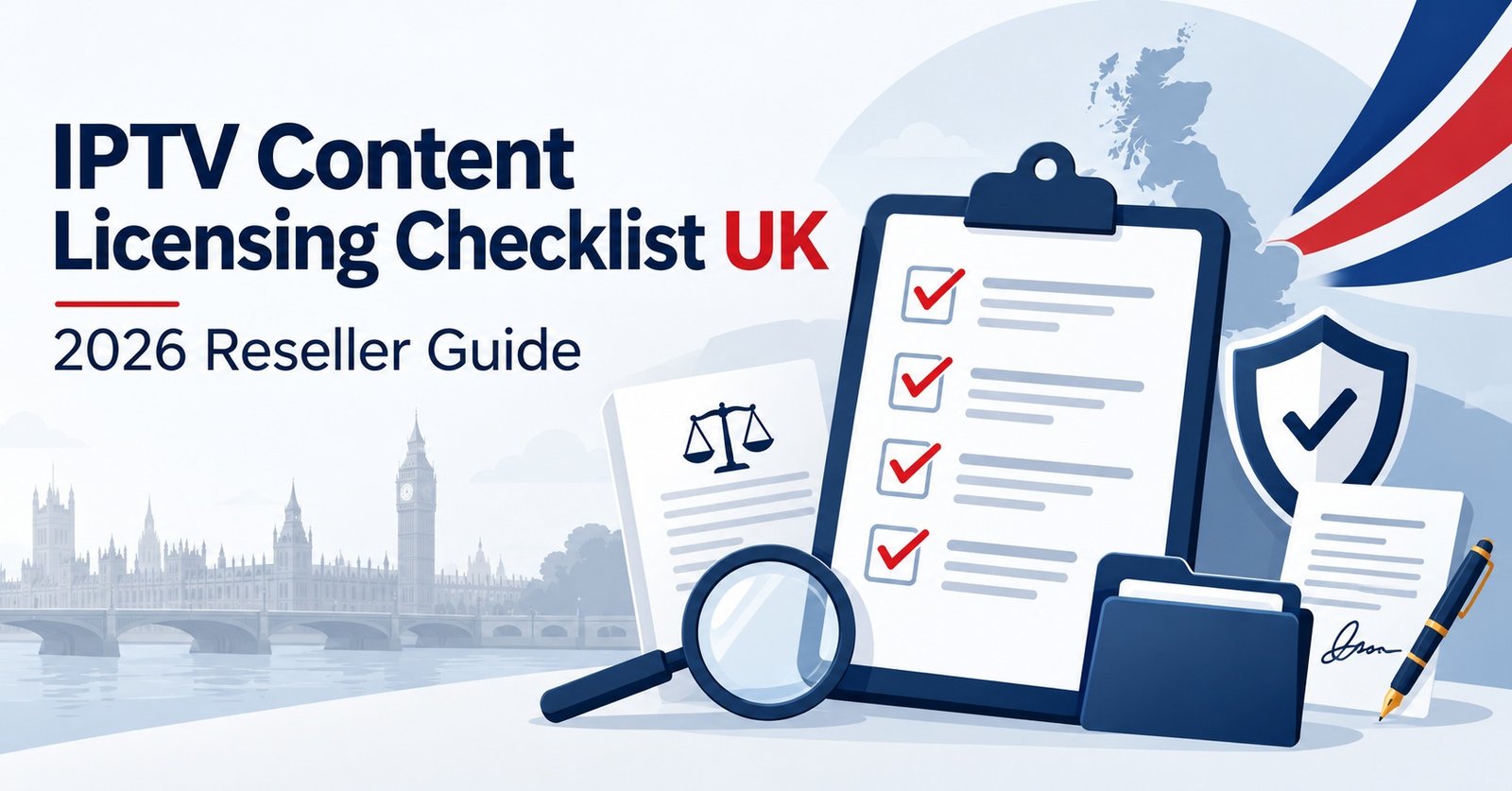
The first item on any IPTV Content Licensing Checklist UK IPTV panel resellers rely on is written evidence that every channel and on-demand title in the service is authorised for UK distribution by someone who actually owns those rights. In practice, you need three things before selling a single subscription: a traceable chain from the rights holder to your supplier, confirmation of the service’s regulatory position with Ofcom where it applies, and a signed agreement that expressly allows you to resell in your territory. If a supplier cannot produce all three, the sensible decision is not to sell its service, however polished its panel looks.
Most problems start with a reasonable-sounding mix-up. Reseller dashboards, credit systems, player apps and middleware are software, and software can be entirely lawful while the streams passing through it are not. Licensed technology tells you nothing about licensed content. Copyright belongs to whoever created or acquired the programming, and only that owner, or a licensee it has authorised in writing, can give you permission to pass it on to paying customers. A tidy website, a registered company or an approved payment account settles none of this.
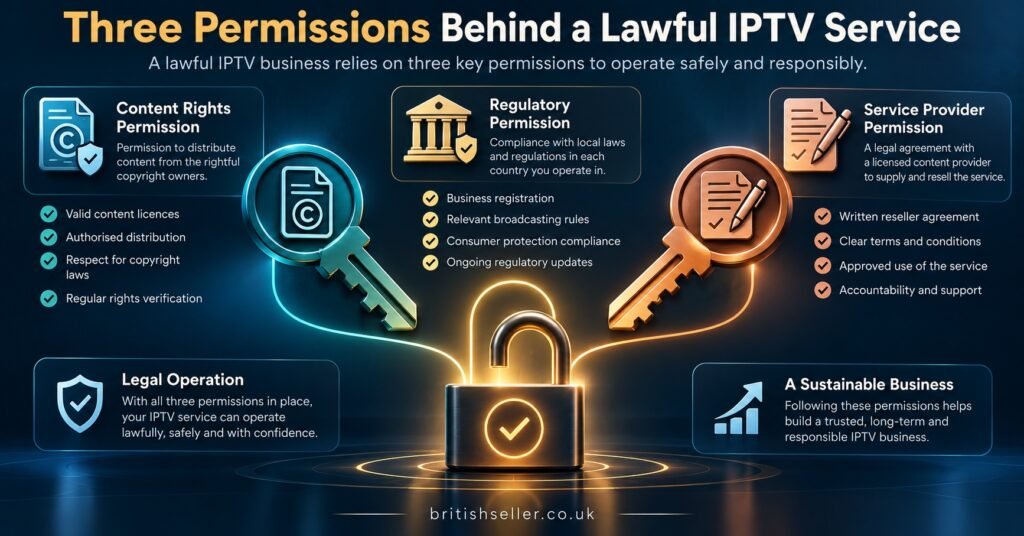
Three Permissions, Three Different Owners
A lawful resale arrangement rests on three separate permissions, each granted by a different party. Resellers who blur them together often end up holding paperwork that proves the wrong thing.
| Permission | Who grants it | What it does not prove |
|---|---|---|
| Content rights | The copyright owner or its authorised licensee | That the service is regulated, or that you may resell it |
| Regulatory status | Ofcom, for services within its jurisdiction | That any programme is cleared for copyright |
| Resale authority | Your supplier, under a written agreement | Anything at all, unless the supplier holds the first permission |
Content rights are the foundation. Programming is usually licensed for a defined territory, a defined set of platforms and a fixed term, so a distributor may hold genuine rights that still do not stretch to internet delivery in the UK.
Regulatory status is a separate question. Ofcom’s own consultation material notes that television services delivered over the internet can fall under a Television Licensable Content Service (TLCS) licence, and the Communications Act 2003 requires a separate licence for each television licensable content service. On-demand catalogues sit under a different regime: UK-based on-demand programme services must formally notify Ofcom and comply with statutory content requirements. Neither process is a copyright clearance.
Resale authority is the contract between you and your supplier. It should say, in plain terms, that the supplier may appoint IPTV panel resellers, that you are one of them, and where you may sell. A resale clause sitting on top of a supplier with no underlying rights is worth nothing, which is why the order of checks matters.
The UK Rules Behind the Checklist
The legal framework is spread across several statutes, but the core points are short enough to keep in mind.
Under the Copyright, Designs and Patents Act 1988, communicating copyright works to the public without permission is an infringement, and in some circumstances a crime. Criminal liability applies where a person knows or has reason to believe they are infringing, and either intends to make a gain or knows the act will cause loss, or a risk of loss, to the copyright owner. The Digital Economy Act 2017 raised the maximum sentence for online infringement of this kind from two years to ten.
A second offence targets reception rather than distribution. Section 297 of the same Act covers dishonestly receiving a programme from a UK broadcasting service with intent to avoid paying the applicable charge. Rights holders also have civil routes that affect resellers directly: under section 97A, the High Court can grant an injunction against a service provider that has actual knowledge of someone using its service to infringe copyright, which is the legal basis behind orders that can cut off access to infringing services with little warning.
The Intellectual Property Office’s guidance on illicit streaming is useful because of how broadly it frames the problem. It defines illicit streaming as watching content without the copyright owner’s permission by any means, and says devices are legal for legitimate content but become illegal once adapted to stream illicit content. The technology is neutral. The permission is everything.
Enforcement is not theoretical. In August 2026, a Lancashire man was jailed for six and a half years after a conviction for conspiracy to defraud at Preston Crown Court, for an illegal streaming business that generated £980,812 in criminal profits, and now faces Proceeds of Crime Act proceedings. Two details matter for anyone selling into English-speaking markets abroad: prosecutors used fraud law rather than relying only on copyright offences, and the operation supplied customers both in the UK and overseas, particularly British expats. Selling to customers outside the country did not place it beyond reach.
Checking Each Claim Against an Official Source
A supplier’s word is a starting point, not evidence. Each claim should be matched against a source the supplier does not control.
Ofcom’s licence and notification records
Ask for the licence number and the exact name of the licensed service. When Ofcom grants a TLCS licence, it publishes the service name, the licensee’s contact details and a brief description of the service on its website, so you can check that the licensee matches the company you are dealing with and that the described service resembles what is actually being sold. For on-demand content, Ofcom’s page on who needs to notify an on-demand programme service explains the regime. Remember that an Ofcom licence concerns broadcasting standards. It does not clear copyright, and a service licensed in another country will not appear on Ofcom’s records at all.
Companies House for the named licensee
Search the Companies House register for every company named in the licence chain. The legal name, company number and status should match the contract exactly. A trading name on a website and a different entity on the paperwork is a gap that needs explaining before you go further.
The rights holder’s own licensing team
This is the check most resellers skip, and the most valuable one. Where a rights holder publishes a list of authorised distribution partners, check it. Where it does not, its licensing or business affairs department is the right place to ask whether a named distributor holds IPTV rights for the UK.
Pro tip: Send that enquiry yourself, from your business email address, quoting the distributor’s full legal name. A confirmation forwarded by your supplier proves far less than a reply you received directly.
The legislation itself
Summaries go out of date. The current text of the Copyright, Designs and Patents Act and the Communications Act is published on legislation.gov.uk, and reading the relevant sections takes less time than most people expect.
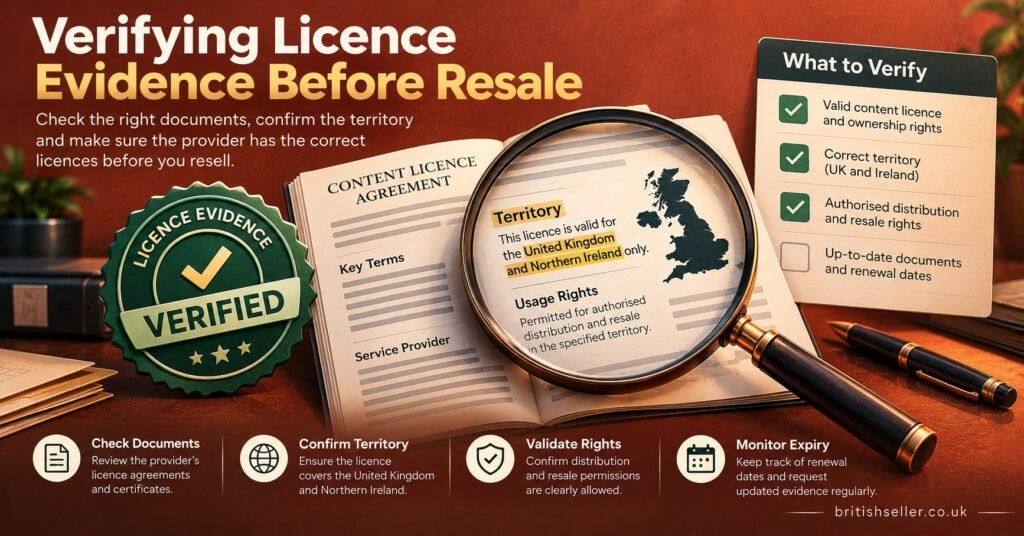
A genuine licence document normally names both parties, the territory, the permitted platforms (internet, IPTV or OTT delivery should be stated explicitly), the start and end dates, a schedule of the channels or titles covered, and a clause dealing with sub-licensing or resale. Where any of those is missing, ask why.
Where the Software Ends and the Rights Begin
Credits, connection limits, renewal dates, player apps and EPG feeds are the working parts of a IPTV panel reseller business, and they are what a technology vendor supplies. A panel provider that develops dashboards and management tools is selling software. Buying that software does not give you a licence for anything that is later loaded into it.
This distinction shapes everyday decisions. Tools for automating account creation and renewals make admin faster, but they check nothing about what each line carries. The same logic applies when you are deciding how to structure trial accounts: a short trial still puts content in front of a member of the public, so the licensing checks belong before the first trial, not after the first sale.
Keep the two kinds of supplier separate in your records too. Your software vendor’s contract covers uptime, support and data handling. Your content supplier’s documents cover rights. Filing them together makes it far too easy to mistake one for the other later.
Mistakes That Create False Confidence
Accepting a screenshot or PDF at face value. Documents are easy to edit. Without independent confirmation from Ofcom’s records or the rights holder, a licence image proves only that someone has an image.
Treating an Ofcom licence as copyright clearance. A broadcast licence regulates content standards. A licensed channel operator can still lack the rights to a particular programme on a particular platform.
Reading “worldwide” without reading the schedule. Headline wording often conflicts with the territory or platform schedule further down. The schedule usually wins.
Assuming overseas customers sit outside UK law. As the August 2026 sentencing showed, serving expats abroad did not move a UK-based operation out of reach of UK courts.
Relying on a disclaimer. Footer text describing your position does not create rights you do not hold, and it does not move responsibility for what you sell onto your customers.
Reading a low wholesale price as a bargain. When the price is far below what authorised services charge for comparable programming, the gap is information. Ask what explains it.
Checking once and never again. Licences expire, catalogues change and distributors lose rights mid-term. A file that was accurate at onboarding can be wrong a year later.
Questions Resellers Ask About Licensing Evidence
Does a licensed reseller panel make my service legal?
No. The panel licence covers the software. Whether the streams are lawful depends entirely on the rights held by whoever supplies the content.
My supplier says its licence agreement is confidential. Is that normal?
Commercial terms such as fees are often confidential. The existence and scope of the rights are not. A legitimate distributor can usually provide a redacted copy showing the parties, territory, platforms and resale clause, or a letter of authorisation from the rights holder. Refusing to show anything at all is a warning sign.
Do I need my own Ofcom licence as a reseller?
It depends on what you provide and who has editorial responsibility for it. Ofcom expects providers to make their own assessment of whether their service meets the statutory criteria, and its guidance states that it cannot decide for you whether you need a licence. If you package or brand a service as your own, take legal advice before launch.
How often should licensing evidence be re-checked?
At every supplier renewal, whenever the channel or catalogue list changes noticeably, and before you start selling into a new country.
What should I do if I discover a supplier is not licensed?
Stop selling new subscriptions, do not renew existing ones, and tell customers honestly that the service is ending. Take legal advice on refunds and record keeping. Suspected illegal broadcasting can be reported confidentially to the Federation Against Copyright Theft.
The IPTV Content Licensing Checklist UK Resellers Should Keep on File
- Supplier’s full legal name, company number and Companies House status recorded
- Copy of the licence or authorisation letter, showing parties, territory, platforms and dates
- Channel or title schedule matched against what the service actually delivers
- Written resale or sub-licensing clause that names you or your reseller tier
- Ofcom licence number or ODPS notification checked against Ofcom’s published records, where applicable
- Direct confirmation from at least one rights holder, received by you rather than forwarded
- Explanation obtained for any price far below authorised market rates
- Software vendor contract filed separately from content rights evidence
- Expiry dates for every licence logged, with a re-check reminder set before each one
- Note of the professional legal advice taken, with the date
Before the First Subscription Goes Out
An IPTV Content Licensing Checklist UK IPTV panel resellers can defend is really a record of questions answered by people other than the supplier. Ofcom’s records, Companies House, the rights holder and the statute book each confirm a different piece, and none of them can be replaced by a confident sales pitch or a well-built dashboard.
This article explains the framework, not your specific contract, so a solicitor with media or intellectual property experience should review any agreement you intend to rely on. Once the rights side is settled, the operational side becomes the easier part, and our guides for running a British reseller operation cover that ground in more detail.