Book Appointment Now
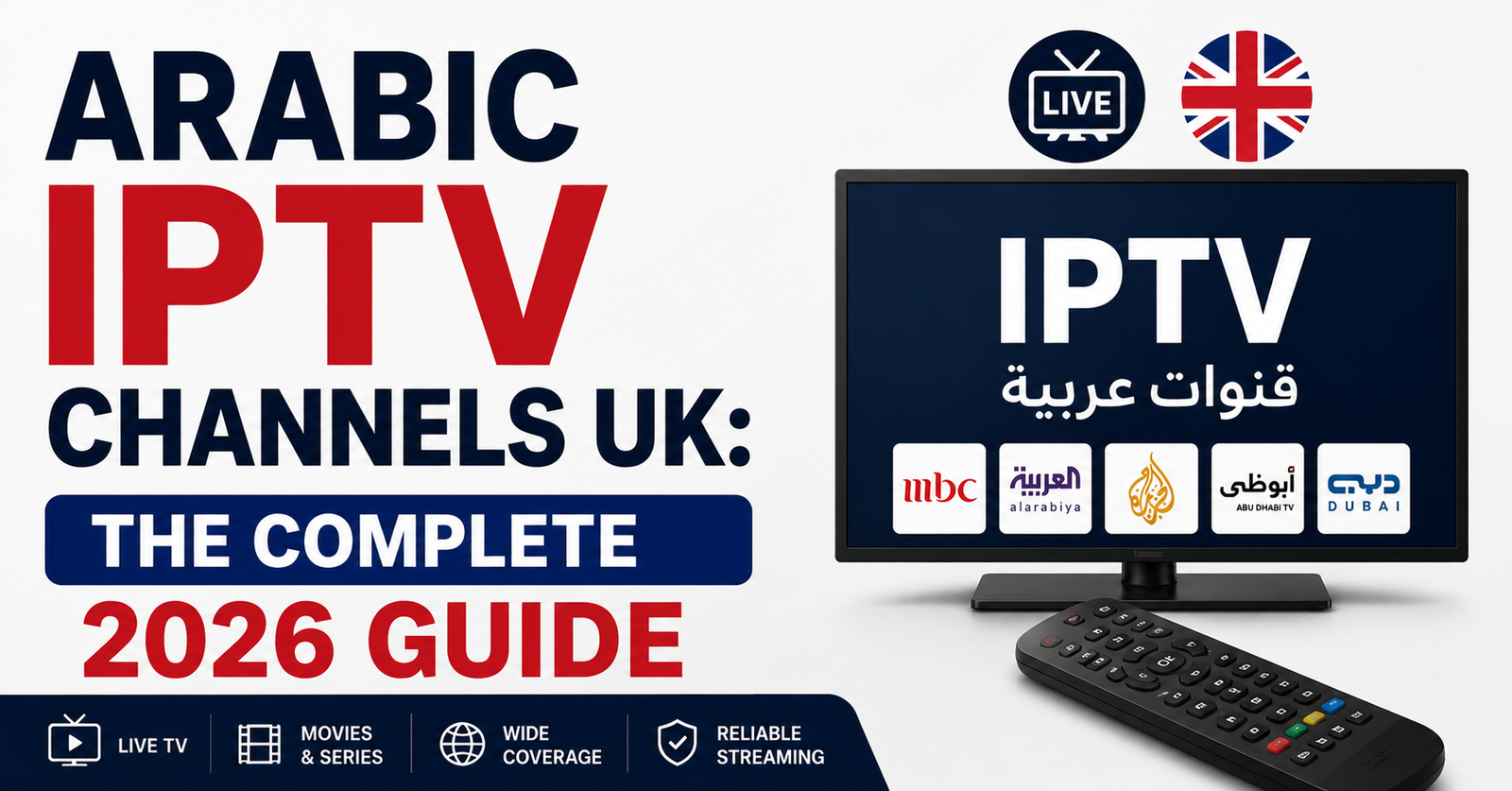
Arabic IPTV Channels UK: The Complete 2026 Guide
The Demand Is Real — But So Are the Problems
Nobody talks about how difficult it actually is to deliver Arabic IPTV channels reliably in the UK. The demand exists — there are over 1.4 million Arabic speakers in Britain, plus a far larger audience that watches Arabic news, sport, and drama without speaking the language natively. MBC, beIN Sports Arabia, Al Jazeera, rotana, Shahid — these are not niche requests. They are mainstream viewing habits for entire communities.
And yet, a significant portion of UK-based IPTV subscribers who specifically came for Arabic content end up abandoning their service within 60 to 90 days. The reason is almost never content availability. The channels are there. The problem is delivery — buffering during Ramadan broadcasts, freezing during Arabic football coverage, channels disappearing mid-season with no explanation, apps that stop recognising their subscription without warning.
After reviewing hundreds of support tickets from IPTV panels across multiple services, the same pattern keeps repeating itself: customers are sold access to Arabic IPTV channels, but nobody prepared the infrastructure to actually carry that load.
This article is about understanding what actually happens behind the scenes — so whether you are a subscriber choosing a service or a UK IPTV reseller building one, you stop making decisions based on channel count alone.
Why Arabic Content Specifically Stresses IPTV Infrastructure
Most people assume an IPTV stream is an IPTV stream. In reality, Arabic IPTV channels create a very specific type of load that differs from UK or US content delivery.
Here is why:
- Simultaneous timezone spikes — Arabic-speaking communities in the UK often watch live content scheduled for Middle Eastern broadcast times, which means peak usage hits at unusual hours from a UK ISP perspective
- Ramadan traffic doubling — during Ramadan, viewing hours increase dramatically. Live religious programming, nightly entertainment shows, and news run consecutively, and concurrent connections on Arabic IPTV channels can double within a single week
- beIN Sports Arabia streams — these carry HD football from Saudi Pro League, AFC qualifiers, and Egyptian Premier League. They are bitrate-heavy. A panel that handles 500 concurrent UK sports viewers may collapse under 200 Arabic sports viewers simply because of stream quality
- Regional geo-blocks — several Arabic content providers apply regional licensing. A stream licensed for Saudi Arabia may not legally — or technically — be deliverable to UK IP ranges without specific routing arrangements
One infrastructure issue appeared repeatedly during a large-scale migration project: the backup uplink was routed through a European CDN node that had no Middle Eastern peering agreements. When the primary server struggled, failover kicked in — and Arabic IPTV channels either disappeared entirely or delivered at 480p when customers expected 1080p.
The Reseller Mistake Nobody Admits
There is a conversation that does not happen often enough between IPTV providers and their resellers. It goes something like this:
“How many of your customers are specifically here for Arabic channels?”
Most resellers cannot answer that question. They have sold credits, they have issued subscriptions, but they have never actually segmented their customer base. And when infrastructure decisions are made — which servers to upgrade, which CDN routes to prioritise, which backup systems to test — Arabic IPTV channels end up deprioritised simply because nobody tracked the demand.
A reseller we were consulting with lost around 40 customers in a three-month window. All Arabic-speaking households. All left for the same competitor. The reseller’s panel had over 4,000 Arabic IPTV channels listed. The issue was not content. It was that three specific channels — MBC Drama, Shahid VIP integration, and one beIN Sports Arabia feed — had been on a degraded server for six weeks, and nobody on the support team noticed because the ticket volume was being handled as generic buffering complaints, not traced back to a specific content group.
Pro Tip: If you are a reseller, run a monthly audit of your top 20 most-streamed channels. Arabic content often ranks higher than expected in that list, and knowing that changes your infrastructure prioritisation completely.
What UK ISPs Do to Arabic IPTV Traffic
This is an area where experience matters more than theory.
UK ISPs — particularly those under Ofcom pressure — have become increasingly aggressive with deep packet inspection on IPTV streams. The targeting is not always random. Traffic patterns from Arabic IPTV channels often look distinctive to DPI systems because:
- The source IPs frequently originate from non-UK CDN nodes
- Stream headers sometimes carry Arabic metadata that differs from expected UK content profiles
- Viewing hours deviate from typical domestic patterns
Virgin Media, BT, and Sky Broadband have all shown periods of selective throttling that disproportionately affect Arabic IPTV delivery. This is not necessarily deliberate targeting of Arabic content — but the technical outcome is the same. Streams buffer, latency spikes, and customers blame the IPTV service.
The practical counter-measures include:
| Problem | Infrastructure Response |
|---|---|
| ISP throttling on foreign CDN IPs | Use UK-hosted HLS relay nodes |
| DPI triggering on IPTV stream headers | Implement header obfuscation at panel level |
| Unstable foreign source feeds | Add secondary uplink from a different regional provider |
| Geo-routing failures on Arabic content | Configure explicit geo-routing rules in DNS |
None of these are optional if you are serious about delivering Arabic IPTV channels reliably to UK subscribers.
Choosing a Service: What Channel Count Doesn’t Tell You
Every IPTV provider marketing Arabic IPTV channels to the UK will quote a channel count. 3,000 Arabic channels. 5,000 channels. Sometimes 10,000. These numbers are nearly meaningless on their own.
What actually matters:
Source quality — where does the stream originate? Channels pulled from unstable third-party re-streams will fail constantly, regardless of how many of them are listed.
Dedicated Arabic server infrastructure — a service that treats Arabic content as a separate traffic category will always outperform one that dumps everything into a shared pool.
Catch-up and VOD depth — live channels are only part of the equation. A substantial portion of UK-based Arabic viewers watch content delayed — drama series, news replays, Ramadan content rewatched the next morning. Services without a deep Arabic VOD library lose customers within weeks.
App compatibility on relevant devices — Arabic-speaking households in the UK often use a mix of Samsung Smart TVs, Amazon Firestick, and mobile devices (iOS and Android equally). A service that does not work smoothly across all three will generate constant support requests.
Pro Tip: Ask your provider specifically which server handles Arabic IPTV channel delivery and whether it is the same server as their UK and European content. If they cannot answer, that tells you everything.
The Ramadan Effect: Infrastructure That Wasn’t Ready
During Ramadan, the situation with Arabic IPTV channels changes faster than most providers anticipate.
We noticed unusual ISP behaviour during one Ramadan observation period where overall stream requests on Arabic channels spiked by 180% over baseline within the first 48 hours. The first week of Ramadan consistently catches underprepared services off guard. Providers that had stable performance in February collapse by the first weekend of Ramadan broadcast schedules.
What happens technically:
- Concurrent connection limits are hit on shared servers
- HLS segment delivery slows because the CDN edge nodes were not pre-scaled
- DNS resolution times increase as Arabic IPTV channels flood lookup requests
- Failover systems trigger unnecessarily, creating brief outages that customers experience as the service “going down”
For subscribers, the experience is infuriating — Tarawih broadcasts cutting out, Suhoor programming buffering, evening entertainment series freezing at critical moments.
A competent provider will begin scaling their Arabic infrastructure two to three weeks before Ramadan. If a service cannot tell you what their Ramadan preparation looks like, they have not done it.
How to Actually Evaluate Arabic IPTV Quality Before You Pay
Testing matters. These are the things worth checking during any trial period:
Step 1 — Test during peak hours Stream Arabic IPTV channels between 9pm and 11pm UK time. This overlaps with evening primetime in both the UK and Middle Eastern time zones.
Step 2 — Check the specific channels you actually watch Do not just confirm they are listed. Play them for 10 minutes each. Freeze frames in the first few seconds are a red flag. Consistent playback at stated resolution is the target.
Step 3 — Test catch-up depth Go back 48 hours on channels you care about. Is content there? Does it load without buffering?
Step 4 — Test on your actual device Whatever you plan to use daily — Firestick, Samsung TV, Android box — test the service on that device specifically, not on a laptop browser.
Step 5 — Send a support message during the trial This sounds strange but is genuinely useful. How fast do they respond? Do they understand Arabic content delivery specifically, or do they give you a generic “clear cache and restart” reply?
Reseller Economics Around Arabic IPTV Channels
For resellers, Arabic IPTV channels represent a specific market segment with distinct economics.
Customer retention in Arabic-speaking subscriber segments tends to be higher than average — when service quality is consistent. These are not casual cord-cutters. They are households that depend on Arabic IPTV because they cannot get their preferred content through any mainstream UK broadcaster. Sky Arabia exists, but the cost is significantly higher than IPTV alternatives. Al Jazeera English is free but Al Jazeera Arabic is not.
This means resellers who serve this community properly earn long-term customers. Renewal rates in well-served Arabic subscriber segments are among the highest of any audience group.
The challenge is the support load. Arabic IPTV channels generate more support requests per subscriber than most other content categories — not because the customers are more demanding, but because:
- The content is more time-sensitive (live sport, live news, Ramadan schedules)
- The consequences of an outage are more visible to the customer
- Most customers have limited technical confidence and need guided support
Resellers building toward this market should factor support infrastructure into their planning from day one. A single reseller handling 200+ Arabic subscribers without a support process will struggle.
If you are looking for a reliable foundation for your Arabic IPTV reseller business in the UK, britishreseller.com offers UK IPTV Reseller panel access with Arabic content infrastructure already built for the UK market.
DNS Routing and Why It Matters for Arabic Streams
DNS is one of the least discussed but most practically important elements in Arabic IPTV delivery. Here is a simple way to understand it:
When your app requests an Arabic IPTV channel, it first asks a DNS server where to find that stream. If the DNS resolution points to a server in Germany when the optimal content node is in a UK-based relay, you are adding latency before the stream even begins. Multiply that across every channel change, every catch-up request, every app restart.
DNS poisoning is a separate risk — where corrupted or manipulated DNS responses redirect traffic to non-functional nodes. This happens more frequently with IPTV services than most customers realise, and Arabic content streams are not immune.
Providers who use geo-aware DNS routing — where the resolution responds differently depending on the requester’s location — deliver consistently better results for UK-based Arabic IPTV subscribers than providers who use static DNS pointing to a single server.
Pro Tip: If you experience sudden channel failures across multiple Arabic streams simultaneously, and a simple app restart does not fix it, the problem is almost certainly DNS-related rather than a content outage. Contact your provider and ask specifically about DNS status, not just server status.
FAQ: Arabic IPTV Channels in the UK
What are the most popular Arabic IPTV channels available in the UK?
The most consistently requested Arabic IPTV channels among UK subscribers include MBC Drama, MBC 1, Al Jazeera Arabic, beIN Sports Arabia, rotana Cinema, Shahid VIP content, Abu Dhabi TV, and Dubai TV. Demand for Arabic news channels — particularly during regional political events — spikes sharply, making reliable delivery during those periods a meaningful quality indicator.
How many Arabic IPTV channels should a good UK service include?
Channel count alone is not a useful measure. A reliable service carrying 800 well-sourced Arabic IPTV channels will consistently outperform one listing 5,000 channels sourced from unstable re-streams. Focus on whether the specific channels you want are available and test them during peak hours before committing.
Why do Arabic IPTV channels buffer more than English content on the same service?
Arabic IPTV channels often originate from non-UK source servers and travel through more CDN hops before reaching UK viewers. Combined with ISP throttling that disproportionately affects foreign-origin streams, this creates higher buffering rates compared to locally-sourced UK content — even on the same subscription.
Is it legal to watch Arabic IPTV channels in the UK through IPTV services?
This depends on the licensing model of the specific service. Channels like Al Jazeera Arabic are available through legitimate IPTV providers with proper licensing agreements. Unofficial services retransmitting beIN Sports Arabia or rotana content without rights agreements operate outside copyright law. Subscribers should verify whether their provider holds the appropriate licensing for the content they are delivering.
Can I access Arabic IPTV channels on a Firestick or Samsung Smart TV in the UK?
Yes, though app compatibility varies by provider. Most UK-based IPTV services support IPTV Smarters Pro, TiviMate, and GSE Smart IPTV — all of which work on Firestick. Samsung Smart TVs require either a sideloaded APK or a dedicated Samsung-compatible app. Always confirm app compatibility before purchasing a subscription.
What should resellers know about selling Arabic IPTV channels in the UK?
Arabic-speaking subscriber segments have higher retention rates than most other groups when service quality is consistent. They are also more likely to refer family members and community contacts, making word-of-mouth acquisition significant. The trade-off is higher support demand. Resellers need a clear support workflow for Arabic content issues before scaling into this market.
How do I know if an IPTV provider actually delivers good Arabic IPTV channels?
Request a trial period and test the channels most important to you during peak hours. Specifically test Arabic sport streams during live fixtures and news channels during active news cycles. Ask whether Arabic content is hosted on dedicated infrastructure. If the provider cannot answer that question clearly, assume it is not.
Does Ramadan affect Arabic IPTV channel quality in the UK?
Yes — significantly. Arabic IPTV channel consumption increases dramatically during Ramadan, and services that have not pre-scaled their infrastructure will show clear quality degradation in the first two weeks. A reliable provider will have a transparent Ramadan readiness plan and demonstrably stable performance during the first Ramadan broadcasting week.
Execution Checklist
For Subscribers
- Test your specific Arabic IPTV channels during peak hours before committing to a full subscription
- Confirm catch-up availability going back at least 48 hours
- Verify app compatibility on the exact device you plan to use daily
- Check whether the provider has dedicated Arabic content infrastructure
- Send a support message during your trial to gauge response time and quality
- Renew after your first Ramadan period only if service held stable throughout
For Resellers
- Audit your top 20 most-streamed channels monthly and identify how many are Arabic
- Ask your wholesale provider specifically which server carries Arabic IPTV channel traffic
- Build a documented support process for Arabic content issues before scaling
- Pre-plan infrastructure scaling requests to your provider at least three weeks before Ramadan
- Segment your Arabic subscriber base separately so you can track churn accurately
- Do not sell a high Arabic channel count unless you have personally verified the top 30 streams
For Sub-Resellers
- Do not onboard Arabic-speaking subscribers without first testing the service on their specific device type
- Set realistic expectations about Ramadan traffic — underpromise and overdeliver on quality
- Escalate Arabic channel-specific complaints to your reseller with channel names, timestamps, and device details rather than generic buffering reports
- Track which Arabic IPTV channels generate the most complaints and report them upstream consistently
The Arabic IPTV channel market in the UK is not a niche — it is a substantial, underserved community with high retention potential and zero tolerance for service failures at the wrong moment. The operators who understand that will keep these customers for years. The ones who treat Arabic content as just another channel count number will keep losing them after the first 90 days.