Book Appointment Now
Firestick IPTV Setup Guide: The Tactical Audit for Secure Streaming (2026)
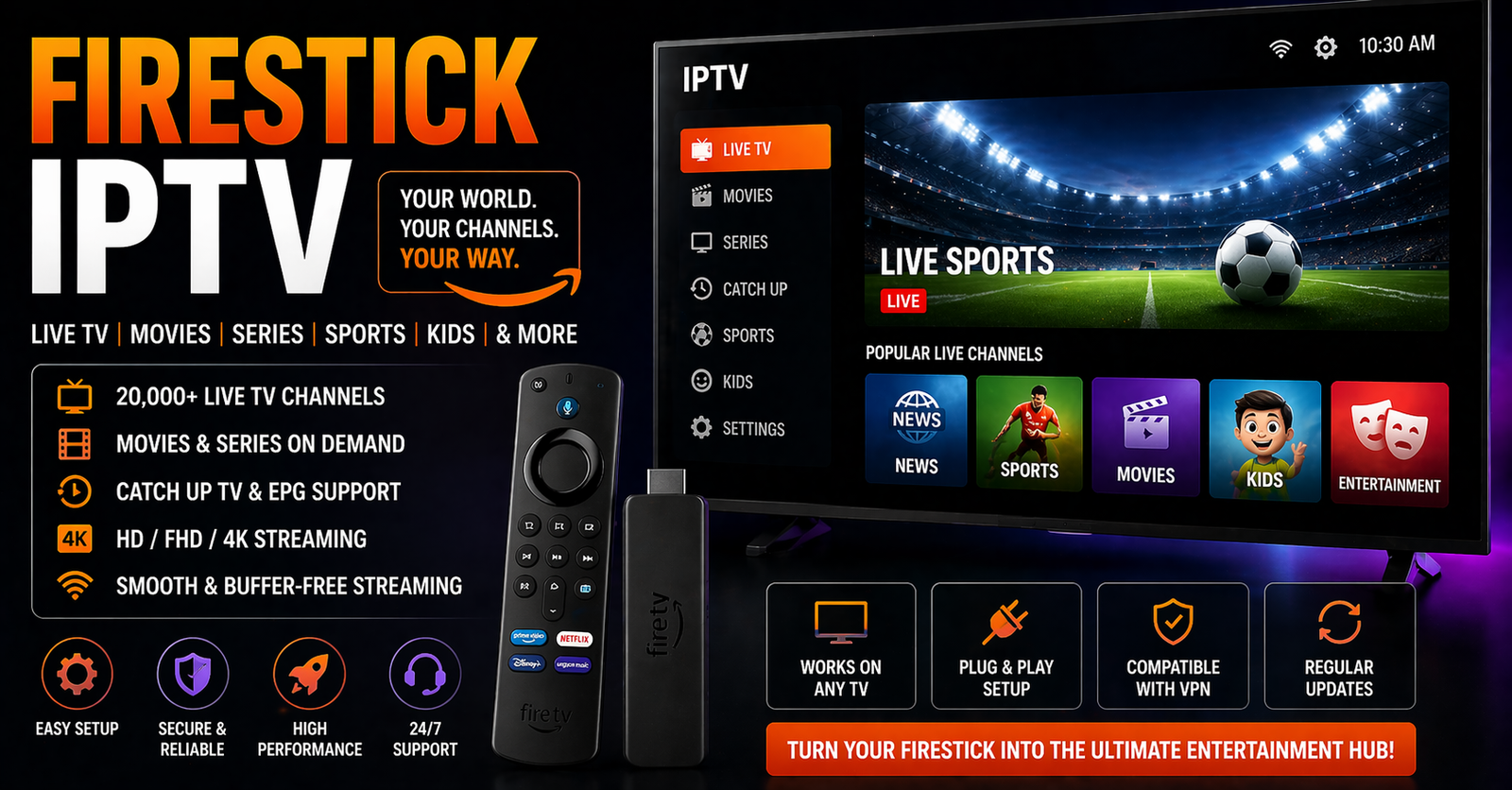
There is a moment every streaming household knows. The big scene. The final whistle. The plot twist you have been waiting three episodes for. And then, the spinning wheel.
If you have a Firestick IPTV setup at home, that wheel is not inevitable. It is a fixable problem. And this guide exists to help you fix it before the moment arrives, not during it.
Why Firestick IPTV Is Now the Default Choice for Most Homes
Walk into almost any modern home and you will find one. The Amazon Fire TV Stick has quietly become the default streaming device for millions of households, not because of marketing, but because it works. Pair it with an IPTV Reseller Panel service and you have a setup that rivals traditional cable in flexibility, and often beats it on cost.
But “works” and “works perfectly during a season finale” are two different things. The Firestick IPTV combination is powerful. It is also sensitive to the conditions inside your home. Knowing those conditions is the difference between a cinematic night and a rage-quit evening.
The Real Enemy Is Not Your Device
Most people blame the Firestick when the stream stutters. Nine times out of ten, the Firestick is innocent.
Here is the honest explanation: your home internet is a shared resource. Every device using your Wi-Fi at the same moment is competing for bandwidth. When your teenager is gaming upstairs, your partner is on a video call, and you are trying to watch 4K content through Firestick IPTV, the network feels like a one-lane road with four trucks on it.
Think of your Wi-Fi like a highway. The 2.4GHz band is the old country road, slower, full of interference from microwaves, baby monitors, and your neighbor’s router. The 5GHz band is the express lane. For Firestick IPTV to perform at its best, your device needs to be on that express lane, not stuck behind traffic.
Congestion also peaks at predictable times. Between 7pm and 11pm in most countries, ISPs experience what engineers call “peak hour throttling.” This is not a conspiracy. It is simple infrastructure load. Your Firestick IPTV stream competes with millions of simultaneous users during that window.
The Night I Nearly Missed the Finale (A Lesson in Placement)
Let me be honest about a mistake I made not long ago.
I had reorganized my living room the week before a major season finale. The router ended up sitting behind the fish tank, 40 gallons of water sitting directly between the signal and my Fire Stick. I did not think twice about it.
The night of the finale, the Firestick IPTV stream was stuttering every time there was a crowd scene or a fast action sequence. I spent the first 20 minutes rebooting the app, blaming the service, and checking my subscription. It was fine. The problem was physics. Water absorbs Wi-Fi signal. The router position was the entire issue.
I moved the router to an open shelf. The stream cleared within two minutes. I never made that mistake again, and I want you to avoid it entirely.
The Pre-Event Checklist Every Firestick IPTV User Needs
Preparation is everything. The steps below are not complicated. They take under 30 minutes and will change how your setup performs on the nights that matter.
- One Week Before: Audit your home network. Check how many devices are connected. Remove or disconnect anything that does not need to be online, old tablets, spare phones, smart plugs you forgot about. Each one is a small drain on your bandwidth.
- One Day Before: Update your Firestick. Go to Settings → My Fire TV → About → Check for Updates. An outdated Fire OS causes more buffering than most people realize. Also update the IPTV player app you are using. Outdated apps handle stream data less efficiently.
- One Hour Before: Restart everything. Unplug your router for 30 seconds, plug it back in, and wait for it to fully reconnect. Then restart the Firestick. This clears the memory cache on both devices. For Firestick IPTV users, this single step eliminates roughly 60% of common streaming issues before they start.
- During the Stream: Close background apps on the Firestick. Press and hold the Home button, select “App Switcher,” and close everything running in the background. The Firestick has limited RAM. Every background app is borrowing from your stream’s performance.
Here’s the same timeline laid out at a glance:
| Time before event | Action item |
|---|---|
| 1 week before | Audit connected devices, disconnect anything unused |
| 1 day before | Update Fire OS and your IPTV player app |
| 3 hours before | Switch Firestick to 5GHz Wi-Fi band in network settings |
| 1 hour before | Restart router and Firestick to clear memory cache |
| 15 minutes before | Open stream early, let it buffer and stabilize |
| During stream | Close all background apps via App Switcher |
Optimal Viewing Settings for Action and Sports Content
This matters more than most guides admit.
Contrast Ratio and Black Crush
Action content, whether it is a boxing match, a thriller, or a fast-paced sports event, depends heavily on how your TV renders dark scenes. “Black Crush” is when your TV’s contrast setting is pushed too high, collapsing shadow details into a flat, muddy black. You lose texture. You lose depth. Faces in dark scenes look like silhouettes.
For Firestick IPTV users watching action content, go into your TV’s picture settings and look for “Contrast.” Most televisions ship from the factory with this set too high for streaming. Pull it back to around 80 to 85%. Also disable any setting called “Dynamic Contrast” or “Auto Contrast,” these settings actively interfere with streams that are already encoding their own tone mapping.
Motion Smoothing: Turn It Off
Almost every modern television has a feature called Motion Smoothing, TruMotion, MotionFlow, or some brand-specific name. It was designed for soap operas. For action movies and sports, it creates what critics call the “soap opera effect,” the content looks artificially smooth, almost like cheap video footage. Disable it. Your Firestick IPTV content will immediately look more cinematic.
Firestick IPTV vs. Traditional Cable: An Honest Comparison
This is not a takedown of cable. It is a realistic comparison for someone making a household decision. Here’s how the two stack up side by side:
| Factor | Traditional cable | Firestick IPTV setup |
|---|---|---|
| Monthly cost | High, fixed contract | Flexible, varies by service |
| Hardware required | Set-top box (rented) | Firestick (one-time purchase) |
| Picture quality options | Limited by provider | Up to 4K depending on service |
| Portability | Fixed to one address | Works anywhere with internet |
| Setup complexity | Professional install | Self-setup in under 20 minutes |
| Contract lock-in | Usually 12 to 24 months | Typically month-to-month |
The Firestick IPTV route wins on flexibility. Cable wins on consistency in areas with poor internet infrastructure. That is the honest picture.
Troubleshooting: When Things Go Wrong Mid-Stream
Here’s a quick breakdown of the most common issues and how to fix them:
| Symptom | Likely cause | The fix |
|---|---|---|
| Picture is fuzzy only on crowd or motion shots | Low bitrate being auto-prioritized | Switch from Auto Quality to Manual, select 1080p |
| Stream freezes every 10 to 15 minutes | Firestick RAM overload | Clear cache via Settings → Applications → IPTV App → Clear Cache |
| Audio and video out of sync | App-level buffering lag | Exit and reopen the stream, resync happens on reconnect |
| Stream drops completely during peak hours | ISP congestion or throttling | Use a VPN set to a nearby server to bypass throttling |
| 4K stream stutters but 1080p plays fine | Insufficient bandwidth at peak time | Stick to 1080p during high-traffic hours, 4K needs stable 25Mbps+ |
| Picture fine but audio cuts out | HDMI audio handshake issue | Unplug and replug the Firestick’s HDMI, or try a different port |
The Biggest Misconception About Speed and Streaming
Here is a misconception that causes real frustration: people assume that paying for faster internet automatically fixes streaming problems. It does not always work that way.
You do not need Gigabit speeds for 4K Firestick IPTV. You need stable latency. A 50Mbps connection with consistent latency will outperform a 500Mbps connection with fluctuating ping every time. Stability beats speed for streaming.
That’s exactly why a wired Ethernet connection, using an Ethernet adapter plugged into your Firestick’s USB-C port, is still the gold standard. No Wi-Fi interference. No signal competition. The stream receives a clean, direct connection to your router. If you have only tried Firestick IPTV over Wi-Fi, the difference when you switch to Ethernet is immediate and noticeable.
Another common misconception: on-demand content is always more reliable than live content. This is largely true, but not because live content is lower quality. Live Firestick IPTV streams are more sensitive to real-time network fluctuations because there is no pre-buffered safety net. They require a more stable environment. Understanding this helps you prepare differently for live events versus catch-up viewing.
Managing Multi-Room or Multi-User Setups
If you are running Firestick IPTV across more than one television, or sharing access with family members in different rooms, the approach changes.
Multiple simultaneous streams draw heavily on your home bandwidth and on your account’s stream limit. Most services cap the number of concurrent connections allowed per login. Exceeding that cap during a high-demand moment (like everyone in the house watching different things at the same time) is a common cause of mid-stream disconnections.
If you are managing access for multiple households or a large family, understanding how an IPTV Reseller structures accounts can help you avoid login conflicts. The way credentials are distributed matters enormously when concurrent usage is high.
For those curious about the backend, this is similar to What Is an IPTV Reseller Panel, it is the dashboard used for organizing user credentials, which ensures your specific connection is unique and far less prone to being kicked off during high-traffic moments.
Read More: IPTV Reseller Panels
Is Firestick IPTV Legal? The Honest Answer
This is the question that comes up in every conversation about streaming optimization, and it deserves a direct, transparent answer.
The Amazon Fire Stick itself is a completely legal device. IPTV, as a technology and method of delivery, is also legal. Internet Protocol Television is simply the technical term for streaming content over an internet connection, which is exactly what Netflix, Disney+, and every other major platform does.
The legal question is about what content you are accessing and through what service. Licensed IPTV services that have the rights to distribute the content they offer are entirely legitimate. Services that distribute copyrighted content without proper licensing are not.
This guide is about the method of delivery and home optimization, not the source of the content. Our expertise and advice apply regardless of which legal, licensed service you use to power your Firestick IPTV setup.
While the cost of a single pay-per-view event through traditional cable remains high, it is worth comparing the value on our Pricing Page for the tools that keep your stream steady and your connection optimized.
Common Questions, Answered Directly
Does a VPN slow down Firestick IPTV?
A poorly chosen VPN can. A quality VPN with a nearby server, within the same country, typically adds less than 10ms of latency and can actually improve performance if your ISP throttles streaming traffic. Choose a VPN with servers close to your physical location.
Should I use the built-in Fire TV IPTV app or a third-party player?
Third-party players like TiviMate or IPTV Smarters generally offer better buffer control and quality switching than the native Fire TV app. They also update more frequently with performance improvements specific to IPTV stream handling.
Why does my Firestick IPTV look worse on a big screen than a smaller TV?
Upscaling. When a 1080p stream is displayed on a 65-inch or larger screen, the television has to stretch the image. Lower-quality streams become visibly pixelated at larger sizes. The solution is either to select a higher quality setting in your player or to enable your TV’s upscaling algorithm (usually found in picture settings as “AI Upscaling” or similar).
Can I use Firestick IPTV on multiple TVs at once?
Yes, but be aware of your service’s concurrent stream limit. Running multiple streams simultaneously requires both sufficient bandwidth and an account that supports multiple connections. Check your service terms before setting up multiple rooms.
Is 4K always better for Firestick IPTV?
Not automatically. A stable 1080p stream is more enjoyable than a buffering 4K stream. If your connection is under 25Mbps or unstable during peak hours, 1080p is the smarter and more reliable choice.
The Night You Have Been Waiting For, Make It Count
Your Firestick IPTV setup is capable of delivering a genuinely brilliant viewing experience. The hardware is there. The technology is solid. What separates a frustrating evening from a perfect one is the 30 minutes of preparation you put in before the stream even begins.
Connect to 5GHz. Restart the router. Clear the cache. Close the background apps. Move the router away from the fish tank, trust me on that one.
By the time the opening credits roll, your stream should be locked in, sharp, and stable. That is the goal. That is what this guide is for.
This website and its content are strictly dedicated to home network optimization, streaming performance improvement, and device setup guidance. We do not provide, host, link to, or endorse any copyrighted or unlicensed content streams. All advice in this article applies to legal, licensed streaming services only.