Book Appointment Now
Telegram IPTV 2026: Underground Market Explained
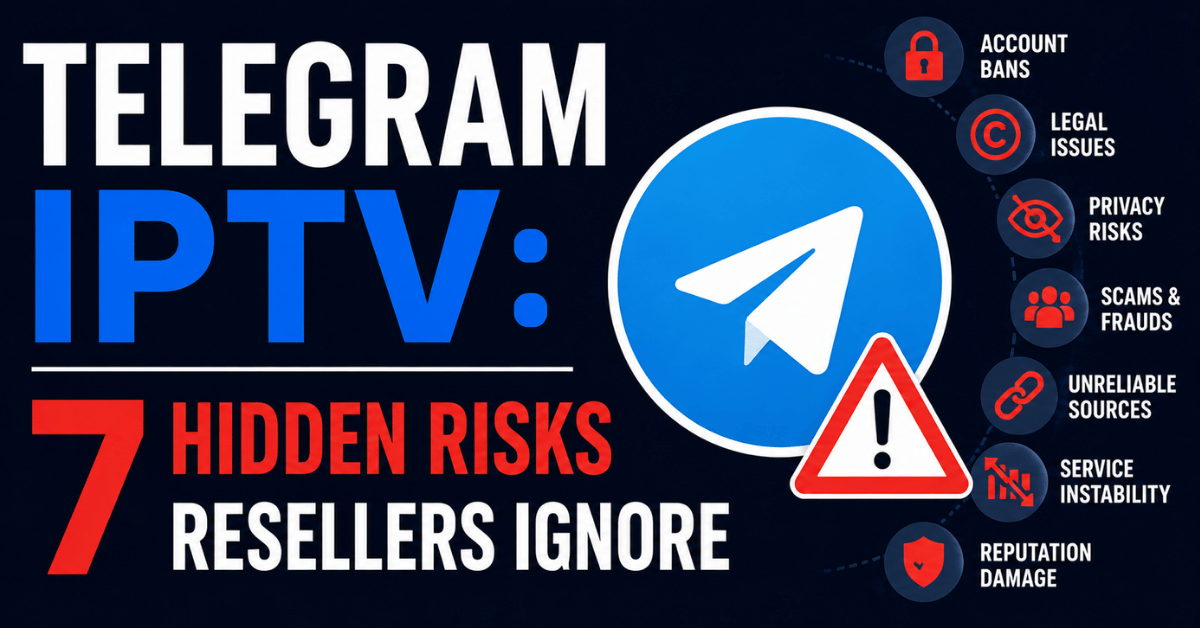
A reseller messaged me last week. He’d lost 142 active subscribers in three days. The reason? His “supplier,” a Telegram IPTV vendor with 18,000 channel group members, vanished after a single takedown wave. No refund, no warning, no backup. Just a deleted account and a frozen panel link.
This is the world of Telegram IPTV. And if you’re buying, selling, or relying on it, you need to understand what’s actually happening behind those glossy channel previews.
The platform has become the unofficial bazaar of the streaming underground. Sellers love it because it’s frictionless. Buyers love it because it feels personal. But that same frictionless nature is exactly what destroys businesses overnight. There are no escrow systems, no enforceable contracts, no infrastructure guarantees, only a chat window and a payment screenshot.
I’ve spent years watching this ecosystem evolve. From the early 2018 days when Telegram IPTV groups had maybe 2,000 members, to today’s mega-channels pushing tens of thousands of subscribers through unverified panel pipelines. The pattern is always the same: explosive growth, sudden silence, repeat.
Pro Tip: Before you ever wire money to a Telegram IPTV seller, screenshot every promise they make in writing. When the account disappears, that screenshot is the only leverage you’ll ever have, and even then, recovery rates sit below 4% based on what I’ve tracked across UK IPTV reseller communities.
If you treat Telegram IPTV as a marketplace, you’ll lose. If you treat it as a recruiting ground where you must verify everything externally, you might survive.
How Telegram IPTV Actually Became the Default Marketplace
The shift didn’t happen by accident. Around 2020, mainstream payment processors began aggressively flagging IPTV-related transactions. PayPal closures hit thousands of operators. Stripe started auto-rejecting any merchant code remotely linked to streaming infrastructure. Sellers needed a new neutral ground that couldn’t be deplatformed by a single corporate decision.
Telegram IPTV groups filled that vacuum almost instantly. The app’s end-to-end encryption, anonymous account creation, and large group capacity made it ideal. You could spin up a sales channel in 90 seconds, push promotional content to 50,000 people, and accept crypto payments without ever building a website.
But here’s what most newcomers miss: Telegram IPTV is not a marketplace. It’s a discovery layer. The actual infrastructure sits somewhere else entirely, a server in Eastern Europe, a panel hosted in Moldova, an Xtream Codes clone running on an unprotected VPS. Telegram is just the storefront window. When the storefront closes, the warehouse behind it usually closes too.
This decoupling between sales channel and infrastructure is the single most dangerous feature of the Telegram IPTV economy. A seller can disappear without ever losing their actual server, they just abandon the buyer relationship and rebuild under a new handle next week.
The Quiet Mechanics Behind the Volume
Most Telegram IPTV operations follow a predictable lifecycle. A vendor opens a channel, posts daily channel lists, runs flash sales every 72 hours, and pumps fake testimonials from sock-puppet accounts. Volume builds. Buyers feel social proof. Then a takedown notice hits the upstream provider, and the entire downstream collapses simultaneously.
Why Telegram IPTV Pricing Looks Suspiciously Low
Walk into any active Telegram IPTV group and you’ll see annual subscriptions advertised at prices that make zero economic sense. £15 for 12 months with 22,000 channels. £8 for six months with full VOD. These numbers don’t reflect honest pricing, they reflect unsustainable acquisition tactics.
Real infrastructure costs money. Bandwidth alone for a properly load-balanced panel runs into thousands per month. Add transcoding servers, backup uplink servers, content acquisition, panel licensing, and technical staff, and you’re looking at operational costs that simply cannot be covered by £15 subscriptions unless the seller plans to disappear before the year is up.
| Infrastructure reality check | Cheap Telegram seller | Stable panel operator |
|---|---|---|
| Annual price point | £8-£20 | £45-£90 |
| Backup uplink servers | None | 2-4 redundant nodes |
| HLS latency average | 18-40 seconds | 4-8 seconds |
| DNS poisoning protection | Absent | Active anycast routing |
| Support response window | 12 hours to never | Under 45 minutes |
| Refund policy enforcement | Theoretical | Contractual |
| Average operational lifespan | 4-11 months | 3+ years |
The math is brutal. When a Telegram IPTV vendor undercuts the market by 70%, they’re either operating at a loss until they can exit-scam, or they’re stealing streams from another panel and reselling without authorization. Both scenarios end the same way for the buyer.
Pro Tip: Calculate the breakeven point. If a seller offers 20,000 channels at £10 per year and claims 5,000 customers, that’s £50,000 annual revenue against what should be £200,000+ in infrastructure spend. Math doesn’t lie, exits do.
I’ve seen resellers chase these prices, build entire customer bases on top of them, and then collapse within 90 days when the upstream evaporates. The cheaper the Telegram IPTV offer, the shorter the runway.
Why Verifying a Telegram Seller Is Nearly Impossible
Here’s a question almost no buyer asks before sending payment: how do you verify that a Telegram IPTV seller actually owns the infrastructure they’re claiming to operate? You can’t. There’s no business registration to check, no domain ownership history to pull, no Companies House record, no tax ID, no anything.
Vendors exploit this gap relentlessly. A common tactic is to screenshot another panel’s dashboard and claim it as their own. Buyers see what looks like real infrastructure, real customer numbers, real uptime stats. None of it has to be true. The screenshot proves nothing except that the seller knows how to use a snipping tool.
Signals that actually mean something: a registered company name searchable in a public registry, even if the company is offshore. A working website with at least 18 months of archived history visible on the Wayback Machine. Public technical documentation explaining their panel architecture, not just marketing copy. A verifiable physical address, even a virtual office, that ties back to filed paperwork. Direct access to a panel demo without requiring upfront payment. Active and responsive support channels outside Telegram (email, ticket system, Discord).
If a Telegram IPTV operator can’t provide at least four of these six signals, you’re not dealing with a business. You’re dealing with a transient.
The verification problem becomes existential when you scale. A reseller with 50 customers can absorb one bad supplier and rebuild. A UK IPTV reseller with 500 customers loses their entire revenue stream and reputation in a single takedown. The bigger you grow on top of unverified Telegram IPTV infrastructure, the harder the eventual fall.
The New AI-Driven ISP Detection Wave
Something fundamental shifted in 2025 that most Telegram IPTV sellers haven’t adapted to yet. Major ISPs across the UK, Italy, Spain, and parts of North America deployed machine-learning systems that fingerprint streaming traffic based on packet timing, payload entropy, and connection persistence patterns. Traditional IP blocklists are now supplementary, the primary detection layer is behavioural.
This matters because the cheap Telegram IPTV vendors operating on single-server setups have no defence against this. Their entire customer base can be detected and throttled inside a single ISP’s network within hours of detection model updates. You don’t get a warning. Streams just start failing, buffering ramps up, and customers blame the reseller.
Pro Tip: Ask any potential supplier directly, “What’s your strategy for behavioural fingerprint detection on residential ISPs?” If they respond with confusion, blame the customer’s router, or pivot to talking about VPNs, walk away. A real operator will explain their traffic obfuscation layer, their HLS chunk randomization approach, or their multi-CDN failover. No real answer means no real protection.
The honest reality is that surviving in 2026 requires backup uplink servers across geographically diverse data centres, active load balancing that can shift customer traffic within seconds, and DNS infrastructure that isn’t dependent on a single resolver. Telegram IPTV vendors selling for £10 per year are not running any of this. They can’t. The economics don’t permit it.
Reseller Survival Tactics in a Telegram-First Ecosystem
If you’re building a reseller business and Telegram IPTV is part of your sourcing pipeline, you need a different operating model than the one most new resellers adopt. The default approach, buy cheap credits from a Telegram seller, resell to customers, pocket the margin, is exactly what gets people wiped out.
A more durable approach treats Telegram IPTV as one input among many, never the sole source of supply. Your panel relationship should sit with a verifiable operator. Your Telegram presence should be marketing-only, not infrastructure-dependent. And your customer relationships should live on platforms you control, a Shopify storefront, a WordPress site, an email list, so that if Telegram itself ever cracks down on streaming-related channels, your business doesn’t evaporate with it.
The three-layer reseller defence looks like this: a primary supplier layer, a verified panel operator with company registration, multi-year history, and contractual obligations. A backup supplier layer, a secondary panel relationship pre-negotiated and stress-tested, even if it costs slightly more per credit. And a customer ownership layer, your own domain, your own email list, your own billing system, completely independent of Telegram.
Resellers who run this three-layer model survive panel outages, supplier disappearances, and Telegram crackdowns without losing their customer base. Resellers who skip it learn the hard way that Telegram IPTV is a sales channel, not a foundation.
Panel Credit Economics Most Resellers Miscalculate
Credit pricing on the Telegram IPTV underground often appears to favour the reseller, until you do the actual math. A seller offers credits at £0.85 each, you resell subscriptions at £18, you assume £17 margin. Beautiful. Except you haven’t factored churn, refund pressure, support time, infrastructure outages, replacement subscriptions, and the inevitable supplier collapse.
Real reseller margins on Telegram IPTV-sourced credits, after accounting for the full operational reality, sit closer to 35-45% of headline revenue rather than the 90%+ that surface math suggests. That gap is where most new resellers go broke without understanding why.
| Cost reality | Headline assumption | Operational reality |
|---|---|---|
| Credit cost per sub | £0.85 | £0.85 |
| Replacement subs (churn) | 0% | 22-34% |
| Support time per customer | 0 minutes | 11-18 minutes monthly |
| Refund pressure | None | 6-9% of revenue |
| Supplier collapse cost | Zero | Full subscription replacement |
| True margin | 95% | 38% |
Pro Tip: Track your refund and replacement rate weekly, not monthly. If you’re absorbing more than 8% of revenue in customer compensation, your supplier is leaking infrastructure quality and you need to begin transitioning before the collapse hits your reputation.
Why Customers Actually Churn in This Market
Subscribers churn for predictable reasons in this market, and almost none of them have to do with content libraries. They churn because buffering hit during a major sports event. They churn because EPG data went stale for three days. They churn because the app stopped opening after a forced update and nobody answered the support ticket.
What this means for resellers sourcing from Telegram IPTV vendors is that your retention is entirely dependent on your supplier’s infrastructure discipline, not your own customer service. You can be the most responsive reseller in the world, but if the upstream panel buffers during a match, your customer blames you and leaves.
The successful operators I’ve watched over the years all share one trait: they invested in supplier quality far earlier than felt financially comfortable. They paid £45 per year for credits when the Telegram IPTV market was offering equivalent volume at £18 per year. They sacrificed margin for stability. And five years later, they still have customers while the cheap-source resellers cycled through three businesses each.
Frequently Asked Questions
Is Telegram IPTV legal to use?
Telegram IPTV operates in a grey zone that varies by jurisdiction. The app itself is legal, but redistributing copyrighted broadcast content through these channels typically violates licensing laws in most countries. Buyers and resellers can face civil action, account terminations, and in stricter regions like Italy and the UK, criminal investigation. Always consult local legal guidance before engaging commercially with any unlicensed streaming distribution.
How can I tell if a Telegram IPTV seller is about to exit-scam?
Watch for behavioural shifts: sudden flash sales offering lifetime subscriptions at extreme discounts, increased ghosting on support queries, refusal to provide trials before payment, and pressure to pay in cryptocurrency only. Exit-scams usually follow a three to five day pattern of accelerated promotional activity before silence. Vendors building long-term reputations don’t behave this way.
What makes Telegram IPTV different from a normal panel reseller relationship?
A traditional panel reseller relationship involves verifiable infrastructure, a contractual credit system, and direct access to a dashboard with audit logs. Telegram IPTV transactions usually skip all of this, no panel access, no contract, no dashboard. You’re paying for promises in a chat window with no recourse if those promises evaporate, which fundamentally changes your risk profile as an operator.
Can I run a serious reseller business sourcing entirely from Telegram IPTV?
No durable business can be built on a single unverified Telegram IPTV supplier. The infrastructure underneath is too unstable, the supplier turnover is too high, and the regulatory pressure on the platform itself is increasing. Resellers who treat Telegram as a discovery layer while maintaining real panel relationships elsewhere can succeed, those who source exclusively from chat-based vendors statistically don’t survive past their second year.
Why does Telegram IPTV pricing collapse so often?
Aggressive undercutting is a customer acquisition tactic, not a sustainable model. Sellers offering subscriptions at 70% below market rate are either subsidising losses to build subscriber lists for future exits, or stealing streams from legitimate panels and reselling without infrastructure costs. Both scenarios produce inevitable price corrections, usually in the form of the seller disappearing rather than the prices rising.
How do AI-driven ISP blocks affect Telegram IPTV subscribers more than panel subscribers?
Smaller Telegram IPTV operations rarely invest in traffic obfuscation, HLS latency optimisation, or behavioural fingerprint defence. When ISPs deploy machine-learning detection updates, single-server setups get fingerprinted within hours and all downstream customers experience simultaneous degradation. Larger panel operators with backup uplink servers and multi-region routing can shift traffic dynamically, insulating their subscribers from these enforcement waves.
What should a household buyer ask before paying a Telegram IPTV seller?
Ask for a 24-hour trial first. Ask whether their service has working EPG data, what their refund policy actually is in writing, and how they handle service outages during major sports events. If the seller refuses any of these, that’s diagnostic. A vendor confident in their infrastructure has nothing to hide; one who deflects is usually selling something they don’t control.
Is it safer to buy Telegram IPTV with cryptocurrency or traditional payments?
Neither is inherently safer, the payment method doesn’t change the underlying infrastructure risk. Cryptocurrency offers no recourse if the seller vanishes. Traditional payments through processors that don’t recognise the transaction category can result in your own account being flagged. The real safety question isn’t payment method, it’s supplier verification before any payment moves.
Reseller Success Checklist
Before engaging with any Telegram IPTV supplier or transitioning your sourcing strategy, work through these execution-focused steps.
- Verify the operator’s company registration in a public business registry before any payment moves, no registration, no purchase.
- Pull the Wayback Machine archive of any associated website and confirm at least 18 months of consistent history before treating the supplier as established.
- Demand a working trial credit loaded into a real panel dashboard before committing to a credit pack, never pay upfront for promises.
- Document every support response time during your trial period, under 45 minutes signals serious operations, anything over 6 hours signals collapse risk.
- Stress-test backup infrastructure by asking the supplier to walk you through their failover process during a major sports broadcast window.
- Build a parallel supplier relationship with a verified UK IPTV reseller panel operator like britishseller.co.uk as your stability anchor, never rely on a single Telegram-only source.
- Migrate customer billing off Telegram entirely, your customer list, payment records, and renewal cycle must live on a platform you control.
- Track refund and replacement percentage weekly, if it climbs past 8% of revenue, begin transitioning suppliers before customer reputation damage compounds. Audit DNS and HLS performance monthly using third-party tools so you’re aware of degradation before your customers report it.
- Establish a clean exit plan for every supplier relationship, know in advance how you’d migrate 100% of customers within 72 hours if a supplier disappeared overnight.
Resellers who execute this checklist consistently outlast the Telegram IPTV churn cycle. Those who skip it become part of the statistics they should have been studying.