
Book Appointment Now
IPTV Reseller Cash Flow Guide 2026: Maximize Profit
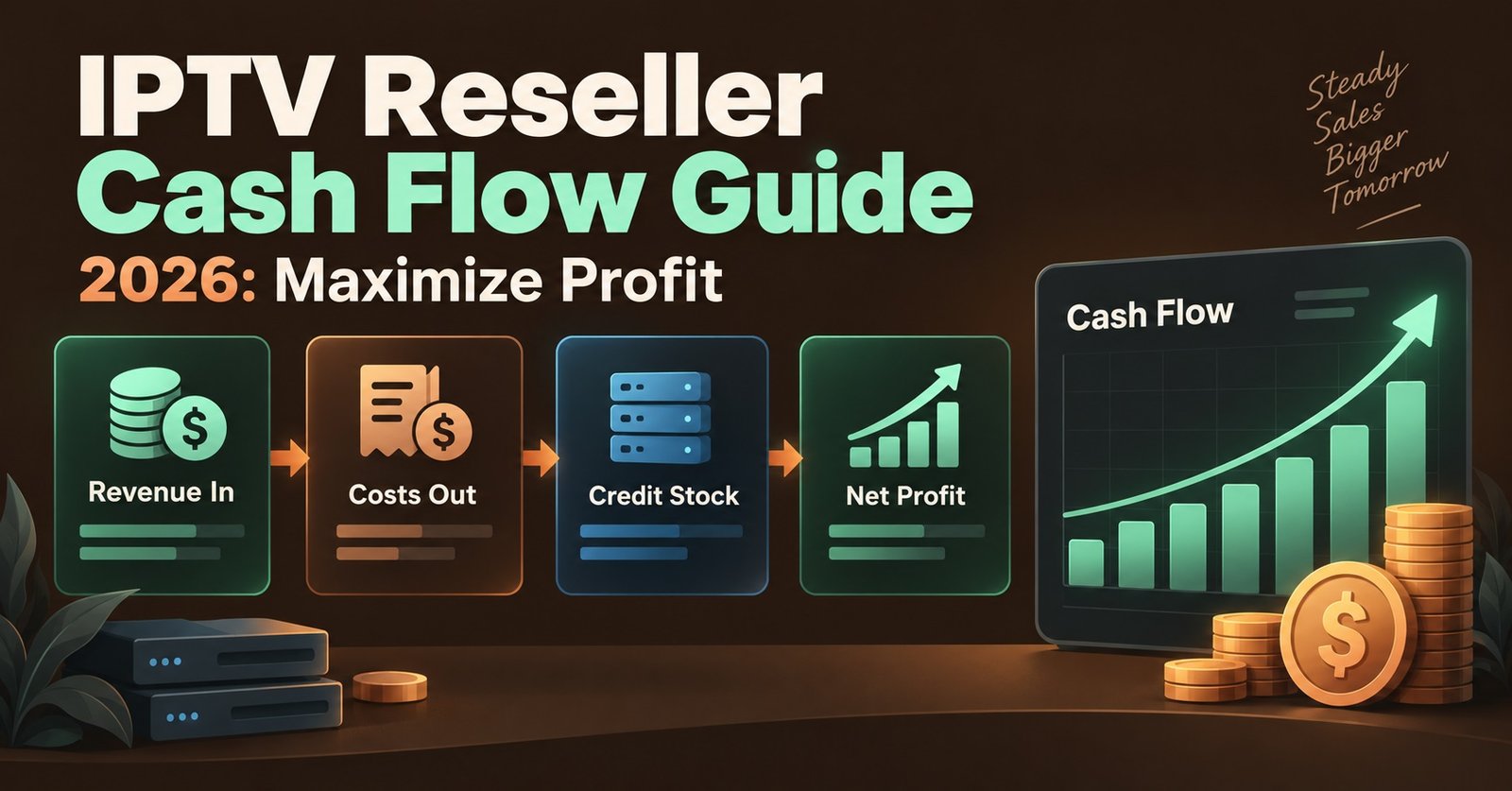
An IPTV reseller cash flow guide really has one job: explaining why the money you spend on credits disappears from your account weeks before the money from renewals comes back to replace it. Credits are bought upfront, in bulk, from your upstream provider. Subscribers pay you in smaller amounts, on staggered dates, often after their service has already started. That timing gap is the entire problem, and almost nobody explains it clearly before a reseller has already spent their first batch of credits and started wondering where the profit went.
How the Money Actually Moves Through a Reseller Panel
Most people who start reselling think about margin first and cash timing never. You buy 50 credits, each one becomes a month of service for a customer, and the difference between what you paid per credit and what you charge per subscriber is your profit. On paper that’s straightforward. In practice, the credits leave your bank account the moment you top up, while the customer’s payment for that same credit might not land for another two or three weeks, sometimes longer if you’re invoicing rather than taking payment upfront.
This isn’t a flaw in any particular panel. It’s how credit-based IPTV Panel reseller systems are built everywhere. The provider needs payment before allocating capacity, because credits represent server load and licensing cost on their side, not just a number on a dashboard. You’re effectively financing your customers’ subscriptions for the gap between your outlay and their payment, and that gap widens the moment you start offering flexible payment dates, family discounts, or “pay when you can” arrangements to keep customers happy.

The Renewal Timing Problem Nobody Budgets For
Renewals are where cash flow actually breaks, not initial sign-ups. A new customer usually pays before you activate them, so that transaction is clean. A renewal is different. The subscriber’s service is often still running when their month ends, because disconnecting someone the second their credit expires is a fast way to lose them to a competitor. So resellers extend a grace period, sometimes without meaning to, just by not being strict about cutoffs.
That grace period costs you a credit you’ve already paid for, against a payment you haven’t received yet. Multiply that across forty or fifty subscribers and you can end up carrying a meaningful float of unpaid, already-delivered service at any given point in the month. It rarely shows up as a single dramatic loss. It shows up as a reseller who keeps needing to top up credits sooner than the maths suggests they should, because a chunk of last month’s inventory is still tied up waiting on payment.
| Cash flow risk | What actually causes it |
|---|---|
| Credit float | Renewals paid late while service continues uninterrupted |
| Margin erosion | Support time and refunds eating into per-credit profit |
| Panel dependency | Upstream provider outage or price change with no notice |
| Seasonal dip | Slower sign-ups in quieter months with fixed credit commitments |
Pro tip: Set a firm renewal cutoff, even if it’s generous, and stick to it consistently. A predictable rule is easier on cash flow than an inconsistent one, even a stricter one.
Where an IPTV Reseller Cash Flow Guide Actually Earns Its Keep
The real value of thinking about cash flow deliberately, rather than reacting to it, is that it changes how you buy credits and how you price subscriptions. Resellers who treat every top-up as a fresh, isolated purchase tend to buy reactively, right when they’re about to run out, often at whatever tier pricing happens to apply that week. UK IPTV Resellers who plan around their actual renewal calendar buy ahead of predictable demand and avoid the panic top-up that eats into margin because it wasn’t planned for.
This is also where panel credit packages built around reseller operations matter more than most people expect. A credit structure that matches how your customer base actually renews, rather than a generic bulk discount, keeps your working capital closer to what you’re actually using rather than sitting idle in unused credits.
Support Costs That Quietly Drain Margin
Cash flow problems aren’t only about timing. They’re also about how much of your margin gets consumed by things that never appear on an invoice. A subscriber whose guide data breaks, for example, doesn’t usually complain. They just quietly stop renewing, and that lost renewal is a cash flow hit you won’t see coming unless you’re already tracking churn by cause. Fixing an EPG mapping issue before it drives silent churn costs a few minutes. Losing the customer costs you every future renewal from them.
The same logic applies to the player software your subscribers use day to day. A player that handles authentication cleanly and doesn’t throw confusing errors generates fewer support tickets, and support time is not free even when nobody’s invoicing for it. It’s time you’re not spending on sales, and time is the one input that doesn’t scale the way credits do.
Choosing an Upstream Provider Without Wrecking Your Own Cash Position
Every reseller’s cash flow depends on someone else’s reliability, whether they think about it that way or not. If your upstream provider raises prices with no warning, or has an outage that triggers a wave of refund requests, that risk lands directly on your working capital, not theirs. Before committing serious credit volume to any single upstream source, it’s worth checking their registration status and infrastructure claims against verifiable evidence rather than taking pricing and uptime promises at face value.
Pro tip: Keep a small cash buffer separate from your credit top-up budget, sized to cover a week or two of refunds if your upstream provider has a bad outage. It’s the difference between a manageable setback and a genuine crisis.
Reseller Considerations Versus Sub-Reseller Considerations
If you’re operating as a straightforward reseller buying directly from a provider, your main exposure is the float between your credit spend and your subscriber payments. You control pricing, renewal policy, and how strict you are about cutoffs, so you have levers to pull.
If you’re a sub-reseller working under someone else’s parent account, your cash flow risk is layered differently. You’re often paying the parent reseller on their schedule, not the provider’s, and if they tighten terms or raise their internal pricing, you absorb that with less negotiating room than a direct IPTV Panel reseller has. Sub-resellers should be especially cautious about extending generous payment terms to their own customers, because they don’t have the same flexibility to absorb a gap further up the chain.
Pro tip: If you’re a sub-reseller, ask your parent account directly what happens to unused credits if you need to pause or reduce volume. Get the answer before you commit, not after.

Pricing Decisions That Protect Working Capital
Cheap pricing sounds like a growth strategy, but it’s often a cash flow trap in disguise. The thinner your margin per subscriber, the more renewals you need just to cover a single bad month of refunds or credit float, and the less room you have to absorb a support-heavy customer or two without the whole month feeling stretched. Pricing that leaves a genuine buffer per subscriber isn’t greedy, it’s what actually lets you survive a slow renewal cycle without needing to delay your own top-up.
Frequently Asked Questions
How many credits should a new reseller buy to start with?
There’s no universal number, because it depends entirely on how many customers you already have lined up. Buying far more than you can place ties up cash in unused credits, while buying too few forces frequent, smaller top-ups that can end up costing more per credit over time.
Should I offer discounts for annual renewals to smooth out cash flow?
It can help, since a bigger upfront payment reduces how often you’re chasing renewals, but only if your pricing still leaves enough margin per subscriber to cover the discount without pushing you into thin territory for the rest of the year.
What happens to unused credits if a customer cancels early?
This depends entirely on your upstream provider’s terms, and they vary. Some providers allow credits to be reassigned to another customer, others don’t, so it’s worth confirming this before you commit to a large batch.
Why does my credit balance drop faster than my subscriber count suggests it should?
This usually points to renewal float, where customers are still being served on credits that haven’t been paid for yet, or to churn you haven’t traced back to a specific cause like support issues or EPG problems.
Is it better to invoice customers or take payment upfront?
Payment upfront protects your cash flow far more reliably. Invoicing after the fact is convenient for customers but shifts the financing burden entirely onto you, since the credit is already spent before the payment arrives.
An IPTV reseller Panel cash flow guide only really matters once you’ve felt the gap it describes: credits paid for today, renewals landing whenever they land, and a margin that looks fine on a spreadsheet but feels tight in your actual bank account. The fix isn’t a single trick, it’s a handful of consistent habits: firm renewal cutoffs, pricing that leaves genuine buffer per subscriber, a provider you’ve actually checked rather than trusted on faith, and a small cash reserve for the weeks that don’t go to plan. None of that guarantees smooth sailing, but it does mean a slow renewal month becomes an inconvenience rather than a crisis.
Reseller Cash Flow Checklist
- Set a firm, consistent renewal cutoff and apply it the same way every month
- Track churn by cause, not just by total lost subscribers, so silent losses like EPG issues get caught
- Keep a small cash buffer separate from your credit top-up budget
- Confirm your upstream provider’s terms on unused or reassigned credits before buying in bulk
- Price with enough margin per subscriber to absorb at least one bad renewal cycle
- Review your provider’s registration and infrastructure claims before committing large credit volumes
- Avoid open-ended invoicing arrangements that shift financing risk onto you



[…] links through providers such as Stripe or SumUp look the most professional and convert well for IPTV resellers who already have some form of branded presence. They are also the most sensitive to how the […]