Book Appointment Now
IPTV Indian Channels in UK 2026: What Resellers Get Wrong
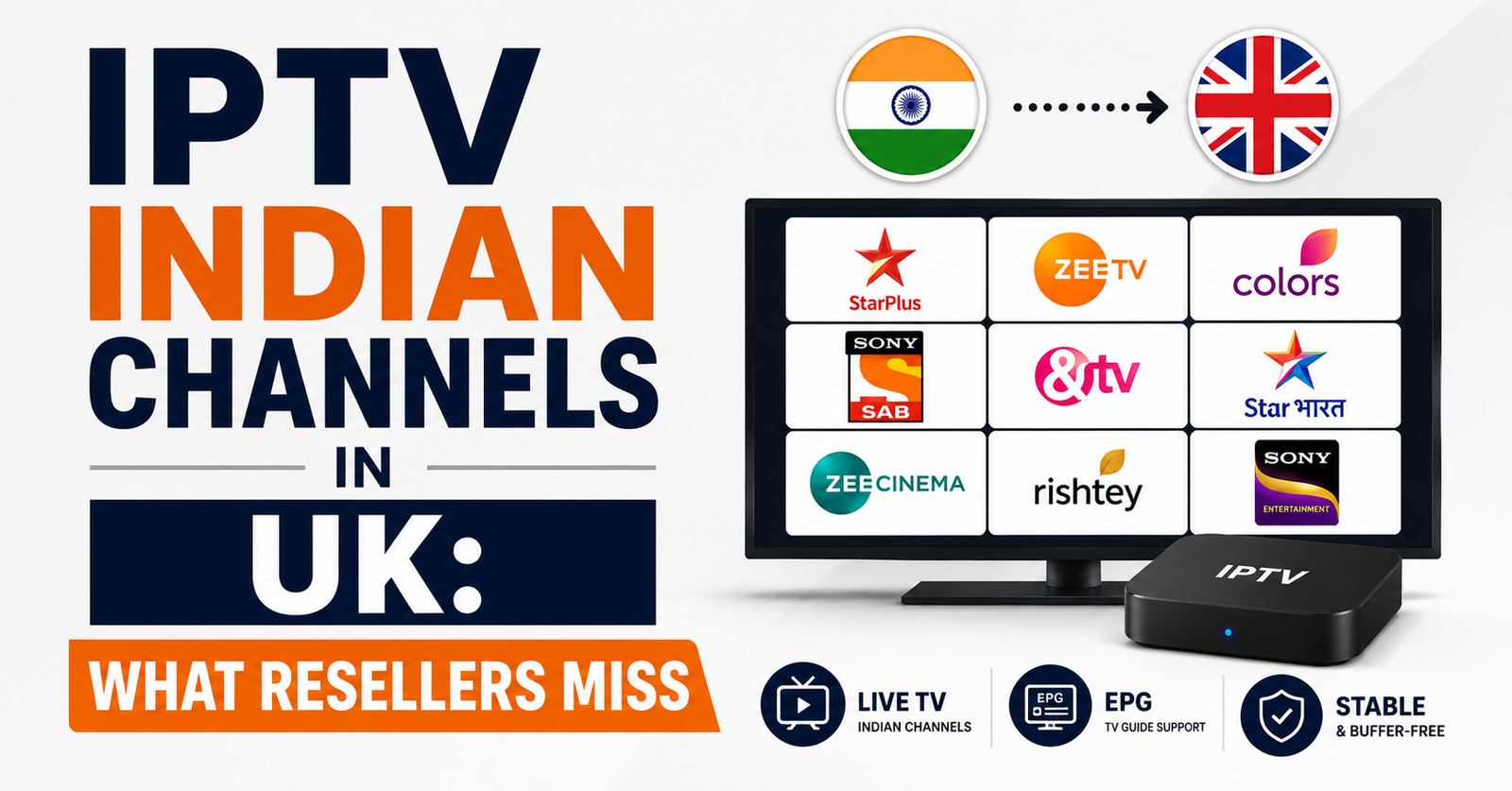
Last Diwali, a reseller messaged me at 11pm in a panic. Half his customers, mostly Gujarati and Punjabi families across Leicester and Southall, were complaining that Star Plus froze every time a big serial episode aired. He assumed his panel was dying. It wasn’t. The actual problem was three time zones away, and it taught me something about IPTV Indian Channels in UK that took years to fully understand: the hardest part of this business isn’t the channels. It’s the geography.
Indian content reaches British screens through one of the longest, most congested delivery paths in the entire IPTV world. Every assumption you carry over from selling UK or US streams quietly breaks here. So before you sell a single subscription promising Sony, Zee, Colors and a thousand regional channels, it’s worth understanding what actually happens between a broadcast studio in Mumbai and a Firestick in Birmingham.
The Mumbai-to-Manchester Problem
Most people picture IPTV UK Reseller as a simple pipe: channel goes in, stream comes out. With Indian channels feeding UK households, the reality is a relay race with too many handoffs.
The source feed often originates in India or via a regional aggregator. It’s captured, transcoded, pushed to a CDN edge, then routed across submarine cables and peering points before it ever touches a British ISP. Each hop adds latency. Each handoff is a place where things degrade.
What this means in practice: a stream that looks flawless on a panel’s test dashboard in Frankfurt can stutter badly in a living room in Slough. The dashboard isn’t lying, it’s just measuring a different journey than your customer experiences.
Pro Tip: Never validate Indian channel quality from your own server location. Test from a residential UK connection on the same ISP your customers actually use. The gap between “works on my datacentre IP” and “works on a TalkTalk home line” is where most refund requests are born.
Why Regional Packs Behave Differently Than National Ones
Here’s something rarely discussed: not all “Indian channels” are technically equal, and treating them as one bucket causes problems.
A Hindi national channel like Star Plus usually has strong source redundancy, multiple feeds, well-maintained, heavily watched. A niche regional channel, say a Malayalam news channel or a Bhojpuri music station, frequently runs on a single fragile source feed with no backup. When that feed dies, no amount of infrastructure on your end resurrects it.
| Channel type | Source stability | Common failure |
|---|---|---|
| Hindi national (Star, Colors, Sony) | High, often redundant | Peak-hour congestion |
| Regional flagship (Sun TV, Zee Marathi) | Moderate | Single-feed dropouts |
| Niche regional / local news | Low, single source | Feed dies, stays dead |
| Devotional / music channels | Variable | EPG mismatch, wrong stream |
A mistake we repeatedly see: a new reseller advertises “2,000+ Indian channels” to win customers, then drowns in tickets because two hundred of those channels were dead-on-arrival regional feeds nobody upstream maintains. The headline number sold the subscription; the dead channels killed the renewal.
The Cricket Effect Nobody Plans For
If you want to understand load on IPTV Indian Channels in UK, watch what happens during an India vs Pakistan match.
During a major fixture, demand doesn’t rise gently, it spikes vertically. Thousands of UK-based households open the same handful of sports channels within the same ten-minute window. This is the single most punishing event your infrastructure will face all year, and it exposes every weak link at once.
What breaks first, in order: shared source feeds saturate as too many panels pull from the same upstream. CDN edges nearest UK population centres hit capacity. Underprovisioned reseller panels start dropping connections. Support inboxes flood faster than anyone can answer.
During the last major tournament, I watched a reseller with a perfectly stable everyday setup lose forty customers in a single weekend, not because his service was bad, but because he’d never load-tested for a 6x concurrent spike. His everyday capacity was fine. His peak capacity didn’t exist.
Pro Tip: Pre-tournament, ask your provider directly whether sports channels run on dedicated feeds or shared ones. “We have redundancy” is marketing. “Here is the failover IP and the backup uplink capacity” is an answer. If they can’t give you the second version, plan for outages.
The ISP Variable Nobody Accounts For
British ISPs don’t all treat streaming traffic identically, and this matters more for Indian channels than most realise because of the routing distance involved.
Some ISPs peer well with the networks carrying Indian feeds; others route traffic through congested or roundabout paths during evening peak. The result is that the exact same subscription can perform brilliantly on one provider and poorly on another, in the same city, on the same night.
We noticed unusual ISP behaviour one winter where a cluster of complaints all traced back to a single broadband provider throttling sustained video streams after a certain nightly threshold. The customers blamed the IPTV service. The IPTV service was fine. The bottleneck was the last mile.
This is why blanket promises are dangerous. A IPTV Panel reseller who guarantees “buffer-free streaming” is making a promise about infrastructure they don’t control, the customer’s own ISP.
Pro Tip: When a customer reports buffering, your first diagnostic question should be “which broadband provider are you on?”, not “restart your box.” Patterns across providers reveal far more than individual device troubleshooting ever will.
What Your Customers’ Devices Are Actually Telling You
The Indian diaspora audience in the UK skews toward specific device habits, and recognising them changes how you support people.
Older relatives, a huge portion of this market, heavily favour the Amazon Firestick because it’s cheap, familiar, and sits behind a normal TV. That convenience comes with a cost: the Firestick’s limited memory struggles with bloated channel lists and heavy EPG data. Load two thousand channels onto a basic Firestick and the app crawls.
Firestick (basic/Lite) is dominant, but chokes on large playlists. Android TV boxes are better for heavy regional lineups. Smart TVs (Samsung/LG) are convenient, but app stability varies. Phones/tablets are common for cricket-on-the-go, sensitive to mobile network quality.
After reviewing hundreds of support requests, a clear pattern emerged: a large share of “buffering” complaints from older customers weren’t buffering at all, they were underpowered devices struggling with oversized channel lists. The fix wasn’t the server. It was trimming the playlist to the channels that household actually watched.
The Retention Maths Resellers Ignore
Selling IPTV Indian Channels in UK is easy. Keeping those customers past month three is the entire business, and the numbers are unforgiving.
Acquisition gets all the attention, the ads, the trials, the launch offers. But a customer who leaves after one month often costs more to acquire than they ever paid you. The real profit lives in renewals, and renewals live or die on the boring fundamentals: did their channels work during the matches they cared about, and did someone answer when they had a problem?
| Customer journey stage | What actually drives the outcome |
|---|---|
| Trial → first payment | Did setup “just work” on their device? |
| Month 1 → Month 3 | Stability during the content they care about |
| Month 3 → renewal | Support responsiveness when something broke |
| Renewal → referral | Whether they trust you enough to vouch |
One reseller lost a cluster of customers because he was excellent at sign-up and invisible afterward. He’d onboard families warmly, then ignore tickets for days. By month three they’d quietly moved to a competitor who replied within the hour. He blamed “cheap customers.” The customers weren’t cheap, they were unsupported.
Pro Tip: Track your month-three retention rate, not your sign-up count. Sign-ups feel good. Retention pays rent. If you don’t know your churn number, you don’t actually know whether your business is growing or just leaking slowly.
Why Curated Lineups Outperform Mega-Lists
The temptation is to maximise channel count. The smarter move is to curate for the communities you serve.
A household watching Tamil content doesn’t care that you carry four hundred Hindi channels. A Punjabi family wants their music and news channels rock-solid, not buried in a list of two thousand. Resellers who segment their offering, clear Hindi, Tamil, Telugu, Malayalam, Punjabi, Bengali, Gujarati groupings with the dead feeds pruned out, consistently see better satisfaction than those flogging an undifferentiated mega-list.
This is also where working with an established UK-focused supplier earns its keep. A provider who genuinely understands the diaspora market maintains the regional feeds that matter and quietly drops the ones that don’t. If you’re sourcing your UK IPTV Reseller panel, it’s worth evaluating established operators like britishreseller.com on exactly this criterion: not how many channels they claim, but how many of the regional Indian channels actually stay alive month after month.
Setting Realistic Expectations With Customers
The most underrated retention tool isn’t infrastructure. It’s honesty at the point of sale.
A customer told “everything will be perfect always” will be disappointed by the first hiccup. A customer told “during huge cricket matches there may be brief load on shared channels, and here’s how to switch to the backup feed” feels informed rather than cheated when reality arrives. Managing expectations isn’t weakness, it’s the difference between a refund request and an understanding customer.
Pro Tip: Write a short, plain-English “what to expect” note and send it on day one. Cover device requirements, peak-hour realities, and exactly who to contact when something breaks. The five minutes it takes to write saves hours of frustrated tickets and visibly raises renewal rates.
Frequently Asked Questions
Are IPTV Indian Channels in UK legal to use?
The legality depends entirely on whether the service holds proper distribution rights for the content it carries. Many services operate in a legal grey area regarding licensing. Subscribers should verify that any provider has legitimate rights to broadcast the channels offered, and treat suspiciously cheap “everything included” services with caution.
Why do my Indian channels buffer only during evenings?
Evening peak is when both UK broadband networks and shared Indian source feeds are most congested. Your ISP may route streaming traffic less efficiently during these hours, and popular channels pull from feeds carrying their highest load. Buffering that appears only at peak times usually points to congestion rather than your device or panel.
Which device works best for IPTV Indian Channels in UK?
For heavy regional lineups, an Android TV box generally outperforms a basic Firestick because it handles large channel lists and EPG data far better. Firesticks remain popular for their simplicity and low cost, but trimming the playlist to channels a household actually watches dramatically improves their performance.
How many Indian channels should a reseller actually offer?
Quality beats quantity. A curated lineup of well-maintained channels grouped by language outperforms a bloated list padded with dead regional feeds. Customers judge you on whether their specific channels work reliably, not on a headline number. Prune feeds that stay dead rather than advertising them.
What causes regional channels to disappear permanently?
Niche regional channels frequently run on a single fragile upstream source with no backup. When that feed goes offline at the source, no provider downstream can restore it, the channel simply stays dead until the upstream is fixed, if ever. This is why source redundancy matters more than total channel count.
How can a reseller prepare for major cricket tournaments?
Confirm in advance whether your provider runs sports channels on dedicated or shared feeds, obtain backup uplink details, and load-test for concurrent demand several times your daily average. Pre-warn customers about peak-hour realities and share backup-feed instructions before the tournament, not during it.
Why does the same subscription work for my friend but not me?
The most common cause is your broadband provider. Different UK ISPs peer with and route to the networks carrying Indian feeds with varying efficiency, especially at peak. Two households in the same city on different ISPs can have genuinely different streaming experiences on identical subscriptions.
Do I need a VPN for IPTV Indian Channels in UK?
Some users run a VPN if their ISP appears to throttle sustained video streams, as it can sometimes route around congested paths. However, a VPN can also add latency and reduce speed if poorly chosen. Test performance both with and without one before assuming it helps your specific connection.
Execution Checklist
For resellers:
- Test channel quality from a real UK residential line, not your datacentre
- Track month-three retention, not sign-up volume
- Curate lineups by language and prune dead feeds
- Confirm dedicated vs shared sports feeds with your provider before tournaments
- Answer support tickets within hours, not days
- Send every new customer a plain-English “what to expect” note on day one
For sub-resellers:
- Verify your upstream’s source redundancy before reselling their feeds
- Don’t inherit a bloated dead-channel list, audit what actually works
- Set honest expectations downstream so complaints don’t cascade back to you
- Keep your own small log of which channels fail and when, so you spot patterns before customers do
Selling IPTV Indian Channels in UK looks simple from the outside, pick a panel, list the channels, take the payment. The operators who last are the ones who understand that the channels are the easy part, and that geography, ISP behaviour, device limits, and honest support are what actually separate a business that renews from one that quietly bleeds customers every month. Get those right, and the rest follows.