Book Appointment Now
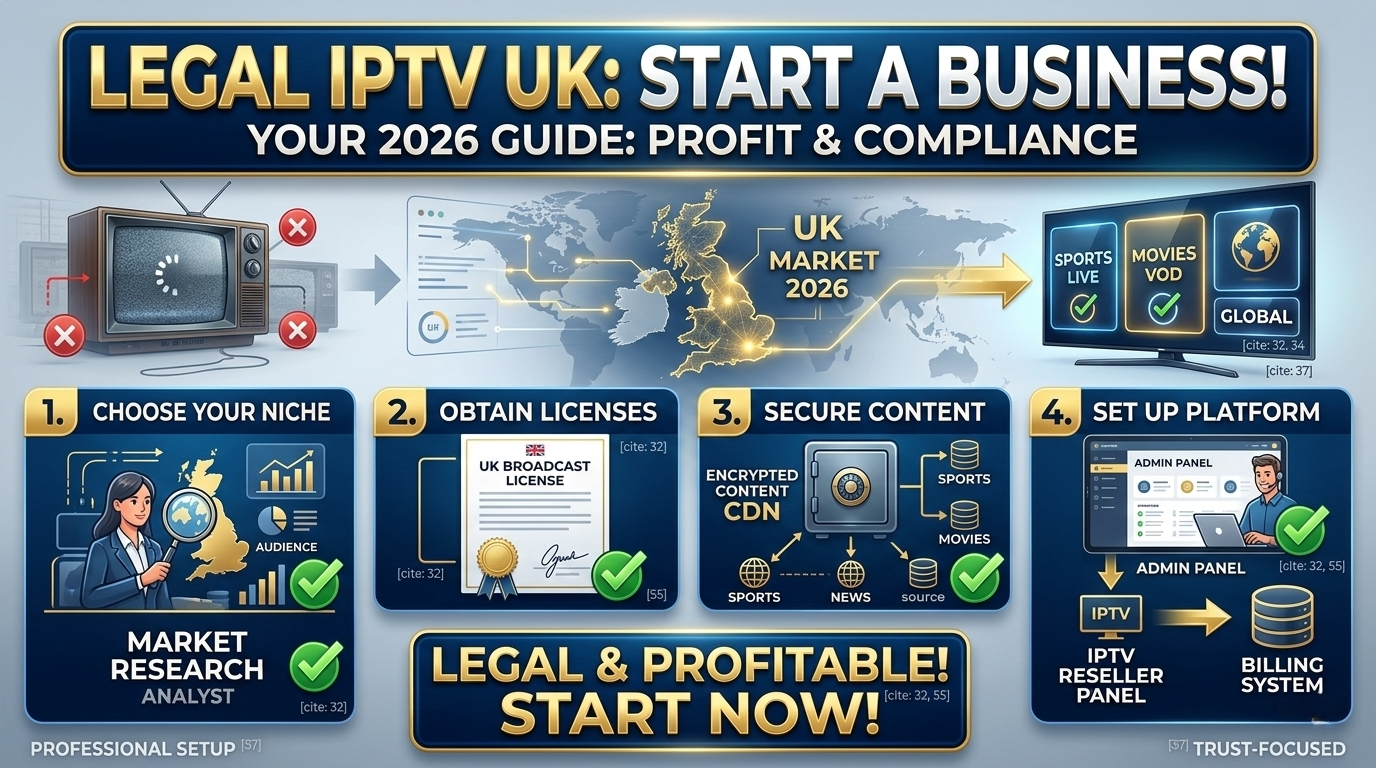
How to Start a Legal IPTV Reseller Business in the UK: 2026 Guide
Starting a legal IPTV reseller business in the UK requires more than choosing a provider and signing up subscribers. It requires understanding the legal framework, selecting the right infrastructure, registering your business correctly, and managing your operation in a way that protects both you and your customers.
This guide covers each of those areas in plain language. Whether you’re exploring this as a full-time business or a structured side income, the steps and principles here give you a clear, honest foundation to build from — without the vague optimism that makes most guides useless once you’re actually trying to do the work.
Before going further, it’s useful to understand What Is an IPTV Reseller Panel — the management tool that sits at the centre of most reseller operations and handles the core functions of subscriber management, plan creation, and account delivery.
What Running a Legal IPTV Reseller Business Actually Means
This is the question most guides skip over. The word legal matters considerably in this industry, and it’s important to understand precisely what it means before building anything around it.
IPTV technology itself is entirely legal. It’s simply a method of delivering video content over an internet connection. Major broadcasters, pay-TV platforms, and streaming services around the world use it. What determines legality in this industry isn’t the delivery technology — it’s the content being delivered and whether the appropriate rights to distribute that content have been secured.
A legal IPTV reseller business, in the context of this guide, refers to operating a management and delivery infrastructure business — using reseller panel software to manage subscribers, configure plan tiers, and facilitate service delivery. The content rights and licensing obligations sit with the content providers at the top of the supply chain. Your role as a reseller is the business management layer.
This is a critical distinction. Operators must always verify that any content accessible through their service is properly licensed for distribution in the UK. If you are uncertain whether a provider or content source meets this requirement, consult a qualified legal professional before proceeding.
Why This Legal Distinction Matters More in 2026
UK enforcement of broadcast copyright has intensified in recent years. Ofcom and the courts have taken action against operators distributing unlicensed content under the guise of IPTV services. Any business built on unlicensed content faces serious legal risk — financial penalties and criminal liability, not just warnings.
Building your operation on a clear, compliant foundation from the start isn’t just an ethical position. It’s a practical protection for your business, your income, and your reputation.
How the Legal IPTV Reseller Business Model Works in Practice
A reseller operates between a panel infrastructure provider and end subscribers. You don’t build or manage servers. You don’t handle stream encoding or delivery technology. Your role is the business management layer: acquiring subscribers, configuring their accounts, setting pricing, collecting payments, and providing support.
Here’s the basic flow. You purchase access credits or connection licences from a panel provider at a wholesale price. You configure your reseller panel with your own branding, plan names, and pricing. Subscribers sign up through you and access the service using a compatible app on their device. You collect a monthly subscription payment. The difference between your wholesale cost and your retail price is your gross margin.
What a Reseller Panel Gives You in a Legal IPTV Operation
A reseller panel is the management interface that makes all of this operational. It lets you create subscriber accounts in the Add User section, set access periods, configure plan tiers in the Plans section, manage renewals through the User Management view, and monitor usage through the stream monitoring dashboard.
Without a panel, managing even a small subscriber base becomes unworkable. Good panels also give you control over your own branding, so subscribers interact with your business identity rather than your provider’s. That matters for building subscriber loyalty over time.
The first time I navigated a reseller panel, it took about two full sessions before I felt genuinely comfortable with where everything was. The Add User flow is straightforward. The credit management section took slightly longer to understand — specifically how credit consumption maps to different plan durations. Once that clicked, the rest of the panel made sense quickly.
Setting Up Your Legal IPTV Reseller Business in the UK
Running a reseller operation without formalising your business structure is a risk that compounds as revenue grows. Here’s what most UK operators need to address before accepting their first subscriber payment.
Business Registration for a UK IPTV Reseller
Most new reseller operators in the UK register either as a sole trader or a private limited company. Sole trader registration is simpler and done directly through HMRC — it costs nothing and takes about 15 minutes online. A limited company structure offers personal liability protection but requires Companies House registration and annual accounts filing.
Which structure fits you depends on your expected revenue, your appetite for administrative overhead, and whether you want personal asset protection. Both are valid starting points. Many operators start as sole traders and transition to a limited company as the business grows and the tax efficiency of the corporate structure becomes relevant.
Tax and National Insurance for UK IPTV Resellers
Any income earned through a reseller business is taxable under UK income tax rules. As a sole trader, you file a self-assessment tax return each year declaring income and expenses. If operating through a limited company, corporate tax obligations apply instead.
If your annual turnover exceeds the VAT registration threshold — verify the current figure directly with HMRC, as it’s subject to change — you’ll also need to register for VAT and charge it on your services accordingly. Most new operators don’t hit this threshold immediately, but it’s worth monitoring from month one rather than discovering it retrospectively.
Banking and Payments for a Legal IPTV Reseller Operation
A dedicated business bank account, separate from your personal finances, is strongly recommended from the start. It simplifies bookkeeping, makes tax filing significantly cleaner, and projects professionalism to any business contacts. Several UK banks offer free or low-cost business accounts for sole traders and limited companies.
Your Ten-Step Launch Plan for a Legal IPTV Reseller Business
The table below maps the complete process from initial research to a running, scalable operation. Work through each stage in sequence before moving to the next.
| Step | Task | What to Do | Result |
|---|---|---|---|
| 1 | Understand the legal landscape | Research UK copyright law and licensing obligations before anything else | Informed starting point |
| 2 | Register your business | Register as a sole trader or limited company with HMRC | Legal business entity |
| 3 | Choose a reseller panel provider | Compare providers on uptime, support, pricing, and terms of service | Reliable infrastructure partner |
| 4 | Set up your panel | Configure branding, plan tiers, and subscriber account management | Operational management system |
| 5 | Define pricing and plan tiers | Set retail prices that cover costs and deliver a sustainable margin | Ready-to-sell subscription plans |
| 6 | Build a payment collection system | Integrate a recurring payment method or invoice process | Ability to collect monthly revenue |
| 7 | Draft basic terms of service | Write clear terms covering what the service is and what it is not | Legal and subscriber clarity |
| 8 | Acquire and onboard first customers | Market via referrals, forums, or social communities | First paying subscribers |
| 9 | Support and retain subscribers | Respond to issues quickly, monitor quality, communicate proactively | Low churn, strong reputation |
| 10 | Review, adjust, and scale | Track revenue, review margins, and grow subscriber base deliberately | Sustainable profitable operation |
Most operators who follow this sequence are live and onboarding their first subscribers within one to two weeks. The legal and business registration steps at the start feel slow, but doing them correctly protects everything that follows.
Choosing the Right Provider for Your Legal IPTV Reseller Business
Your provider choice is the most consequential operational decision you’ll make. The provider’s infrastructure determines the quality of service your subscribers receive. A weak provider creates a support burden that grows faster than your subscriber base and ultimately damages your reputation — regardless of how well you manage everything else.
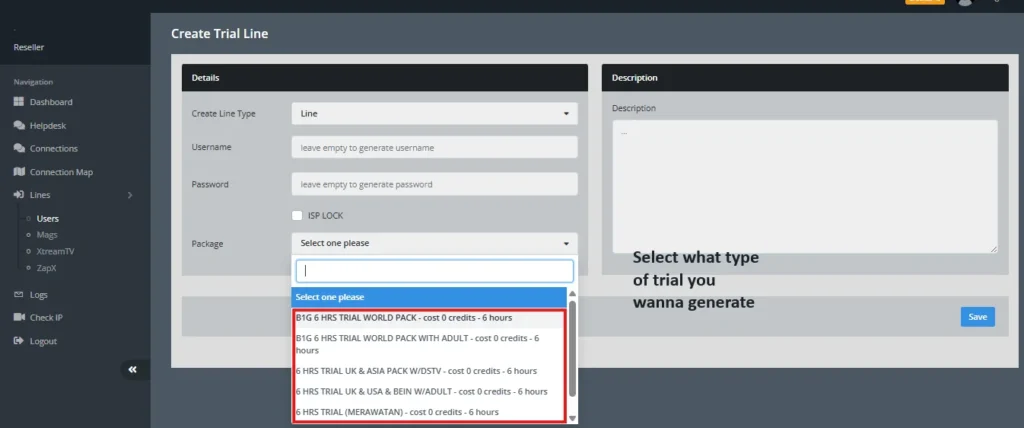
Key Evaluation Factors When Vetting an IPTV Reseller Provider
| Evaluation Factor | What to Look For | Red Flag to Avoid |
|---|---|---|
| Uptime History | Consistent 99%+ uptime with documented track record | No uptime data or vague claims with no verification |
| Server Locations | Servers in or close to the UK for low-latency delivery | All servers in distant regions with no local presence |
| Support Availability | Responsive technical support via chat, ticket, or direct contact | No clear support channel or days-long response times |
| Terms of Service | Clear, transparent terms covering reseller rights and limitations | Vague or missing terms with no accountability structure |
| Panel Features | Subscriber management, credit system, plan configuration tools | Panel with limited management options or no subscriber control |
| Pricing Transparency | Clear wholesale pricing with no hidden fees or surprise charges | Pricing that changes without notice or includes unexplained extras |
| Trial or Test Access | Ability to test service quality before committing | No trial offered and pressure to purchase immediately |
| Reputation | Positive reviews from other resellers in industry communities | No verifiable reviews or widespread operator complaints |
When you’ve shortlisted potential providers, test the service personally before committing. Ask for a trial if one is available. Use the service on the same devices your subscribers will use. Test during peak evening hours — that’s when infrastructure under load behaves differently from how it performs at 11am on a Tuesday.
I tested two providers before committing to the one I’ve built on. The first had an attractive wholesale rate. During a peak hours test on a Fire Stick, streams dropped twice in a 30-minute window. The second cost slightly more per credit and performed without issue across four devices over three evenings. That’s not a difficult choice when you think about what poor performance costs in subscriber churn.
Pricing Structure for a Legal IPTV Reseller Business That Actually Sustains Itself
Pricing is where many new operators make their first significant mistake. Setting prices too low to attract early subscribers is tempting, but it creates a margin structure that can’t sustain growth or absorb cost increases over time.
How to Build Plan Tiers for Your UK Reseller Operation
A basic three-tier structure works well for most new UK resellers:
- Single-connection plan for individual users and budget-conscious subscribers
- Mid-tier plan with two or three connections for households
- Premium plan with additional connections or extended access periods for power users
Each tier must be priced to cover your wholesale credit cost, any payment processing fees, a portion of your time for support, and a margin that makes the business genuinely worthwhile. Do not price based on what competitors charge. Price based on your actual costs and your own value delivery — then check where that lands relative to the market.
Monthly Recurring Revenue and What It Means for a Legal IPTV Reseller
The financial strength of this model lies in predictable recurring income. Once a subscriber is onboarded and receiving good service, they pay month after month without requiring any new sales effort. A base of 150 reliable, low-churn subscribers generates consistent monthly revenue that compounds over time.
Focus on retention as much as acquisition. The cost of keeping a subscriber is always lower than the cost of acquiring a new one to replace them. That asymmetry is the core financial logic of the entire model.
What Most Legal IPTV Reseller Business Guides Don’t Tell You
Most guides cover the steps. They don’t cover the specific friction points and quiet costs that catch operators off guard.
The legal clarity question comes back every time you switch providers. Most operators do their legal due diligence once, at launch. But if you switch providers later — which many operators do as they evaluate alternatives — the licensing question applies to the new provider’s content too, not just the original one. Build a brief provider evaluation checklist that includes the licensing question explicitly. Don’t assume a provider is compliant because they’re operating at scale or because other resellers use them.
Panel setup takes longer the first time than guides suggest. Configuring plans in the Plans section involves setting connection limits, durations, credit costs, and plan names for each tier. The first time I configured a six-plan grid, it took about 40 minutes — partly because I hadn’t pre-calculated all the credit costs per plan before opening the panel, and partly because some fields weren’t immediately intuitive. Have your credit cost calculations ready before you open the panel configuration. The input itself is quick. The thinking beforehand is where the time actually goes.
Terms of service for subscribers is often skipped and later regretted. A short, plain-language document covering what the service includes, what it doesn’t include, your support response time commitment, and your refund or cancellation policy takes about an hour to write. Most new operators skip it. When a subscriber dispute arises — and at some point one will — having clear written terms makes the conversation significantly simpler.
The tax obligation surprises operators who didn’t plan for it at launch. The first self-assessment filing as a sole trader often involves not just the current year’s profit but also a payment on account toward the following year. Operators who treated their gross income as take-home income during the first year find themselves needing to produce a lump sum at filing time. Set aside 25% of net profit monthly from the first subscriber payment. It removes the filing-time cash flow shock entirely.
Real Setup Mistakes I Made Starting a Legal IPTV Reseller Business
Not registering with HMRC before accepting the first payment. I told myself I’d register once the business was “properly running.” In practice that meant I accepted the first three subscriber payments before registering, which created a small but entirely avoidable compliance gap. HMRC registration as a sole trader takes about 15 minutes. Do it before the first payment arrives, not after.
Testing the provider service only on my own broadband. My initial provider test used my home fibre connection. Looked fine. When I onboarded a subscriber using a slower ADSL connection in a different area, buffering appeared consistently during peak hours. The issue wasn’t the subscriber’s connection — it was how the provider’s CDN handled lower-bandwidth connections specifically. Testing across multiple connection types and at different times of day is the proper evaluation. I shortened that process and paid for it in early support contacts.
Skipping the written terms of service. Three months in, a subscriber asked for a refund after a provider outage lasting about six hours. I didn’t have a clear refund policy. I ended up issuing a week’s free extension as a goodwill gesture — which was the right call — but the conversation was more difficult than it needed to be because there was no clear reference document for either of us. A simple terms document resolves this before it becomes an issue.
Setting plan prices without calculating full costs first. I set my initial pricing by looking at what others were charging and matching the midpoint. My wholesale rate at the time was higher than I’d assumed comparable operators were paying, which meant one of my plans was generating a margin thin enough that any credit rate adjustment would have made it unprofitable. Calculate your actual cost floor per plan before looking at market pricing. The floor is your starting point. Everything else is positioning.
Honest Advantages and Real Limitations of the Legal IPTV Reseller Business Model
| Advantages | Limitations to Plan For |
|---|---|
| Low entry cost — no server investment required | Margins depend partly on provider wholesale rates |
| Fast to launch — operational within days of setup | Stream quality is tied to your provider’s infrastructure |
| No technical server management required | Provider outages directly affect your subscribers |
| Recurring monthly revenue from each subscriber | Switching providers later can temporarily disrupt subscriber access |
| Set your own pricing and plan structure | You share infrastructure with other resellers on the same platform |
| Provider handles uptime, maintenance, and delivery | Limited ability to customise delivery-layer features |
| Scalable — add credits or connections as demand grows | Long-term margins improve most meaningfully with subscriber volume |
Best Practices for UK Legal IPTV Reseller Operations in 2026
Document Everything From Day One
- Keep records of all subscriber payments, renewal dates, and plan configurations
- Maintain a simple log of support requests and how they were resolved
- Store provider terms of service and any written agreements securely
- Keep financial records ready for your annual self-assessment or company accounts
Build a Subscriber Experience That Reduces Churn
- Provide setup guides for the most common devices your subscribers use
- Send a welcome message to every new subscriber confirming their access details
- Set up a renewal reminder routine so subscribers don’t lapse from forgetting
- Respond to all support queries within 24 hours as a minimum standard
Grow Your Legal IPTV Reseller Business With Compliance in Mind
- Stay informed about UK copyright and broadcasting law developments
- Verify that any content accessible through your service is appropriately licensed
- Do not make claims in your marketing that you cannot substantiate or deliver
- If uncertain about any legal aspect of your operation, seek qualified legal advice before proceeding
Manage Your Finances Deliberately
- Separate business and personal finances from the start — before the first payment
- Set aside tax obligations monthly rather than dealing with them annually
- Review your pricing and margins every quarter to ensure they remain sustainable
- Build a small financial reserve to cover credit costs during periods of lower subscriber activity
Frequently Asked Questions About Running a Legal IPTV Reseller Business in the UK
Is it legal to run an IPTV reseller business in the UK? Operating as a reseller using panel management software is legal. The critical factor is whether the content accessible through the service is properly licensed for distribution in the UK. Operators are fully responsible for ensuring compliance with UK copyright law and broadcasting regulations. This article covers business management and software tools only and does not constitute legal advice. For questions specific to your setup, consult a qualified legal professional.
Do I need to register a company to start a UK IPTV reseller operation? You don’t need to form a limited company to start. Many UK operators begin as sole traders, which simply requires registering with HMRC for self-assessment — free and takes about 15 minutes online. As revenue grows, transitioning to a limited company can offer tax advantages and personal liability protection. Either structure is a valid starting point. What matters is that you operate formally and declare your income from the first subscriber payment.
How much does it cost to launch a UK IPTV reseller business? Startup costs for the reseller model are low compared to most other businesses. The main initial outlay is purchasing your first block of credits from your panel provider. Business registration with HMRC as a sole trader is free. A business bank account typically has a small monthly fee or is free through certain UK banks. Most new operators launch for between £50 and £200 in total, most of which is recovered quickly with the first month of subscriber payments.
How do I find subscribers for a legal IPTV reseller business in the UK? Your existing network is the best starting point. People who already know and trust you are the easiest first customers to acquire and typically the most loyal. UK-based online communities focused on cord-cutting, streaming, and home entertainment are another strong channel. Word of mouth compounds over time — subscribers satisfied with the service refer others naturally, which significantly reduces your ongoing marketing effort as the business grows.
What devices do UK subscribers commonly use? The most common devices among UK IPTV subscribers are Amazon Fire Stick, Android TV boxes, Samsung and LG smart TVs with compatible apps, and Android smartphones. A smaller segment uses Apple TV or iOS devices. Ensuring your setup guide covers the top three or four devices in your subscriber base dramatically reduces support volume during onboarding — and is worth writing before you activate your first account.
What should I do if my provider has an outage? Contact your provider immediately to understand the issue and expected resolution timeline. Communicate with your affected subscribers proactively rather than waiting for them to complain. Be honest about what’s happening and realistic about timelines. Follow up once service is restored. Transparent, timely communication during an outage retains significantly more subscribers than silence does. Silence reads as indifference, regardless of whether that’s accurate.
When should I consider moving from reselling to direct operation? Moving toward owning your own infrastructure becomes financially attractive once your subscriber base is large enough that the improved margins from direct operation outweigh the significantly higher costs of building and managing servers, a CDN, and middleware. For most operators, this threshold is in the range of several hundred consistent subscribers. There’s no obligation to make that transition — many profitable UK reseller businesses operate at scale without ever managing their own infrastructure.
Final Thoughts on Building a Legal IPTV Reseller Business in the UK
Building a legal IPTV reseller business in the UK in 2026 is a realistic goal for anyone willing to approach it with the right structure and the right provider. The technology is accessible, the entry costs are low, and the recurring revenue model creates a financial structure that grows with your subscriber base.
What separates operators who build something lasting from those who struggle isn’t the tools — it’s the discipline of doing the foundational work well. Register your business before the first payment. Choose your provider on performance and reliability, not just price. Test before you launch. Support your subscribers well. Grow at a pace your operation can genuinely handle.
The legal dimension of a legal IPTV reseller business isn’t a barrier. It’s a framework that, when understood and respected, protects your business and your subscribers. Operating within it gives you a solid foundation that operators cutting corners simply don’t have — and that advantage compounds over time as the business grows.
This guide covers software tools, reseller panel management, and business structure principles only. No media content, channels, or streams of any kind are hosted or provided here. All guidance is strictly educational and informational.