
Book Appointment Now
IPTV Reseller vs Affiliate: Which Model Offers the Highest Profits in 2026
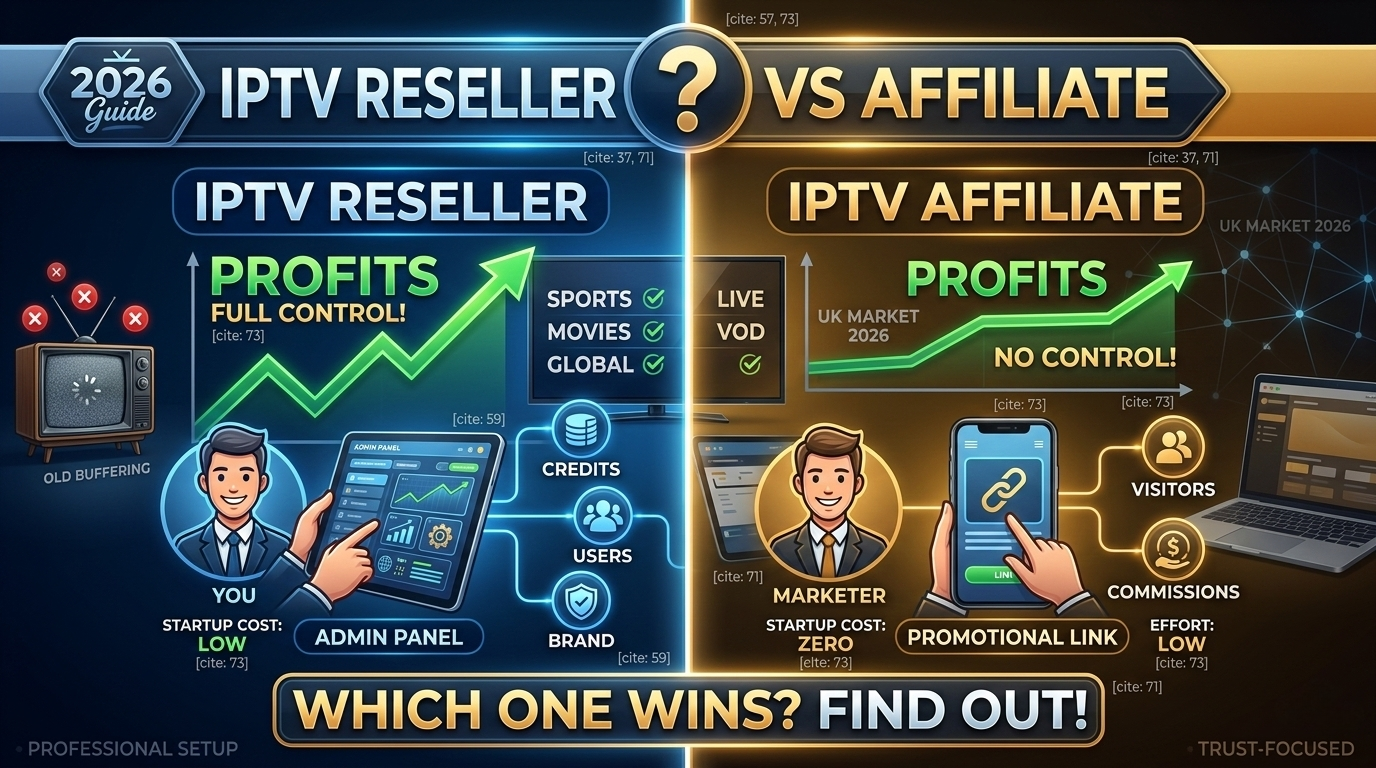
Two distinct income models exist for people who want to earn from the IPTV industry without building infrastructure from scratch. The IPTV reseller vs affiliate debate comes down to one practical question: do you want to own subscriber relationships and earn recurring income, or do you want to refer customers and collect a commission?
Both paths are valid. Both have real earning potential. But they work very differently, and the one that fits you depends entirely on your goals, your resources, and how much control you want over your income.
This guide compares both models clearly and in detail — how each one works, what it earns, what it costs, what it requires, and which situations each is better suited for. By the end, you’ll have a direct answer about which model fits your circumstances in 2026.
If you’re leaning toward the reseller model, understanding the tool that makes it work is an essential first step. Reading about What Is an IPTV Reseller Panel explains the management system at the core of any reseller operation.
IPTV Reseller vs Affiliate: Understanding Each Model Before Comparing Them
Before making any comparison, it’s worth being clear about what each model actually involves. The labels are simple enough. The operational realities behind them differ significantly.
How the IPTV Reseller Model Works
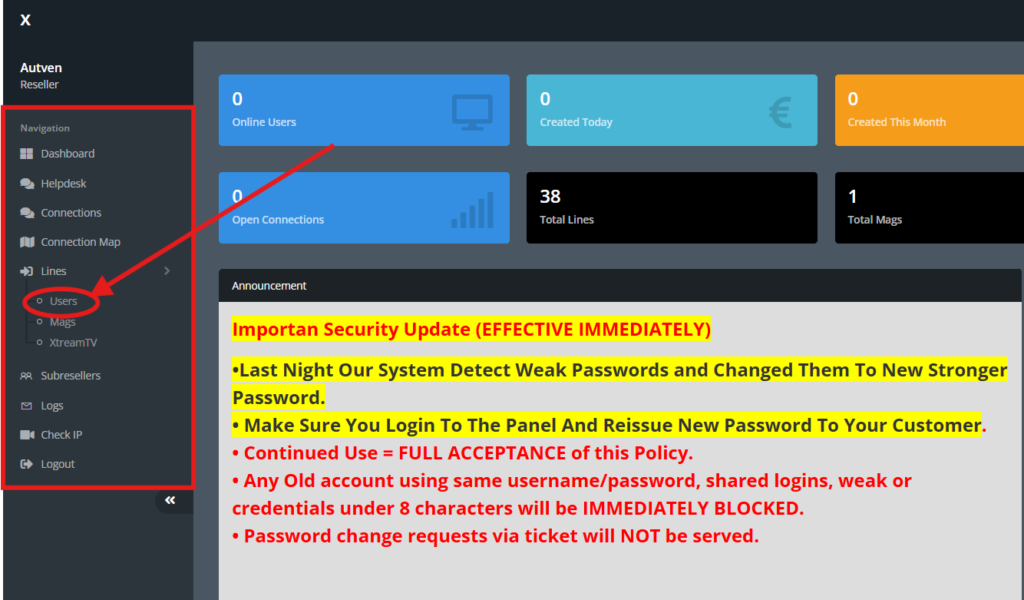
A reseller purchases wholesale access from an IPTV infrastructure provider and sells retail subscriptions to end users. You set your own prices, create your own plan structure, and manage subscriber accounts through a reseller panel dashboard. Subscribers pay you directly, month after month. Your income is the margin between your wholesale credit cost and your retail price, multiplied by your active subscriber count.
The reseller model creates a real business. You build a subscriber base, a brand identity, and a recurring revenue stream that grows with every account you retain. That subscriber base has tangible value — it represents a predictable forward income that compounds over time.
How the IPTV Affiliate Model Works
An affiliate earns commission by referring new customers to an IPTV provider. When someone clicks your referral link and subscribes, you receive a commission — either a one-time payment or a recurring percentage of that subscriber’s payments, depending on the programme.
The affiliate model requires no panel management, no subscriber support, and no credit purchasing. Your role is marketing: creating content, building an audience, and directing interested people toward the provider’s offering. You have no direct relationship with the subscribers you refer and no control over the product they receive.
IPTV Reseller vs Affiliate: The Full Head-to-Head Comparison
The table below compares both models across twelve factors that matter when choosing how to structure your IPTV income.
| Factor | Reseller Model | Affiliate Model |
|---|---|---|
| Revenue Type | Recurring monthly subscription income per active subscriber | One-time or recurring commission per referred customer |
| Income Predictability | High — stable once subscriber base is established | Variable — depends on monthly referral performance |
| Startup Cost | Low to moderate — initial credit purchase required | Very low — often free to join |
| Control Over Pricing | Full — you set your own retail prices | None — provider sets all prices |
| Brand Identity | Your own — subscribers associate with your business | The provider’s — you drive traffic to their brand |
| Subscriber Relationship | You own it — direct ongoing relationship with every account | None — no ongoing contact after referral |
| Income Ceiling | Grows with subscriber count and plan pricing | Capped by commission rate and referral volume |
| Effort to Earn | Higher upfront — setup, onboarding, support required | Lower upfront — focus on referral traffic generation |
| Long-Term Value | High — business asset with recurring revenue | Moderate — depends on programme continuation |
| Technical Requirement | Panel management — beginner-friendly | Marketing and content skills — beginner-friendly |
| Exit or Sale Value | Subscriber base has tangible, transferable asset value | No saleable asset — referral traffic is not transferable |
| Best Suited For | Operators wanting a scalable, independent income stream | Content creators or marketers with existing audiences |
The pattern that emerges is clear. The reseller model trades higher upfront effort and modest initial investment for significantly more control, higher income potential, and a business with real long-term value. The affiliate model trades control and scalability for simplicity and near-zero entry cost.
IPTV Reseller Income: How Earnings Actually Compound Over Time
Understanding how income builds in the reseller model makes the case for it more concrete than an abstract comparison ever can.
The Margin Structure in an IPTV Reseller Operation
As a reseller, your income per subscriber is the difference between your wholesale credit cost and your retail price. If your wholesale cost for a one-month single-connection account is £3 and you charge £8 at retail, your gross margin is £5 per subscriber per month.
At 20 subscribers, that’s modest. At 200 subscribers, it’s a meaningful monthly income. At 500, it’s an income that — depending on your pricing — can comfortably supplement or replace a full-time salary for most UK operators.
The critical insight is that management effort doesn’t scale linearly with account count. Managing 50 accounts through the User Management tab of a reseller panel takes a fraction more time than managing 10. Managing 200 takes a fraction more than 50. As subscriber count grows, the effective hourly return on your management time increases. That compression is where the real leverage in this model lives.
Why Subscriber Retention Compounds IPTV Reseller Income
A subscriber who stays for 12 months generates 12 monthly payments. Your initial effort to acquire them is amortised across all 12. A subscriber who stays for 3 years generates 36. This compounding effect is why resellers who focus on service quality and retention build disproportionately strong income over time relative to their monthly acquisition effort.
The difference between a 3% monthly churn rate and a 7% monthly churn rate doesn’t sound dramatic. Across a 200-subscriber base over 12 months, it’s the difference between needing roughly 72 new subscribers to maintain headcount versus 168. That’s an enormous difference in acquisition effort — and therefore in how much of your gross margin actually converts to net income.
The IPTV Reseller Business Asset: What Most People Undervalue
Unlike affiliate income — which stops the moment you stop referring customers, or the moment a programme changes its terms — a reseller subscriber base has real, transferable value. It represents a predictable forward income stream. It can be sold, transferred, or used as the foundation for a more sophisticated operation as it grows.
This asset value is one of the most underappreciated advantages of the reseller model for anyone thinking about income over a multi-year horizon rather than just the next few months.
IPTV Reseller Model: Real Advantages and Honest Limitations
| Reseller Advantages | Reseller Limitations |
|---|---|
| Recurring monthly income from every active subscriber | Requires initial credit investment before first earnings |
| Full control over pricing, plans, and subscriber tiers | Ongoing responsibility for subscriber support and billing |
| Build a business with real, transferable asset value | Income is tied to provider infrastructure quality |
| Subscriber loyalty and brand recognition are yours | Churn management is an ongoing operational requirement |
| Scales efficiently as subscriber count grows | More management overhead than affiliate marketing |
| Predictable cost forecasting via the credit system | Provider outages directly affect your subscriber experience |
For operators prepared to invest the effort required to build a subscriber base, the advantages are substantial. The key risk — provider infrastructure quality — is manageable through proper vetting before you commit your first credit purchase.
IPTV Affiliate Model: How Commission Income Actually Works
The affiliate model is genuinely well-suited to certain types of people and situations. Understanding how it actually generates income — and where it plateaus — is essential before deciding it’s the right path.
How IPTV Affiliate Commissions Are Structured
Affiliate programmes in the IPTV space typically offer one of two commission structures. A flat one-time payment pays you a fixed amount for each new subscriber who signs up through your link. A recurring commission pays you a percentage of that subscriber’s ongoing payments for as long as they remain active.
Recurring commission structures are significantly more valuable over time. If you refer a subscriber who stays for two years, a recurring model pays you for all 24 months. A flat commission model pays you once and stops. Always confirm which structure a programme offers before investing serious effort in promoting it. The long-term income difference between the two is substantial.
The IPTV Affiliate Income Ceiling Problem
Affiliate income depends on a consistent flow of new referrals. If your content output decreases, your audience engagement drops, or the programme changes its commission rate, your income falls immediately. There is no subscriber base generating income — only the ongoing effort of producing content and driving traffic.
This creates a practical ceiling on affiliate income that doesn’t exist in the same way for resellers. A reseller with 400 active subscribers earns from those 400 accounts every month whether or not they actively acquire any new subscribers that month. An affiliate earns only in months where they’re actively generating referrals.
When the IPTV Affiliate Model Actually Makes Sense
The affiliate model is well-suited to content creators, bloggers, reviewers, or social media personalities who already have an engaged audience interested in streaming, home entertainment, or cord-cutting. In these situations, the audience already exists and the affiliate model generates income from an existing asset without requiring additional operational work.
It also makes sense as a complementary income stream alongside a reseller operation — using content marketing to drive both affiliate referrals and direct subscriber acquisition simultaneously.
IPTV Affiliate Model: Real Advantages and Honest Limitations
| Affiliate Advantages | Affiliate Limitations |
|---|---|
| Very low or zero startup cost | No control over product, pricing, or service quality |
| No subscriber management or support responsibilities | Income stops if the programme changes or ends |
| Ideal for content creators with existing audiences | Variable income — depends on monthly referral volume |
| Simple to start — join a programme and begin promoting | No subscriber relationship or long-term loyalty built |
| Can be run alongside other income streams easily | Commission rates are set by the provider, not by you |
| No credit management or panel administration required | No business asset to sell or transfer at exit |
IPTV Reseller vs Affiliate: Which Model Earns More Over Time?
This is the question that drives most people to this comparison, and it deserves a direct answer.
Over a 12-to-24-month horizon, the reseller model consistently produces higher total income for operators who build and retain a meaningful subscriber base. The compounding effect of recurring monthly subscription income from a growing base of satisfied subscribers creates an income trajectory that affiliate commissions — even at good rates — rarely match at the same level of effort.
The affiliate model wins on simplicity and speed of initial setup. It wins if you have an existing audience you can activate immediately. It wins when you have no budget for initial credit purchases.
The reseller model wins on income ceiling, business asset value, control, and long-term income for operators willing to invest the initial effort. Most people who start in this industry and build something significant over multiple years do so through the reseller model. That’s not an opinion. It’s just the pattern that plays out consistently.
The IPTV Hybrid Approach: Running Both Simultaneously
Some operators use both models at the same time. They build a reseller subscriber base for recurring income and run affiliate content marketing to supplement that income with referral commissions. The content they create for affiliate marketing also helps attract direct subscribers to their reseller operation.
This approach works well for operators with content creation skills who are also prepared to invest time in subscriber management. It demands more than either model alone — but it maximises income from both channels when it’s executed properly.
What Most IPTV Reseller vs Affiliate Comparisons Don’t Tell You
Most comparisons cover the theory. They don’t cover the places where real operators make decisions they later regret.
The affiliate model is not passive income for a new account with no audience. Every guide implies you can start earning quickly. That’s true if you have an established audience ready to receive your referral links. If you don’t, affiliate income requires building a content platform from scratch — which typically takes 6 to 12 months of consistent effort before generating meaningful commissions. Starting with the affiliate model specifically to avoid upfront cost, without acknowledging this timeline honestly, leads to significant disappointment.
The reseller model’s operational demands in the first 60 days are front-loaded. The first two months as a reseller involve building your panel configuration, setting plans in the Plans section, onboarding early subscribers, handling setup queries, and figuring out your renewal management rhythm. After that, the day-to-day workload drops considerably. Most people who quit the reseller model do so in those first 60 days, before the operation stabilises. If I’d understood that the friction was front-loaded rather than permanent, I’d have managed the early period very differently.
Affiliate programme terms change more often than operators expect. Commission rates get reduced. Programme structures change. Programmes terminate entirely. I’ve spoken with operators who built six months of affiliate content around a specific programme, only to have the commission structure change materially before they recouped their content creation effort. Diversifying across multiple affiliate programmes, or combining affiliate with reseller income, is a risk management decision that most comparisons skip entirely.
Switching from affiliate to reseller mid-stream is harder than it sounds. The skills are different. Affiliate success builds content and audience skills. Reseller success builds operational and support skills. Starting as an affiliate with the plan to “switch later” often results in neither being executed well, because the transition requires building an entirely new skill set and operational rhythm. If the reseller model is your goal, start there.
Real Mistakes I Made Choosing Between IPTV Reseller and Affiliate
Choosing affiliate first specifically to avoid the initial credit cost. The first few months generated almost nothing because I had no existing audience to refer to the programme. By the time I’d built enough content to start generating consistent referrals, the time investment was already comparable to what setting up a small reseller subscriber base would have taken. The credit cost I was avoiding was actually modest relative to the time cost I accumulated. If I’d run that comparison honestly at the start, I’d have launched the reseller operation first.
Not checking whether the affiliate programme offered recurring or one-time commissions. I promoted a programme for several weeks before realising it paid a flat one-time commission rather than a recurring percentage. The income was far lower than I’d projected. Always confirm the commission structure in writing before investing content effort.
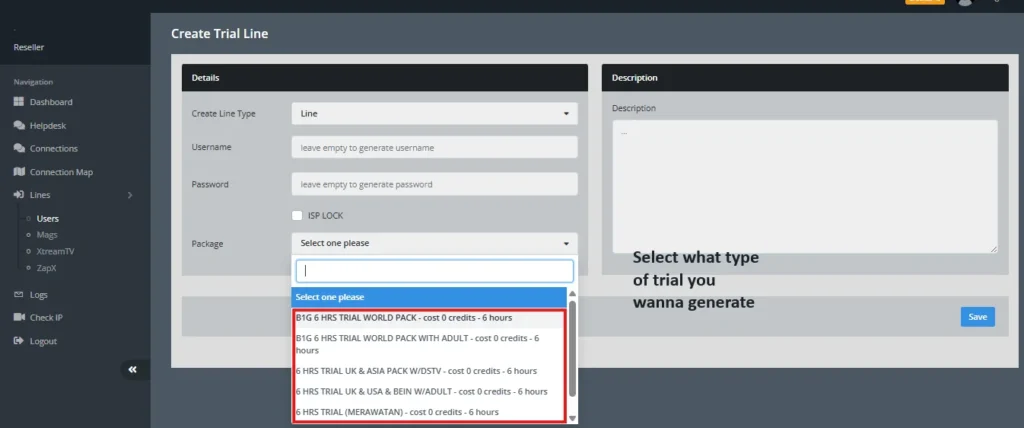
Underestimating how long reseller panel setup takes the first time. The panel itself — Add User, Plans configuration, Credit Management — is straightforward once you know it. The first session took about two hours, mostly spent second-guessing the plan configuration fields and double-checking credit costs before activating anything. The second session took 20 minutes. The learning curve is real but short. I’d overestimated how technically demanding it would be, which delayed my launch unnecessarily.
Trying to run both models simultaneously from day one. I launched a reseller operation and an affiliate content strategy at the same time without either being fully set up. Neither got enough focus to build momentum in the first month. The reseller operation needed consistent subscriber onboarding and support attention. The affiliate content needed consistent publishing. Splitting focus between both meant both moved slowly. The staged approach — build one to stability, then layer in the second — is the right sequence. It’s obvious in hindsight.
Who the IPTV Reseller Model Is NOT Right For
The reseller model is the stronger long-term choice for most operators. But it’s not the right choice for everyone.
If you have no capacity for even a short daily check of your panel — the Renewal View in User Management, a quick credit balance review — the subscriber experience will degrade noticeably within a few weeks. Lapsed accounts, missed renewals, unanswered support questions. The model requires consistent light-touch management. Not hours per day. But it can’t be left entirely unattended for weeks at a stretch.
If you’re expecting profitability in the first two to three weeks, the reseller model may frustrate you. The first credit purchase, the panel setup, the first few subscriber onboardings — this is the period where costs are visible and income is building. The inflection point where monthly income noticeably exceeds monthly costs typically arrives somewhere between months two and four for most operators. That’s not a long time. But it’s worth knowing in advance.
If you want to earn from IPTV content you’re already creating without any operational involvement, the affiliate model is genuinely the better fit. Trying to force the reseller model into a pure content creation workflow produces a poorly managed operation and a frustrated content creator.
Best Practices Based on Your IPTV Model Choice
If You Choose the IPTV Reseller Model
- Vet your panel provider thoroughly before purchasing your first credit block
- Start with a modest credit purchase and scale once the operation is verified
- Set pricing based on your actual wholesale costs before looking at competitor pricing
- Build a renewal tracking routine from week one — check the expiry filter every two to three days
- Focus subscriber support quality as your primary retention mechanism
- Review your provider relationship at least twice a year against performance benchmarks
If You Choose the IPTV Affiliate Model
- Prioritise programmes offering recurring commission over flat one-time payments
- Verify the commission structure and payment terms in full before promoting
- Build an audience first — affiliate income without an existing audience develops slowly
- Create genuinely useful content rather than purely promotional material
- Track which content generates actual conversions and direct more effort there
- Read the programme terms carefully, especially regarding commission changes and termination rights
If You Choose the IPTV Hybrid Approach
- Be realistic about time commitment — both models require active management
- Use content marketing to serve both audiences simultaneously where possible
- Track income from each channel separately to evaluate which merits more effort
- Start with one model, prove it works, then layer in the second — don’t launch both from day one
Frequently Asked Questions About IPTV Reseller vs Affiliate
Which model is better for someone without an existing audience or subscriber base? The reseller model is often the better starting point for people without an existing audience. Affiliate income depends heavily on having people to refer. Without an audience, building affiliate income requires constructing a content platform first — which takes consistent effort over months before generating meaningful commissions. The reseller model allows you to acquire subscribers individually through personal networks, word of mouth, and direct outreach, which is accessible even without a pre-existing platform.
Can I switch from the affiliate model to the reseller model later? Yes. Many operators start with affiliate marketing, build industry familiarity, and transition to the reseller model once they have the confidence and modest capital for an initial credit purchase. The skills are complementary — content and audience-building experience from affiliate work translates into subscriber acquisition capability useful in a reseller operation. The transition is manageable; just don’t assume the affiliate skill set automatically transfers to panel management without a separate learning period.
How quickly can I start earning from each model? With the affiliate model, you can earn a commission as soon as your first referral converts — potentially within days if you have an engaged audience ready to receive the recommendation. With the reseller model, you need to set up your panel, purchase credits, and onboard your first subscribers before any payment arrives. For most new resellers, the first subscriber payment comes within one to two weeks of setup. Both models can generate income quickly — affiliate is faster if the audience already exists.
Does the affiliate model require any technical knowledge? No technical knowledge is required for the affiliate model. You need the ability to create content — written, video, or social media — and to share a referral link. No panel management, server knowledge, or technical configuration is involved. The skills that matter most are communication, content creation, and audience engagement.
Can the IPTV reseller model realistically replace a full-time income? Yes, and it does for many operators who build subscriber bases in the several-hundred-account range with well-structured pricing. The timeline varies depending on acquisition approach, pricing, provider quality, and how effectively subscribers are retained once acquired. A realistic expectation for a focused operator starting from zero is six to eighteen months to reach a significant recurring income, with growth compounding from there as the subscriber base stabilises.
What happens to affiliate income if the programme changes its terms? If an affiliate programme reduces its commission rate, changes its payment structure, or terminates entirely, your income from that programme changes or stops immediately. This is one of the structural risks of the affiliate model. Operators who rely entirely on a single affiliate programme are exposed to this risk without any buffer. Diversifying across multiple programmes, or combining affiliate with reseller income, reduces this dependency significantly.
Is the hybrid approach recommended for beginners? The hybrid model works best for operators who have already proven one model and are ready to expand into a second. For beginners, trying to manage both simultaneously from day one typically results in neither being executed well — the focus gets split before either has momentum. Start with the model that best fits your current situation, build it to a point where it runs with limited daily oversight, then layer in the second. That staged approach produces consistently better results than launching both from the start.
Final Thoughts on IPTV Reseller vs Affiliate in 2026
The IPTV reseller vs affiliate decision is not about which model is objectively superior. It’s about which model fits your specific situation, goals, and resources right now.
The affiliate model offers simplicity, low entry cost, and a natural fit for content creators with existing audiences. The reseller model offers recurring income, full control, scalability, and a business with genuine long-term asset value.
For most people who want to build a sustainable IPTV income stream over a multi-year period, the reseller model is the stronger choice. The upfront effort is manageable. The startup cost is modest. And the compounding effect of a growing subscriber base paying month after month creates an income dynamic that one-time affiliate commissions simply cannot replicate at scale.
If you have an existing audience and want to start earning immediately with no operational overhead, the affiliate model is worth exploring first. If you’re serious about building something with real, lasting value — a business rather than a side referral stream — the IPTV reseller model is the path that gets you there.
This article covers business model comparisons, software tools, and reseller panel management principles only. No media content, channels, or streams of any kind are hosted or provided here. All guidance is strictly educational and informational.
