Book Appointment Now
IPTV Reseller Profit Margins: What You Can Really Earn in the UK (2026 Secrets)
Before you activate your first subscriber, there’s one question that matters more than anything else: what can you actually earn, and when does this become worth the effort?
IPTV reseller profit margins aren’t complicated. But most guides explain them in vague, optimistic language that falls apart the moment you sit down with real wholesale credit costs and an actual payment processing statement. This guide doesn’t do that.
It breaks down exactly how margins are calculated, what they look like at different subscriber counts, and — more usefully — where they bleed out quietly over time. I’ve worked through these numbers on live panels, made the pricing mistakes personally, and seen the difference between a well-structured reseller operation and one that looks profitable on paper until tax season arrives.
The figures used throughout reflect typical UK wholesale and retail rates in 2026. Your real IPTV reseller profit margins depend on your provider’s credit pricing and how cleanly you run the operation.
If you’re still getting to grips with how the credit system works inside a reseller panel, reading about What Is an IPTV Reseller Panel is a useful starting point before working through margin structure.
How IPTV Reseller Profit Margins Actually Work
The margin structure is simpler than most people expect. You buy wholesale access credits from your provider. You charge subscribers a retail price for their subscription. The difference is your gross margin.
That’s it at the unit level.
A subscriber paying £8 per month on a plan that costs you £3 in credits generates £5 gross margin per month. If that subscriber stays for twelve months, one account activation produces £60 in gross margin across the year. Modest in isolation. At 200 active subscribers, that becomes £10,000 annually — from accounts you activated once and managed through a dashboard.
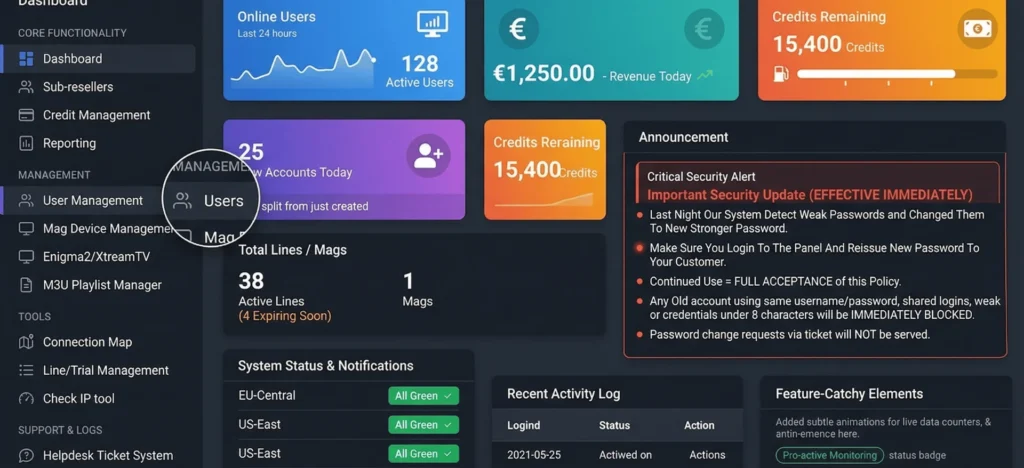
The model scales multiplicatively. The effort doesn’t scale at the same rate. Managing 300 subscribers through the User Management tab inside a reseller panel takes meaningfully less effort per subscriber than managing 30 did when you were first learning the system. That compression of management effort per unit is where the real leverage in this business lives.
IPTV Reseller Gross Margin vs. Net Margin: The Gap That Surprises Most Operators
Gross margin — the difference between wholesale credit cost and retail price — is not what you take home. Operators who conflate the two hit ugly surprises, usually around month three or four when the numbers don’t match expectations.
Your net margin is what remains after:
- Payment processing fees (typically 1.5% to 3% per transaction depending on platform)
- Fixed monthly operational costs — business banking, tools, subscriptions
- Tax obligations, which for UK sole traders in 2026 are significant above certain thresholds
- Your own time cost, if you choose to account for it honestly
The payment processing percentage is the most invisible cost in the entire business. It runs on every single transaction without generating a line on any panel report. At 20 subscribers it’s negligible. At 500 subscribers it’s over £1,200 per year. I ignored it for the first two months. That was a mistake I’ve watched other operators repeat.
IPTV Reseller Profit Margins by Plan Tier: Illustrative UK Figures for 2026
The table below shows illustrative margin figures across six common plan configurations. These reflect typical UK wholesale and retail conditions in 2026. Use them as a starting framework — your provider’s specific credit pricing will shift these numbers in either direction.
| Plan Tier | Monthly Wholesale Cost | Suggested Retail Price | Gross Margin Per Subscriber | Margin % | Annual Value (1 Subscriber) |
|---|---|---|---|---|---|
| Single connection, 1 month | £3 | £8 | £5 | 62% | £60 |
| Single connection, 3 months | £8 | £20 | £12 | 60% | £48 |
| Dual connection, 1 month | £5 | £12 | £7 | 58% | £84 |
| Dual connection, 3 months | £12 | £30 | £18 | 60% | £72 |
| Triple connection, 1 month | £7 | £16 | £9 | 56% | £108 |
| Triple connection, 6 months | £18 | £45 | £27 | 60% | £54 |
A few things worth flagging from this model.
Monthly plans generate higher gross margin per month in absolute terms. But longer-duration plans often produce better annual value because churn risk is lower. A subscriber who has paid three months upfront is not thinking about cancelling in week two. Monthly subscribers can and do disappear after 30 days with no warning and no prior indication anything was wrong.
The margin percentage across plan tiers sits between 56% and 62% in this model. That consistency is useful for planning. But the percentage matters less than the absolute margin per subscriber — and whether that absolute margin is enough to cover your operational floor and leave something real at the end of the month.
Monthly IPTV Reseller Income at Different Subscriber Scales
Understanding per-subscriber margin is step one. Watching what happens as that margin compounds across a growing subscriber base is what makes the financial case for this model genuinely land.
The table below projects monthly income from 10 to 500 subscribers using a single-connection monthly plan at £8 retail and £3 wholesale.
| Subscriber Count | Monthly Retail Income | Monthly Wholesale Cost | Gross Monthly Margin | Processing Fees (~2.5%) | Est. Net Monthly Income |
|---|---|---|---|---|---|
| 10 subscribers | £80 | £30 | £50 | £2 | ~£48 |
| 25 subscribers | £200 | £75 | £125 | £5 | ~£120 |
| 50 subscribers | £400 | £150 | £250 | £10 | ~£240 |
| 100 subscribers | £800 | £300 | £500 | £20 | ~£480 |
| 200 subscribers | £1,600 | £600 | £1,000 | £40 | ~£960 |
| 300 subscribers | £2,400 | £900 | £1,500 | £60 | ~£1,440 |
| 500 subscribers | £4,000 | £1,500 | £2,500 | £100 | ~£2,400 |
These figures assume a single plan tier and full monthly retention. Real operations run a mix of plan types — some at higher retail rates and longer durations — which can push average margin per subscriber above or below these numbers depending on your plan structure.
The trajectory is the important point. The business reaches meaningful supplemental income somewhere around 50 to 100 subscribers. Full-time income equivalent for most UK operators sits between 200 and 300 subscribers, depending on plan pricing, operational costs, and how consistently you’re setting aside tax each month.
How Churn Quietly Destroys IPTV Reseller Profit Margins Over Time
This is the section most margin guides skip. It’s probably the most important one in the entire article.
Every number in the projection table above assumes subscribers stay. Some don’t. The gap between projected figures and actual results is determined almost entirely by churn rate — the percentage of your subscriber base that cancels or lapses in a given month.
An operator with 200 subscribers and 5% monthly churn loses 10 subscribers per month. To hold that count steady, they need to acquire 10 new subscribers every single month just to stay flat. At 2% monthly churn, they only need to replace 4. That difference in acquisition effort — and the cost and time attached to it — is enormous across a full year.
Run the numbers on it:
- 200 subscribers, 5% monthly churn: approximately 120 new subscribers needed per year just to maintain the base
- 200 subscribers, 2% monthly churn: approximately 48 new subscribers needed per year to maintain the same base
That is not a minor operational difference. That is the difference between a reseller business that grows and one that runs in place while you exhaust yourself finding new people. Subscriber retention is not a soft benefit. It is the primary financial lever in this model.
What Most IPTV Reseller Profit Margin Guides Don’t Tell You
Most guides list the formulas. They don’t cover the micro-leaks that collectively eat 10 to 15% of net margin in a poorly managed operation. These are the ones that actually cost operators real money.
The Renewal Gap Problem in the Reseller Panel
Most panels show an expiry date for each subscriber account in the User Management section. What they don’t do automatically is alert you three days before an account lapses.
If you’re checking the Renewal View once a week, you will miss expiring accounts. Those accounts go dark. The subscriber gets annoyed, contacts you after they’ve already lost access, and you’ve lost a day of their service and a portion of their goodwill in the same moment.
I lost two subscribers in my second month this way. Not because the service was bad. Because I wasn’t checking the expiry queue often enough. Checking it every two to three days takes about four minutes. It is the highest-return operational habit in this entire business.
The Credit Block Buying Mistake That Shrinks IPTV Reseller Margins
New operators almost always buy small credit blocks. It feels safer — lower upfront commitment, less risk if things don’t work out. The problem is that small credit blocks cost more per unit than larger ones at almost every provider.
When I moved from buying 50 credits at a time to 200, my per-credit cost dropped noticeably. At scale, that reduction compounds across every subscriber, every plan, every month. It’s a direct improvement to IPTV reseller profit margins with zero change to your service or retail pricing.
The Cheap Provider Trap
I’ve seen operators choose the lowest wholesale credit rate they can find, activate 80 subscribers, and then spend three weeks fielding buffering complaints because the provider’s uptime wasn’t reliable. The subscribers churn. The operator’s reputation suffers. The apparent margin saving costs more in lost subscribers than the credit rate difference ever saved.
A slightly higher wholesale rate from a provider with a consistent uptime history is almost always the better financial decision. A 62% gross margin is worthless if the service drives subscribers away inside 60 days.
Where IPTV Reseller Profit Margins Leak and How to Protect Them
| Area | Margin Killer | Margin Protector |
|---|---|---|
| Pricing | Setting retail prices by copying competitors without knowing your own cost floor | Build pricing from wholesale cost upward; know your floor before looking at the market |
| Churn | High monthly churn forces constant acquisition with no net revenue growth | Invest in support quality; a retained subscriber costs nothing to acquire |
| Credit buying | Small credit blocks at higher per-unit rates | Forecast monthly usage; buy larger blocks once consumption is stable |
| Payment fees | Ignoring transaction processing costs on every payment | Factor payment platform percentage into pricing before setting retail prices |
| Provider quality | Choosing a cheap provider whose poor uptime drives cancellations | Accept a higher wholesale rate from a proven provider with strong uptime |
| Tax obligations | Not setting aside income tax contributions monthly | Set aside 20–30% of net profit each month into a separate account |
| Passive churn | Letting subscriber accounts lapse without proactive renewal reminders | Check the Renewal View every two to three days; send reminders before accounts expire |
Building a Pricing Model That Protects Your IPTV Reseller Profit Margins
The most common pricing mistake is starting from what competitors charge and working backward.
This produces pricing that looks competitive but may sit below your actual cost floor — especially if your wholesale rate is higher than a competitor who has been buying credits at volume for longer than you have. You can’t see their cost structure. You can only see their retail price. Copying it is a gamble.
Build from your cost upward instead.
The Cost-Up Method for IPTV Reseller Margin Planning
Start with your per-subscriber wholesale credit cost for each plan you want to offer. Add your payment processing percentage. Add a proportional share of fixed monthly costs — business banking, operational tools. Add a rough estimate of your time cost for onboarding and support.
That total is your cost floor per subscriber per month.
Your retail price must sit above that floor to generate any margin at all. A target of 55% to 65% gross margin is realistic and sustainable based on typical UK 2026 wholesale rates. Below 50%, any unexpected cost increase or wholesale rate rise creates an immediate loss on that plan.
Plan Structure That Balances IPTV Reseller Margin and Retention
A three-tier structure works well in practice:
- Entry tier: monthly single-connection plan for price-sensitive or new subscribers
- Mid tier: monthly dual-connection plan for households, higher absolute margin per account
- Retention tier: quarterly plan at a slight monthly equivalent discount — lower churn, stable revenue per cycle
More than four or five distinct plan options creates decision paralysis for prospective subscribers and makes panel configuration and renewal tracking noticeably more complicated. Simpler is almost always better — for you and for the subscriber.
When to Review and Raise Your IPTV Reseller Pricing
Review pricing every six months at minimum. If your wholesale rate has increased, check immediately whether your retail price still produces a viable margin. If your service quality has demonstrably improved — better uptime history, faster support resolution, more consistent streams — a modest price increase is entirely justifiable.
A 10 to 15% price increase on an established subscriber base with low churn, communicated four weeks in advance with a clear and honest explanation, typically retains the majority of subscribers. The ones who leave purely on price at that level were usually marginal churn risks already.
Real IPTV Reseller Margin Mistakes I Made (and What Fixed Them)
Ignoring payment processing fees entirely for the first two months. I treated gross margin as take-home margin. By month three, the processing fees across a growing subscriber base were a visible gap between what I expected and what actually arrived. Now I factor them in before setting any retail price, not after.
Buying credits in blocks of 50. Every purchase cost more per unit than it needed to. The fix was straightforward — forecasting monthly consumption, building a six-week buffer, and buying in blocks of 200 or more. The per-credit saving was real and immediate.
Pricing a plan by copying a competitor. I didn’t know their wholesale rate. My wholesale rate at the time was higher than I assumed theirs was. The plan I launched was technically profitable — but barely. When my provider’s credit rate adjusted slightly upward two months later, that plan went negative. The fix: always price from the cost floor up, not from a competitor’s retail price down.
Treating churn as background noise rather than a primary metric. For the first three months I tracked total subscribers. I didn’t track how many were leaving each month versus arriving. When I built a simple monthly churn rate tracker — took about 20 minutes to set up in a spreadsheet — the pattern was immediately visible. Two specific plan types had significantly higher churn than others. I restructured those plans and churn on both dropped within six weeks.
Not setting aside tax from the beginning. Month one felt like found money. By month six, the tax liability was real. Set aside 20 to 30% of net profit every single month from the first payment. Not optional.
Who IPTV Reseller Income Is NOT Right For
Worth saying plainly, because most guides skip this entirely.
If you’re expecting passive income from day one — the model doesn’t work that way at startup. The first 60 to 90 days require active subscriber acquisition, active support management, and active panel monitoring. The passive quality comes later, as the subscriber base stabilises and renewal management becomes routine.
If you’re not willing to check your Renewal View every two to three days, the churn and lapsed account rate will erode the income trajectory visibly. This is a five to ten minute daily habit, not a major time commitment — but it has to happen consistently.
If you’re planning to compete purely on price against the cheapest operators in the market, the margin structure won’t support it at small to medium scale. You’re buying credits at retail reseller rates. The operators charging the lowest prices are usually buying at volume. Competing on price before you reach volume credit rates is a losing proposition.
The operators who build genuinely sustainable IPTV reseller income are the ones who price correctly from the start, retain subscribers through service quality, and manage the panel consistently. That’s the profile this works for.
IPTV Reseller Profit Margin Misconceptions That Cost Operators Money
High subscriber count equals high profit. Not automatically. A large base with thin margins and high churn can generate less net income than a smaller base with healthy margins and strong retention. 500 subscribers at 2% net margin after churn and acquisition costs may produce less income than 200 subscribers at a healthier margin with low churn. Raw subscriber count is a vanity metric. Margin health and churn rate are what matter.
Lowering prices builds a sustainable subscriber base. Subscribers who choose you purely on price are the first to leave when something cheaper appears. Sustainable income comes from subscribers who value reliability and stay because of it. Competing on price alone is a race to a margin floor that benefits no one — including you.
Payment processing fees are too small to plan around. At 20 subscribers, 2.5% is negligible. At 500 subscribers generating £4,000 monthly, that same percentage is £100 per month — over £1,200 per year. It scales exactly with revenue and never disappears. Factor it in from the first pricing conversation you have with yourself.
Credit costs are fixed. They’re not. Most providers offer lower per-credit rates for larger purchases. Operators buying small blocks pay more per credit than operators who have forecasted consumption and buy in volume. Understanding your monthly credit burn is a direct, cost-free route to IPTV reseller margin improvement.
Best Practices for Protecting and Growing IPTV Reseller Profit Margins
Cost Discipline for IPTV Reseller Operations
- Calculate your actual per-subscriber cost before setting any retail price — not after
- Review your wholesale credit rate quarterly and ask your provider directly about volume discount thresholds
- Factor payment processing fees into your pricing model as a fixed percentage before launch
- Set aside tax obligations monthly without treating it as optional income
Pricing Strategy That Supports IPTV Reseller Margins
- Price from your cost floor upward, not from a competitor’s retail price downward
- Review pricing every six months against current wholesale rates
- Offer longer-duration plans at a modest monthly equivalent discount to reduce churn with a small margin trade-off
- Avoid discounting existing plan prices to retain individual subscribers — it trains your entire base to expect discounts at renewal
Retention as an IPTV Reseller Margin Strategy
- Track monthly churn rate as a core metric and investigate any upward movement before it compounds
- A subscriber retained for 12 months is worth twelve times a subscriber retained for one month — simple, but easy to lose sight of during acquisition focus
- Every support interaction resolved quickly is a churn prevention action with a direct margin benefit
- Proactive renewal reminders sent three to four days before expiry are the single highest-return habit for protecting recurring revenue
Scaling IPTV Reseller Income Efficiently
- Grow at a pace where support quality and panel management remain consistently strong
- As subscriber count increases, reassess credit purchasing frequency to access lower per-unit rates
- Review whether a limited company structure improves your tax efficiency as monthly revenue grows
- Build a financial reserve from early margins before increasing acquisition spend significantly
Frequently Asked Questions About IPTV Reseller Profit Margins
What gross margin percentage should I target as a UK reseller in 2026? A gross margin of 55% to 65% is realistic and healthy for most UK resellers at small to medium scale. If your wholesale cost is £3 per subscriber per month, your retail price should sit between £6.70 and £8.60 to hit that range. Below 50%, your net margin after processing fees and operational costs becomes thin enough that any cost increase pushes you toward loss on that plan.
How long does it take to reach full-time income as a UK IPTV reseller? Most operators who build consistently reach meaningful supplemental income within three to six months. A full-time income equivalent — broadly £2,000 to £3,000 net monthly for most UK individuals — typically requires 200 to 400 active accounts at typical UK plan pricing, depending on your margin structure, operational costs, and churn rate. Timeline varies significantly with acquisition approach and how well the subscriber base is retained.
Is it better to offer monthly or quarterly plans from an IPTV reseller margin perspective? Monthly plans generate higher absolute margin per month and collect payment more frequently, but they carry higher churn risk. Quarterly plans generate slightly lower margin per equivalent month but provide three months of locked-in revenue per cycle and typically produce lower churn. A mix of both serves different subscriber preferences and creates a more stable overall revenue base than running exclusively one or the other.
How does churn affect annual IPTV reseller income in practice? Churn compounds negatively over time. A base of 100 subscribers with 10% monthly churn loses roughly 10 subscribers per month. Across 12 months, replacing those subscribers just to maintain headcount requires acquiring approximately 140 new accounts — essentially rebuilding most of the base over the course of a year. The same base with 2% monthly churn needs only around 24 replacement subscribers across the year. The difference in acquisition effort and cost between those two scenarios directly determines how much gross margin converts to actual net income.
Should I lower my prices to compete with cheaper operators in my market? Competing on price alone is rarely the right strategy for sustainable IPTV reseller income. Subscribers who choose you primarily on price are the first to leave when a cheaper option appears. A more durable competitive position comes from consistent service reliability, responsive support, and a predictable subscriber experience. Price fairly relative to your actual service quality — and let retention do the compounding rather than a continuously eroding price point.
How do I calculate my true cost per subscriber as an IPTV reseller? Start with your wholesale credit cost for the plan duration and connection count you’re pricing. Add your payment processing fee as a percentage of your intended retail price. Add a proportional share of any fixed monthly costs across your expected subscriber base. Add a rough estimate of your average monthly support time per subscriber valued at your own time rate. That total is your complete cost per subscriber per month. Everything above it is your net margin before tax.
What is the most effective way to improve IPTV reseller profit margins without raising retail prices? Two changes produce the highest impact without touching retail pricing. First, buy credits in larger blocks to reduce per-unit wholesale cost — the saving is immediate and compounds across every renewal. Second, reduce churn through proactive renewal management and responsive support — increasing the number of months each subscriber’s margin is collected directly improves the annual value of every account in your base. Both are operational habits that cost nothing beyond consistency.
Final Thoughts on IPTV Reseller Profit Margins
Understanding your IPTV reseller profit margins with real precision is what separates operators who build something sustainable from those who undercharge, burn through subscribers, and plateau wondering what went wrong.
The structure is accessible. Gross margins of 55% to 65% are realistic with typical UK wholesale rates and sensible retail pricing. The path from launch to meaningful income is a function of subscriber count, churn control, and cost discipline — not luck or volume alone.
But the numbers in this guide are a framework, not a guarantee. Your actual IPTV reseller profit margins depend on your provider’s credit rates, the prices you set, and how well you retain the subscribers you’ve worked to acquire.
Build pricing from the cost up. Check your Renewal View every two to three days. Buy credits in volume once your monthly consumption is predictable. Set aside tax monthly without treating it as optional. Track churn as a primary metric from month one, not an afterthought you revisit when the numbers look wrong.
Those habits, applied consistently, are what produce the IPTV reseller profit margins that make this business genuinely worth building — and keep them growing as the subscriber base does.
This guide covers reseller panel management, pricing strategy, and business financial planning principles only. No media content, channels, or streams of any kind are hosted or provided here. All figures are illustrative estimates based on typical UK market conditions in 2026. This content is strictly educational and informational.