Book Appointment Now
How to Build a Sports IPTV Customer Base in 2026
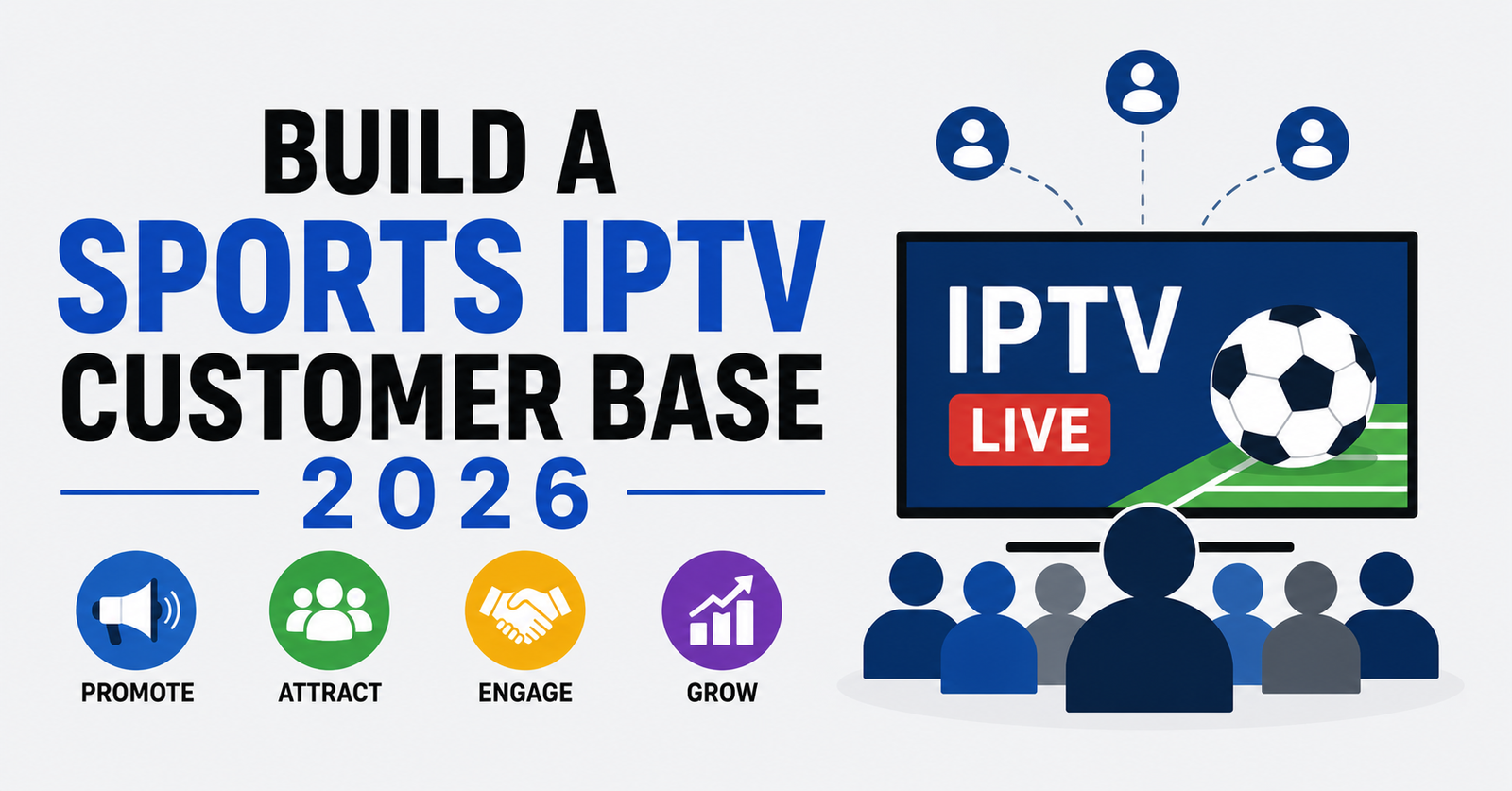
Most resellers chase the wrong customer. They go after the casual viewer who wants cheap channels, then wonder why those people vanish after one billing cycle. Sports fans are different. A man who watches his club every weekend will pay, stay, and tell three friends, but only if your service survives the ninety minutes that actually matter to him.
If you want to build a sports IPTV customer base in 2026, the short version is this: win on reliability during live events, target fans by sport and league rather than treating IPTV as a generic product, and build retention into your operation before you spend a single rupee on ads. Most failed sports panels do not fail because of price. They fail because the stream froze during a penalty shootout and the customer left before the replay loaded. Fix that first, then everything else compounds.
Why Sports Fans Are the Most Valuable and Most Unforgiving Customers
Here is something we have watched play out across hundreds of accounts. A sports subscriber has a higher lifetime value than almost any other IPTV customer, but their patience is measured in seconds, not days. A movie buffer is annoying. A buffer during a 89th minute equaliser ends the relationship permanently.
This is the central tension every IPTV Panel reseller building a sports audience has to accept. You are selling to people who will reward consistency with loyalty and punish a single failure with a chargeback and a bad review. The upside is that this same intensity is what makes the segment so profitable once you earn it. Casual viewers comparison shop. A committed football fan who trusts your service stops looking elsewhere entirely.
Pro Tip:
Track your churn against the fixture calendar, not the billing calendar. If cancellations spike in the 48 hours after a major match, your infrastructure failed during peak load, and no discount will win those customers back.
The Quiet Truth About Where Sports Customers Actually Come From
New resellers assume customers arrive through advertising. In reality, the strongest sports IPTV customer base is built through referral inside fan communities, where one trusted recommendation outperforms fifty paid impressions.
Think about how a fan finds a service. He asks in a WhatsApp group, a Reddit thread, a Discord for his club, or a local five-a-side league chat. Someone he trusts says it works. That is the entire funnel. Your job as a panel owner is not to shout louder than competitors. It is to become the answer that gets typed when a fan asks where to watch.
We saw one reseller grow from forty to six hundred customers in a single season without spending on ads, purely because he gave free trials to admins of three football fan groups and those admins vouched for him. Compare that to another operator who burned a large budget on generic IPTV ads and converted almost nothing, because his targeting treated everyone the same.
| Generic IPTV Marketing | Sports-Focused Acquisition |
|---|---|
| Broad “watch everything” messaging | Targeted by league, club, or sport |
| Paid ads to cold audiences | Seeding into existing fan communities |
| Price as the main hook | Reliability during live events as the hook |
| High churn, low trust | Referral-driven, high retention |
| Customer forgets you exist | Customer defends you in group chats |
Build the Infrastructure for the Match, Not the Average Day
Most panels are sized for normal traffic. Sports breaks that assumption violently. On an ordinary Tuesday your servers idle. During a League night, a derby, or a title decider, every customer logs in within the same fifteen minute window. The IPTV operator who planned for the average gets crushed by the spike.
Concurrent load during a major fixture can be several times your daily baseline. If your infrastructure has no headroom, the stream degrades exactly when your most valuable customers are watching. This is why cheap, single-source setups quietly destroy sports panels.
Pro Tip:
Run a load test the day before a fixture you know will be busy. Simulate your full subscriber base hitting one stream simultaneously. If quality drops in the test, it will collapse in production, and you will learn the hard way during the actual match.
A few infrastructure principles that separate panels that survive big nights from those that do not:
- Keep meaningful capacity headroom so peak concurrency never saturates your uplink
- Use load balancing so no single server carries the entire match audience
- Build failover so a dead node reroutes traffic instead of dropping viewers
- Add backup uplinks because a single ISP route is a single point of failure
- Monitor in real time during events, not from a report the next morning
How ISP Interference Hits Sports Streams Hardest
There is a pattern we have noticed repeatedly. ISP throttling and DNS poisoning intensify around high-profile sporting events, precisely because that is when rights holders apply the most pressure. A stream that worked all week can degrade the moment a marquee fixture begins.
For someone trying to build a sports IPTV customer base, this is the threat that quietly undoes good work. Your service is fine on quiet evenings, so the customer trusts it, then the one match he cares about most is the one that fails. DNS routing diversity, multiple uplinks, and geo-aware delivery are not luxuries here. They are the difference between a fan who renews and a fan who never returns.
The technical defence is layered. Diversify DNS so a single poisoned route does not take you offline. Spread delivery across multiple paths so throttling on one network does not affect everyone. Keep redundant uplinks ready so traffic engineering can shift load away from a degraded route mid-event. None of this needs to be explained to the customer. He only needs to experience a stream that does not flinch when it matters.
Pricing Psychology for a Sports Audience
Sports fans do not buy on lowest price. They buy on confidence. A fan will happily pay more for a service he believes will hold up on the big night than for a cheaper one that might fail. This flips the usual reseller instinct to compete on cost.
The smarter play is to price for the value of never missing a match, then deliver on exactly that. Underpricing signals fragility to this audience. When a service is suspiciously cheap, experienced fans assume it will buckle under load, and they are usually right.
For resellers managing panel credits and sub-reseller pricing, this matters at every tier. If you arm your sub-resellers with credits priced so low they have to oversell to profit, the whole distribution network strains during peak events. A healthy IPTV reseller panel protects margins so the infrastructure stays funded and reliable.
A Mini Case Study in Seasonal Retention
One reseller we worked with had a recurring problem. He gained customers heavily at the start of each football season, then lost most of them by winter. The numbers looked like growth but were actually a leaking bucket.
The cause was not price or content. It was that he treated acquisition as the whole job and ignored the weeks between marquee fixtures. Customers who signed up for one big match had no reason to stay through quieter periods. We restructured his approach around the fixture calendar: proactive reminders before big matches, fast support during events, and small loyalty gestures for subscribers who stayed past three months. Churn dropped sharply within two seasons, and his referral rate climbed because retained customers are the ones who recommend you.
Pro Tip:
The cheapest customer to acquire is the one you already have. A retained sports subscriber refers others for free, while a churned one often warns people away. Retention is acquisition in disguise.
What Support Tickets Reveal About Your Real Problems
After reviewing thousands of support requests across sports-heavy panels, a clear signal emerges. The volume and timing of tickets tells you more about your infrastructure than any dashboard. A flood of buffering complaints clustered around kickoff is not a customer problem. It is a capacity problem wearing a customer’s face.
Smart panel owners read tickets as infrastructure telemetry. If the same complaint repeats at the same time every match week, the issue is structural, and answering each ticket individually is treating symptoms. Fix the cause once and the ticket volume falls, support cost drops, and customer trust rises in the same motion.
Turning Trials Into Long-Term Sports Subscribers
Free trials are standard, but most convert poorly because operators schedule them carelessly. A trial during a dead week shows the customer nothing. A trial timed to a fixture he actually cares about shows him exactly why your service is worth keeping.
The principle is simple. Let the customer experience your strength when it counts. A fan who watches his team win on a flawless stream during a trial weekend is far more likely to convert than one who tested the service on an empty Wednesday. For any IPTV business owner building a sports base, trial timing is one of the highest leverage decisions available.
If you are still designing your acquisition funnel, it is worth studying how established providers structure their sports offerings and reliability guarantees, and you can review how a UK IPTV service positions sports coverage at britishreseller.com to benchmark your own presentation against the market.
Frequently Asked Questions
How long does it take to build a sports IPTV customer base?
Realistically, a solid base takes one to two full sports seasons. Early growth comes fast if you seed into fan communities, but durable numbers depend on retention through quiet periods. Operators who focus only on acquisition see fast spikes followed by collapse. Steady, referral-driven growth around the fixture calendar is what compounds into a lasting customer base.
What is the biggest mistake when trying to build a sports IPTV customer base?
Underbuilding infrastructure for peak load. Panels sized for average traffic fail during major matches, which is exactly when sports customers judge you. A single buffered final can trigger mass churn. The fix is capacity headroom, load balancing, and failover planned around big fixtures rather than ordinary days.
Why do sports customers churn faster than other IPTV subscribers?
Because their loyalty is tied to live performance. A movie viewer tolerates a glitch. A sports fan watching a decisive moment does not. Any failure during a match he cares about often ends the relationship instantly, which is why reliability during events matters more than price or channel count.
How should resellers price for a sports audience?
Sports fans buy confidence, not cheapness. Price for the value of never missing a match and fund the infrastructure that delivers it. Suspiciously low pricing signals fragility to experienced fans. Resellers should also protect panel credit margins across sub-resellers so the whole distribution network stays reliable during peak events.
Do free trials help convert sports subscribers?
Yes, but only when timed well. A trial during a dead week proves nothing. A trial scheduled around a fixture the fan cares about lets him experience your reliability when it counts. Well-timed trials convert far better than randomly scheduled ones because they showcase your strength during real demand.
How do I keep a sports IPTV customer base from leaking each season?
Manage the weeks between big matches, not just signup peaks. Send fixture reminders, priorities support during events, and reward subscribers who stay past a few months. Customers who only joined for one match leave without a reason to stay. Retention built around the season calendar stops the seasonal leak.
Conclusion
To build a sports IPTV customer base in 2026, stop thinking like a generic UK IPTV reseller and start thinking like an operator who serves fans. The segment is more profitable and more loyal than any other, but it demands that you win the moments that matter. Reliability during live events earns trust, trust drives referral, and referral builds a base that competitors cannot easily steal. Get the infrastructure right, target real fan communities, price for confidence, and treat retention as seriously as acquisition. Do that, and the customer base builds itself.
Execution Checklists
For Subscribers:
- Test a service during a real match, not a quiet evening
- Check whether the provider has visible support during live events
- Avoid suspiciously cheap services that signal weak infrastructure
- Confirm the service works on your specific device before committing
For Resellers:
- Size infrastructure for peak fixture concurrency, not average load
- Seed free trials into trusted fan communities for referral growth
- Time trials around fixtures customers actually care about
- Track churn against the fixture calendar to spot infrastructure failures
- Protect panel credit margins so reliability stays funded
For Sub-Resellers:
- Avoid overselling cheap credits that strain the network during peak events
- Prioritise customer support tickets clustered around match times
- Build referral loops inside niche club and league communities
- Reward subscribers who stay past three months to cut seasonal churn
The single lesson underneath all of this: a sports audience does not reward the cheapest service or the loudest marketing. It rewards the operator whose stream holds steady when the match is on the line. Win that one moment consistently, and growth stops being something you chase and becomes something fans hand to you.