Book Appointment Now
IPTV With Subscription 2026: 7 Tactical Truths for Professional UK Resellers
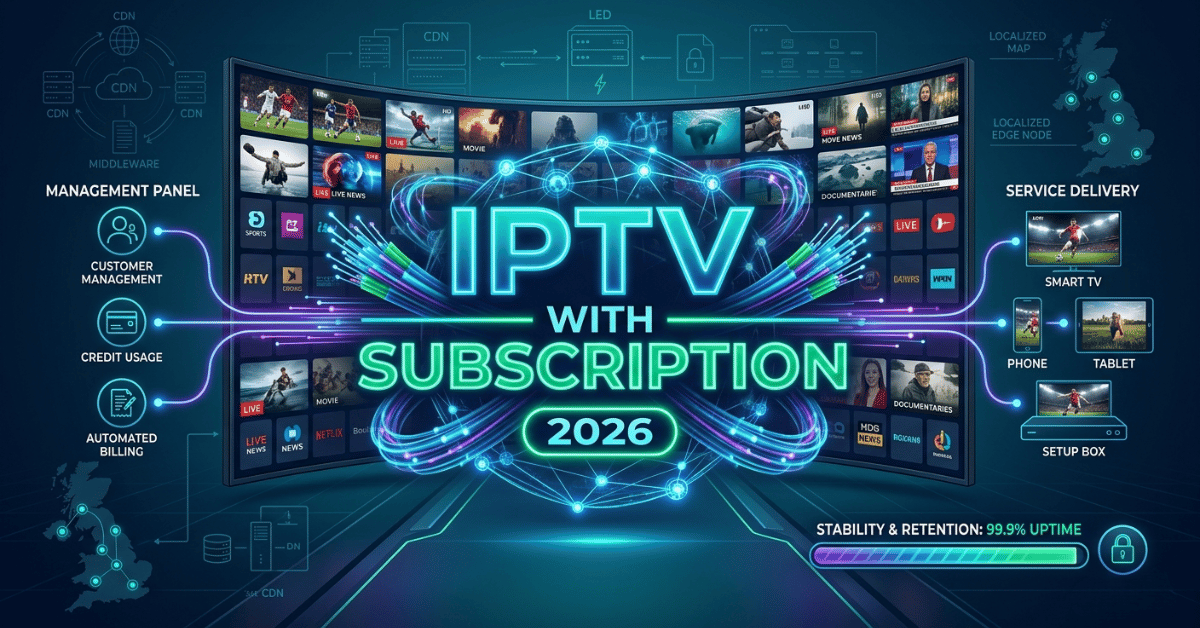
An IPTV with subscription service gives you a reserved login, tied to a specific number of connections, that streams live channels and on-demand content over the internet instead of through satellite or cable. How well it performs depends far less on the app you use and far more on the infrastructure behind it: server capacity, how many customers share that capacity, and how the provider handles peak demand.
What “IPTV With Subscription” Actually Involves
When people search for IPTV with subscription, they are usually trying to understand one of two things: whether the service will actually work reliably day to day, or how to sell it as a business. Both questions come back to the same starting point. A subscription is not simply a username and password. It represents a slot on a streaming server, usually limited to one or a small number of simultaneous connections, drawing from a shared pool of bandwidth.
That pool is finite. A provider running a modest server setup can handle a modest number of concurrent viewers comfortably. Once demand climbs, whether from a busy evening or a popular live event, the same infrastructure has to work harder, and quality can start to slip if there isn’t enough headroom built in.
Understanding this is useful whether you’re a subscriber trying to judge a provider or a reseller trying to build something sustainable, because most complaints about buffering, freezing or dropped connections trace back to this basic capacity question rather than anything wrong with the app or the device.
What Actually Affects Streaming Reliability
A few factors tend to determine whether an IPTV with subscription service holds up under real conditions.
Server capacity relative to active users is the biggest one. A provider that keeps adding customers without expanding server capacity will eventually show it during busy periods, even if everything looks fine on a quiet Tuesday afternoon.
Network routing matters too. Streams that travel a shorter, more direct path to a UK viewer generally perform more consistently than ones routed through distant or congested networks. This is one reason UK-based or UK-optimised infrastructure is often mentioned as a factor worth checking, rather than something to assume by default.
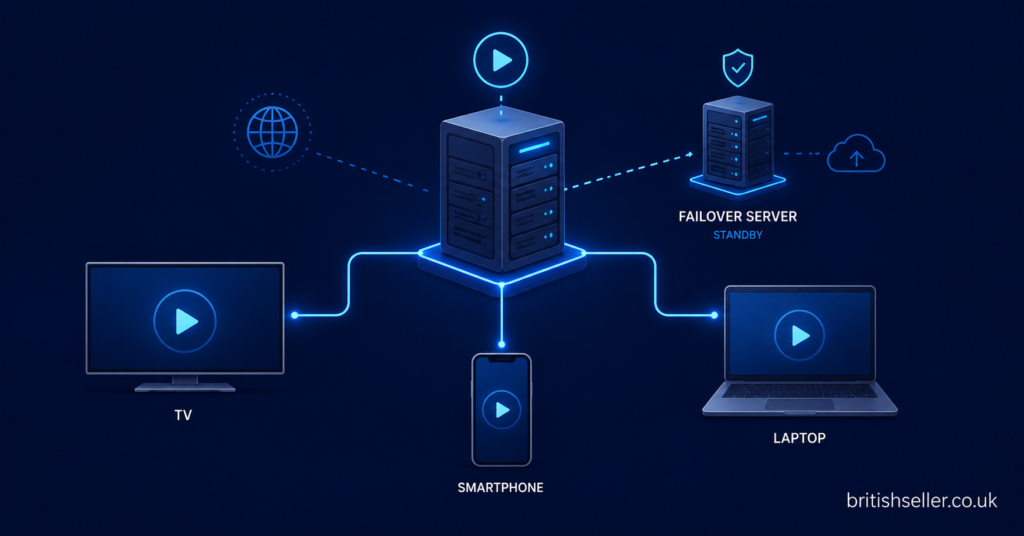
Failover setup is another. Some providers run backup servers that can take over automatically if a primary server has issues. Others don’t, which means a single point of failure can affect every customer at once until it’s manually fixed.
Pro tip: Ask a provider directly what happens if their main server goes down, and whether failover is automatic or manual. A vague or evasive answer tells you more than a confident one.
Questions to Ask Before You Subscribe
- For anyone comparing IPTV with subscription providers as a customer, a short evaluation checklist saves a lot of frustration later.
- Ask about device compatibility first. Firestick, Android TV, Smart TV apps and mobile support vary between providers, and not every service covers all of them equally well.
- Ask about connection limits. Some subscriptions allow only one device active at a time; others allow more for an extra cost. Get this in writing before paying.
- Ask about refund and trial terms. A provider confident in their service usually offers some form of trial or a clear refund policy rather than an immediate, no-exceptions sale.
- Ask how support is handled when something breaks. Response speed during an outage is often more revealing about a provider than anything on their marketing page.
| Factor | Reseller | Sub-Reseller |
|---|---|---|
| Credit source | Panel provider directly | An established reseller |
| Per-credit cost | Lower (source rate) | Slightly higher (marked-up rate) |
| Entry threshold | Often a larger volume commitment | Usually lower, flexible |
| Dashboard access | Full panel control | Limited, dependent on parent reseller |
How Pricing Actually Works for Resellers
Resellers looking at IPTV with subscription as a business often make the same early mistake: pricing purely to undercut competitors without accounting for their own costs.
A sustainable price needs to cover the wholesale credit cost, a reasonable allowance for customer support time, and a margin that lets the business survive a bad month, not just a good one. Selling right at cost, or below what covers support overhead, tends to catch up with resellers once volume grows and support demands grow with it.
It’s worth building pricing tiers rather than a single flat rate. Monthly, quarterly and annual IPTV with subscription plans each carry different cash flow and churn implications, and offering all three gives customers flexibility while giving the reseller more predictable income.
Pro tip: Before setting a price, calculate your actual cost per active customer, including the time you spend on support each month, not just the credit price. It’s usually higher than resellers expect.
Why Customers Actually Cancel
Price is rarely the only reason someone cancels an IPTV with subscription service. In most subscription-style businesses, unresolved service problems, poor communication during outages, and a lack of clarity about what’s included tend to drive cancellations more than cost alone. IPTV is no exception, and because switching providers is easy for the customer, there’s little to hold someone in place once trust breaks down.
Proactive communication helps more than most UK IPTV resellers expect. Letting customers know about a known issue before they notice it themselves, even briefly, tends to reduce frustration considerably compared with customers discovering a problem on their own and getting no explanation.
Pro tip: Keep a simple, low-effort way to broadcast service updates to customers, even something as basic as a WhatsApp or Telegram group. It costs almost nothing to set up and consistently reduces support friction during outages.
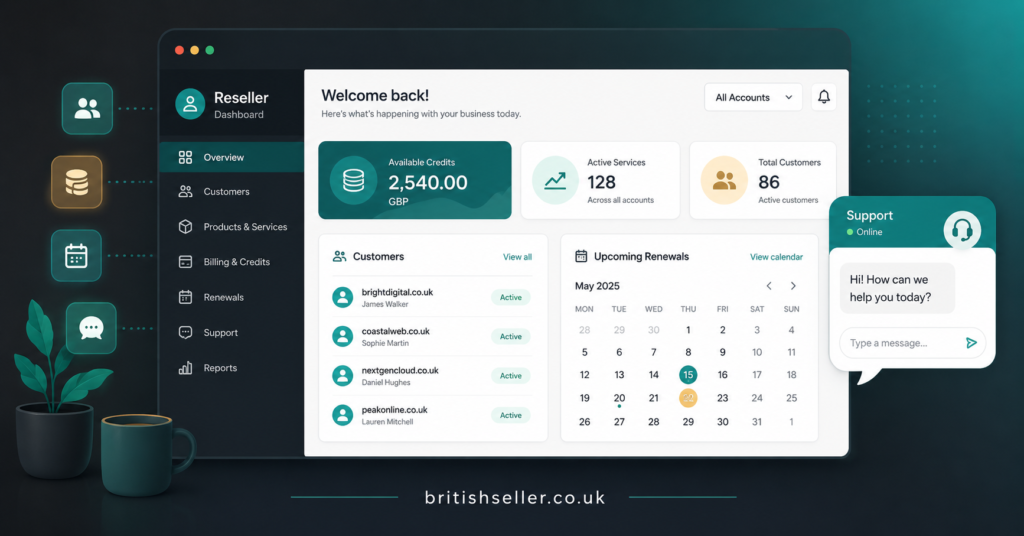
Scaling Past a Handful of Customers
Many single-operator resellers find that manual management works fine at a small scale but becomes difficult once the customer base grows. Renewals, onboarding, troubleshooting and credit top-ups all take longer to manage manually as volume increases, and without some structure in place, the operational workload can grow faster than the income does.
At this stage, panel access, credit flexibility, and a direct line to your provider rather than a generic support queue become genuinely useful. This is one of the practical reasons resellers pay attention to providers offering IPTV reseller plans with clear tiers, rather than a single undifferentiated package. A service such as britishreseller.com is sometimes used as an example of this kind of tiered structure, though the same evaluation questions above should be applied to it, or to any provider, before relying on it.
Subscribers, Resellers and Sub-Resellers: Different Priorities
Subscribers mainly need clarity: what devices are supported, how many connections they’re paying for, and what happens if the service has an issue.
Resellers need operational control: panel visibility, credit management, and a support relationship with their own provider that’s fast enough to pass reassurance on to customers.
Sub-resellers sit in a slightly different position. They typically operate under a parent reseller’s permissions, so their margins and options are shaped by whatever terms that parent account offers. Understanding those limits before committing volume matters, since a sub-reseller’s customer relationships and pricing flexibility often depend heavily on decisions made above them in the chain. Checking the about page or contact details of a prospective parent reseller or provider is a reasonable first step before agreeing to terms.
Staying on the Right Side of Content Rules
IPTV is a delivery technology, not a content licence in itself. Whether a particular service is operating within content rights depends on where that content comes from and what agreements sit behind it, which varies by provider and isn’t something a professional-looking website or a working payment system proves on its own. Anyone evaluating a provider, whether as a subscriber or a reseller, should look at how transparent that provider is about its terms, refund conditions and business information, and treat that transparency as one signal among several rather than a guarantee.
Frequently Asked Questions
Is IPTV with subscription legal to use?
Legality depends on where the content comes from and what rights the provider holds, not on the technology itself. Checking a provider’s transparency about content rights and terms is a reasonable step before subscribing.
How many devices can I use with one subscription?
This varies by provider and plan. Some subscriptions allow a single active connection; others offer multi-device access for an additional cost. Always confirm this before purchasing.
Why does my IPTV stream buffer during busy times?
Buffering during peak hours is usually related to server capacity relative to the number of active users, rather than a fault with your device or app.
Can I switch IPTV providers easily?
Yes, switching is generally straightforward since most services don’t require long-term contracts. Confirm any cancellation or refund terms with your current provider first.
What’s the difference between a reseller and a sub-reseller?
A reseller typically buys credits directly from a provider and sells subscriptions to customers. A sub-reseller usually operates under a parent reseller’s account and permissions, which can affect margins and flexibility.
Do I need technical skills to become an IPTV reseller?
Most reseller panels are designed to be usable without technical background, though understanding basic concepts like server capacity and connection limits helps avoid common mistakes.
Conclusion
IPTV with subscription comes down to a few practical fundamentals: enough server capacity behind the login you’re buying, clear terms around devices and connections, and a provider willing to answer direct questions about reliability and support. Whether you’re subscribing for your own household or building a reseller business around it, the providers worth trusting are the ones that hold up to the same questions every time, not just the ones that look polished on a landing page. Start by checking those basics before committing to any plan.
Subscriber Checklist
- Confirm device compatibility with your specific TV, box or app before paying
- Get connection limits and refund terms in writing
- Ask what support looks like during an outage, not just during sign-up
- Check the provider’s stated terms on content and copyright transparency
Reseller Checklist
- Calculate your true cost per customer, including support time, before setting prices
- Offer monthly, quarterly and annual tiers rather than one flat price
- Set up a simple way to broadcast service updates before you need one
- Review IPTV reseller plans and confirm failover and support structure directly with your provider
Sub-Reseller Checklist
- Understand exactly what permissions and margins your parent reseller account allows
- Confirm how customer ownership and support responsibility are split between you and the parent account
- Ask what happens to your customers if the parent reseller account changes provider
- Keep your own records of credits and renewals separate from the parent account’s dashboard