Book Appointment Now
IPTV Reseller Mistakes: 5 Deadly Errors to Avoid and Save Your Business in 2026
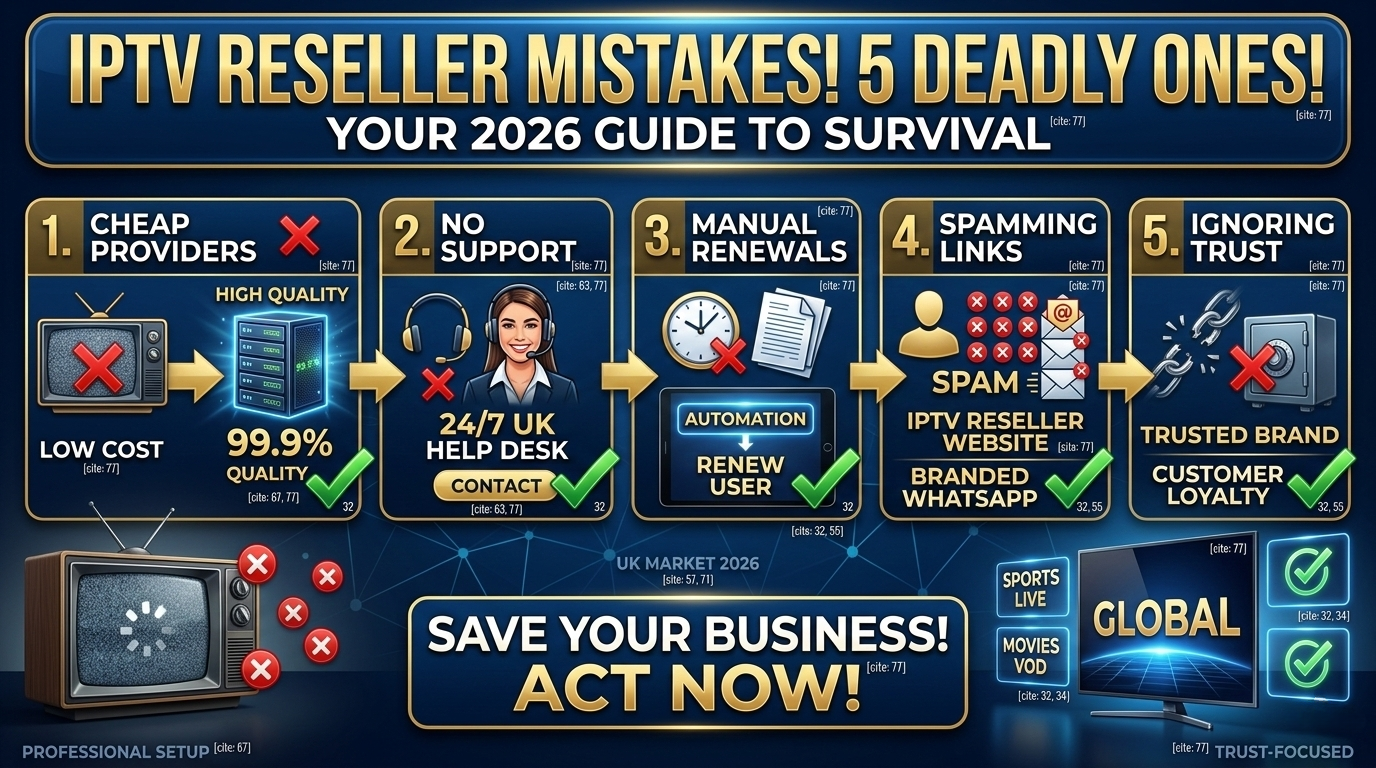
5 IPTV Reseller Mistakes That Quietly Kill New Operations
Most reseller operations don’t fail because the market is too competitive or the technology is too complicated. They fail because of a small number of avoidable mistakes made in the early stages of the business, mistakes that compound quietly until the damage is already done.
Understanding the most common IPTV reseller mistakes before you encounter them is the most efficient way to protect the time and money you’re investing in building your operation. I’ve made several of them personally. I’ve watched others make the rest. This guide covers the five that cause the most damage, exactly why they happen, and what a practical fix actually looks like in a real reseller operation.
Before going further, it helps to have a clear picture of the core management tool in any reseller business. Reading about What Is an IPTV Reseller Panel explains how the platform works day-to-day and what to look for when choosing one.
| # | Mistake | What Goes Wrong | The Fix |
|---|---|---|---|
| 1 | Choosing a provider on price alone | Poor uptime and slow support drain subscriber trust and drive churn | Evaluate uptime history, support speed, and panel quality before price |
| 2 | Underpricing plans to grow faster | Margins become unsustainable; no buffer for cost increases | Price based on real costs first; benchmark competitors second |
| 3 | Ignoring subscriber support | Unresolved issues drive cancellations that acquisition effort can’t offset | Set a response time standard from the first subscriber and stick to it |
| 4 | Letting renewals lapse passively | Avoidable revenue loss from subscribers who would have renewed with a reminder | Check the renewal view every two to three days and send reminders proactively |
| 5 | Growing faster than operations can support | Overloaded support, poor first impressions, and rapid early-stage churn | Grow at a pace your panel management and support capacity can genuinely serve |
The sections below go into each mistake in detail, what’s actually happening under the surface and what the fix looks like in practice.
Mistake 1: Choosing a Provider Based Only on Wholesale Price
Wholesale price is the most visible variable when evaluating providers, so it naturally attracts the most attention. It’s also the variable least correlated with subscriber satisfaction and long-term business health.
A provider offering the lowest wholesale rate may be cutting costs on the infrastructure that determines your stream quality, the server redundancy that determines your uptime, or the support team that determines how quickly your problems get resolved. When those cuts show up in your service, your subscribers don’t blame the provider. They cancel your subscription.
What This Mistake Actually Costs
The true cost of a weak provider doesn’t appear in the credit price. It shows up in churn rate. Every subscriber who cancels due to persistent stream problems, buffering at peak hours, or unresolved access issues represents months or years of recurring revenue that will never materialise. Replacing churned subscribers requires time, outreach effort, and often additional marketing spend. In almost every case, that total cost exceeds the savings from the lower wholesale rate by a significant margin.
I tested a cheaper provider for about six weeks when I was first building out my subscriber base. The wholesale rate was noticeably lower. The uptime was not. I spent more time that month handling buffering complaints and opening support tickets with the provider than I did onboarding new subscribers. Three accounts cancelled. The credit saving was nowhere near the revenue those three accounts would have generated over their expected lifetime.
The Fix
Evaluate providers across five dimensions before comparing price:
- Uptime history: ask for specific percentage data, not a general assurance
- UK or region-appropriate server presence relevant to your subscriber geography
- Support response time: test it before you commit, not during an active outage
- Panel feature set: does it include a functional renewal tracking view, stream monitoring, and account management?
- Terms of service transparency: are pricing, credit structure, and cancellation terms clearly stated?
Test the service personally during peak hours on the devices your subscribers actually use. A provider that performs well across all five dimensions is worth a higher wholesale rate. One that performs poorly on two or more is a risk regardless of how attractive the pricing appears.
Mistake 2: Underpricing Plans to Grow Subscriber Count Faster
The logic sounds reasonable. If you price lower than everyone else, you attract subscribers faster. More subscribers means more income. It looks like a growth strategy.
In practice, it’s one of the most common reasons reseller businesses stall or collapse within their first twelve months.
The Margin Trap
Every subscriber acquired below a sustainable margin makes the business weaker, not stronger. The income generated by 100 low-margin subscribers may be less than the income generated by 50 subscribers at a properly structured price. And when your wholesale costs increase, which they do, for most resellers, as credit rates adjust over time, you have no pricing buffer to absorb the rise without running at a loss.
Raising prices on an existing subscriber base is also significantly harder than setting the right price at launch. Subscribers who signed up at a lower rate often resist increases even when the service quality hasn’t changed. Some leave. The churn from a price increase can eliminate the benefit of raising the price at all.
I underpriced my first plan by about 20% because I was focused on building subscriber count quickly. At 30 subscribers it looked fine. At 60 subscribers, when I tried to calculate actual monthly profit after credits, processing fees, and time cost, the number was embarrassingly thin. Correcting it mid-operation was far more disruptive than setting it correctly at launch would have been.
What Sustainable Pricing Actually Requires
The table below maps the cost components that should go into every plan price before you look at what competitors are charging.
| Plan Cost Element | What to Include | Risk of Ignoring It |
|---|---|---|
| Wholesale credit cost | Your per-account credit cost at the current purchase tier | Pricing below this means selling at an immediate loss |
| Payment processing fee | Platform or gateway percentage on each subscriber payment | Fees quietly erode margin on every transaction |
| Support time per account | Estimated hours per month at your own time value | High-support subscribers consume margin invisibly |
| Credit buffer reserve | Credits held in reserve for renewals and new accounts | Running out mid-cycle creates service gaps and churn |
| Tax and business overhead | Self-employment tax, bank fees, admin costs apportioned | Ignoring these leaves obligations unpaid at filing time |
| Target profit margin | The margin percentage that makes the business genuinely worthwhile | Thin margins leave no buffer for any cost increase |
The Fix
Build pricing from the cost up, not from a competitor’s rate down. Calculate your total cost per subscriber per month including all the elements above. Add your target margin. That is your floor price. Then look at what competitors charge and position accordingly.
If your floor price is higher than the average market rate, your options are to reduce costs, accept a lower margin temporarily, or find a subscriber segment that values service quality over price. What you should not do is price below your floor and hope the volume compensates. It doesn’t. Not at reseller scale.
Mistake 3: Treating Subscriber Support as a Low Priority
Many new resellers focus almost entirely on subscriber acquisition, finding new customers, setting up accounts in the Add User section of the panel, collecting first payments. Support is treated as a reactive task to handle when complaints arise.
This is backwards. And it’s a more costly mistake than most operators realise until the churn data makes it undeniable.
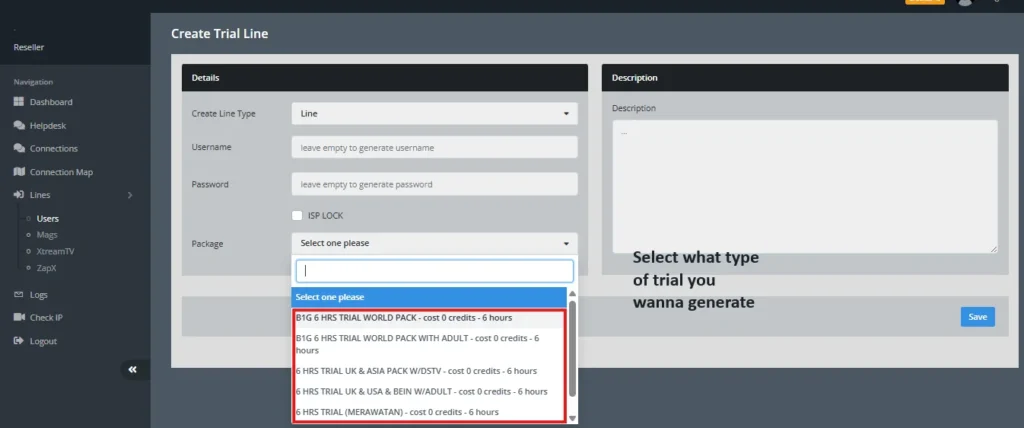
Adding new user screen
The Real Revenue Cost of Poor Support
Acquiring a new subscriber costs more in time and effort than retaining an existing one. Every subscriber who cancels because of an unresolved support issue represents a revenue loss plus an acquisition cost to replace them. At small scale, this is manageable. At medium scale, it compounds into a business that is constantly running to stand still, acquiring new subscribers just fast enough to replace those leaving for better-supported alternatives.
The most damaging support failures aren’t the ones where you give a bad answer. They’re the ones where you give no answer at all. A subscriber who messages about a connection issue and receives no response within 24 hours has already mentally started looking for an alternative before you’ve replied.
| Support Scenario | Poor Handling | Strong Handling |
|---|---|---|
| New subscriber cannot connect | No reply for 24+ hours; subscriber gives up and cancels | Response within a few hours with step-by-step setup guidance |
| Stream quality drops for multiple accounts | Wait for provider to fix without notifying subscribers | Notify affected subscribers immediately; update as resolution progresses |
| Subscriber forgets to renew and account expires | No contact; subscriber assumes the service ended | Reminder sent before expiry; follow-up after lapse with easy reactivation |
| Subscriber asks about a plan upgrade | No clear answer; subscriber researches elsewhere | Clear, prompt explanation of plan options with easy upgrade path |
| Provider outage affects all subscribers | No communication until service is restored | Proactive message to all affected subscribers within the first hour |
The Fix
Establish a response time standard from day one. Even a simple commitment, all queries receive a reply within 24 hours, changes the subscriber experience significantly when it’s met consistently. A clear standard, consistently applied, builds subscriber confidence and reduces impulsive cancellations after a service issue.
Create a basic setup guide covering the three or four devices your subscribers most commonly use. This single document eliminates the most frequent support category, new subscriber setup questions, and typically takes about two hours to write once. I built mine in the first week and it eliminated roughly 60% of first-week support contacts within a month. Worth every minute.
Mistake 4: Letting Renewals Lapse Without Proactive Follow-Up
Passive churn is the revenue leak most resellers don’t notice until it’s already become significant. It happens when subscribers who fully intended to renew simply forget, get distracted, or don’t receive a reminder, and their accounts expire before they take action.
These are not unhappy customers. They are not cancelling because of a service issue. They are lapsing because the renewal process wasn’t made visible enough to happen automatically. That is entirely within your control to fix.
How Passive Churn Compounds Over Time
At a small subscriber count, a few lapsed accounts per month looks like a minor inconvenience. At 200 subscribers, even a 10% monthly lapse rate represents 20 lost accounts per month. That is 20 replacement subscribers needed just to maintain revenue, before any growth happens at all. Over 12 months, passive churn from a modest subscriber base can represent thousands of pounds in unrealised recurring revenue.
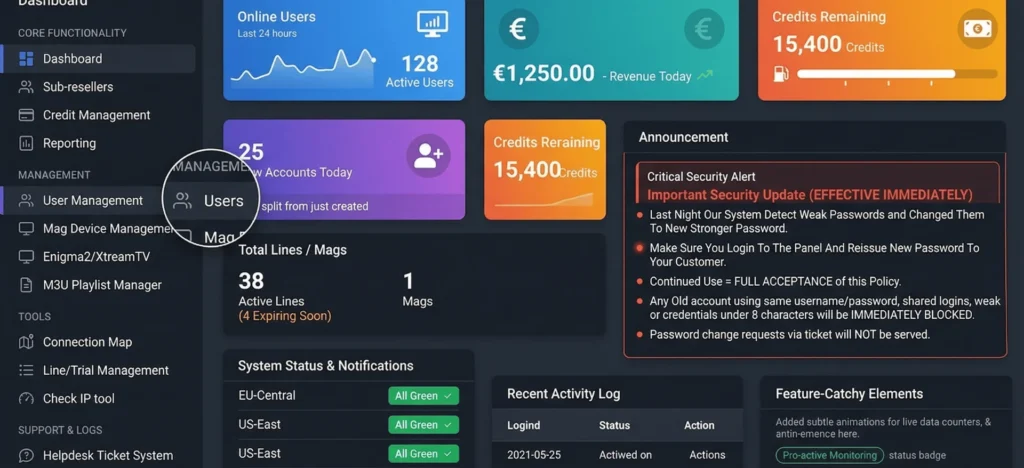
The Renewal View inside the User Management section of a reseller panel shows every account with its expiry date. It’s the most revenue-protective feature in the entire dashboard. Most new operators open it reactively, after an account has already lapsed. That’s the wrong direction.
The Fix
Build this routine and run it without exception:
- Check the renewal tracking view in your panel every two to three days, taking about four minutes
- Send a renewal reminder five to seven days before every account expiry
- Follow up again within 24 to 48 hours of the reminder if no renewal has been made
- After account expiry, send one final message within three days offering easy reactivation
- Make the renewal process itself as frictionless as possible, with clear instructions and a familiar payment method
This routine protects a disproportionate amount of revenue relative to the time it requires. I started doing this consistently in month three. The difference in monthly renewal rate compared to months one and two, when I was checking the panel reactively, was immediately visible. Not dramatic. Just quietly, consistently better, every single month after.
Mistake 5: Growing Subscriber Count Faster Than Operations Can Support
Rapid subscriber growth looks like success. It can actually damage a reseller business more than slow growth when it outpaces the operator’s capacity to manage it properly.
When subscriber count jumps faster than support capacity, setup queries go unanswered, billing errors increase, and quality monitoring falls behind. New subscribers who encounter problems in their first week are the most likely to cancel, and first impressions are among the strongest predictors of long-term retention. A fast-growing subscriber base with poor early-stage experience generates the worst possible combination: high support volume, high churn, and a damaged reputation in the community where you’re trying to build the business.
What Sustainable Growth Actually Looks Like
Sustainable growth means adding subscribers at a pace where you can onboard each one properly, answer their first questions promptly, and confirm their service is working before moving to the next acquisition. For most new operators, that’s a handful of new subscribers per week, not dozens.
The instinct is to push acquisition as fast as possible. The reality is that a subscriber base built slowly with strong early support retains far better than one built quickly with patchy onboarding. A 20-subscriber base with 95% retention after 60 days is a stronger foundation than a 60-subscriber base with 60% retention.
As your processes mature, setup guides in place, renewal routine running, support channel established, your capacity to handle more subscribers per week increases naturally. Grow into that capacity deliberately rather than chasing subscriber count as a vanity metric.
The Fix
- Define a maximum number of new subscribers you can properly onboard per week before you start acquiring
- Build setup documentation before acquiring your first subscriber, not after
- Follow up with every new subscriber in their first week to verify their service is working
- Only accelerate acquisition once your support and renewal routines are running smoothly
- Track churn rate monthly, since a rising churn rate is almost always a signal that growth is outpacing support capacity
What Most Reseller Mistake Guides Don’t Tell You
Most articles cover the five obvious errors. They don’t cover the quieter operational patterns that make the same mistakes more likely to happen, or harder to catch when they do.
The credit balance problem is almost always a forecasting failure, not a spending failure. Operators who run out of credits during busy renewal periods aren’t overspending, they’re under-forecasting. The fix isn’t buying more credits reactively. It’s calculating your average monthly credit consumption over the previous 60 days, maintaining a four to six week buffer above that number, and topping up before you hit the threshold, not after. Takes about five minutes monthly to review. Prevents a genuinely disruptive operational gap.
Provider evaluation gets skipped because it feels premature at launch. New operators feel pressure to start quickly. Vetting a provider thoroughly feels like delay. So they pick one that looks reasonable, start activating subscribers, and discover the uptime or support issues two months later, after they’ve already built a subscriber base on that infrastructure. The evaluation is not overhead. It’s the most leveraged 60 minutes you’ll spend before launch.
Support response time is only as good as your actual availability pattern. Committing to 24-hour responses means nothing if you check your messages every three days. Either commit to a response time you can actually meet, or be upfront with subscribers about when you’re available. Subscribers tolerate slower responses far better than they tolerate missed ones. Silence reads as abandonment.
The renewal gap and the support gap are connected. Operators who are weak on support are also typically weak on renewal follow-up. Both come from the same operational habit, reactive management rather than proactive management. Building the renewal tracking routine often improves support response too, because both require the same thing: logging in consistently and dealing with what’s there before it becomes urgent.
Real Mistakes I Made and What Fixed Them
Using a low-cost provider for the first subscriber batch. I picked a provider whose wholesale rate was about 25% lower than the next option. Within six weeks I had buffering complaints from multiple accounts, two cancellations, and a support ticket with the provider that took four days to get a response on. I switched providers. The migration took about three hours across 15 active accounts, renewing each one under the new provider’s credentials. The service complaints stopped within a week. The cost of that mistake in lost subscribers and time was multiples of what I’d saved on the credit rate.
Not building a setup guide before the first subscriber. My first three new subscriber support contacts were all setup questions, which app to use, where to enter the server URL, why the EPG wasn’t loading. I answered each one individually, which took about 20 minutes each. I then spent two hours writing a setup guide covering the four most common apps. The next 15 new subscribers generated a combined two setup support contacts. One document. Significant time saving.
Checking the renewal view once a week. In months one and two I treated the renewal section of User Management as a weekly task. I missed three renewal windows in that period, accounts that expired before I’d sent a reminder. Two reactivated after a follow-up message. One didn’t. Moving to every-two-to-three-day checks eliminated missed windows entirely.
Onboarding too many subscribers in one week during a promotional push. I had a period where eight new subscribers joined in five days. For context, I’d been averaging two to three per week. The support load from that cohort, setup questions, EPG issues, one account creation error on my end, was more than I handled well. Two subscribers from that group didn’t receive prompt responses in their first 48 hours. One cancelled after a week. Slowing down acquisition to match support capacity is not a conservative choice. It’s a retention decision.
Building a Resilient IPTV Reseller Operation: Core Practices Beyond the Mistakes
Avoiding the five mistakes above gets you to a solid baseline. These practices move you from solid to genuinely strong.
Provider Management
- Test your provider’s service personally each month, not relying only on subscriber reports
- Keep records of any outages: date, duration, impact, and how the provider communicated
- Review your provider relationship formally every six months against your original evaluation criteria
- Know your provider’s escalation route before you need it, not during an active outage
Financial Discipline
- Review your margin per plan tier every quarter
- Set aside tax obligations monthly rather than annually, since the amount is the same, but the cash flow shock is very different
- Maintain a credit reserve buffer so you never approach zero during active renewal periods
- Track total monthly revenue and total monthly costs separately, not just the difference
Subscriber Relationship Management
- Respond to all support contacts within your stated response time, consistently
- Send proactive communications during outages, without waiting for complaints to arrive
- Acknowledge long-term subscribers periodically, since retention is built through relationship, not just service quality
- Ask cancelled subscribers for feedback, since their answers are your most honest source of operational insight
Frequently Asked Questions About IPTV Reseller Mistakes
How do I know if my current provider is causing my subscriber churn?
Track churn alongside service quality events. If churn increases following outages, periods of poor stream quality, or delayed support responses from your provider, the correlation is likely causal. Ask cancelled subscribers directly, even a brief, casual message asking why they left produces genuinely useful data. If a meaningful percentage cite service quality rather than price or personal circumstances, your provider is contributing to the churn. Compare that insight against alternative providers before committing to a switch.
What is a healthy churn rate for an IPTV reseller operation?
There’s no universal benchmark, but most stable UK IPTV reseller operations see monthly churn rates in the low single digits as a percentage of their subscriber base. Rates above 5% per month indicate a systemic issue, whether in service quality, support, pricing, or subscriber acquisition targeting. Rates below 3% reflect a well-supported subscriber base with strong retention fundamentals. Track this number monthly and treat any sustained upward trend as a priority signal, not background noise.
Is it possible to recover a subscriber who has already cancelled?
Yes, and at higher success rates than most operators expect. A subscriber who left because of a service issue that has since been resolved, or who simply lapsed passively, is often open to reactivation. A short, direct message acknowledging the previous issue and noting what has changed converts a meaningful proportion of lapsed accounts. Worth attempting systematically for any subscriber inactive for less than three months, particularly if the cancellation wasn’t driven by price alone.
How often should I review and potentially adjust my pricing?
A structured pricing review every six months is the right cadence for most operators. Review your cost structure, your provider’s wholesale rates, and your margin on each plan tier. If margins have compressed due to cost increases, or if your pricing has drifted below what the market supports, a modest adjustment is appropriate. Communicate changes to existing subscribers with reasonable advance notice, typically two to four weeks, and explain the adjustment clearly. Transparent communication during price changes retains significantly more subscribers than an unexplained increase.
What is the most time-efficient way to manage renewals for a growing IPTV subscriber base?
Use the renewal tracking view in your panel as your primary tool. Filter by accounts expiring within the next seven days and work through that list systematically every two to three days. Batch your reminder messages where possible, since a well-crafted template reduces time per reminder to under a minute per subscriber. As your base grows, look for panel providers that offer automated expiry notifications. This eliminates the manual step while preserving the proactive follow-up that protects revenue.
Can I fix a pricing mistake once I’ve already built a subscriber base around it?
Yes, but it requires care. An increase that is well-communicated, clearly reasoned, and applied with adequate notice typically retains the majority of subscribers, particularly those satisfied with service quality. Framing the adjustment around the value you deliver rather than your own cost structure is more effective. Offering existing subscribers a grace period at the current rate before the new price takes effect reduces friction further. Expect some churn from any increase, but don’t let that expectation prevent changes the business genuinely needs.
How do I prevent running out of credits during a busy renewal period?
Set a minimum balance threshold and replenish before you reach it, never when you reach zero. Review your credit usage over the previous 60 days to calculate your average monthly consumption. Purchase credits to maintain a buffer of at least four to six weeks of projected usage above your current balance at all times. During periods of expected subscriber growth, increase that buffer proportionally. Running out of credits mid-renewal cycle is entirely preventable with this habit in place. It takes about five minutes monthly to review. There’s no good reason to skip it.
Final Thoughts on IPTV Reseller Mistakes
The five mistakes covered in this guide share a common thread. They are all avoidable with the right information and the discipline to act on it consistently. Choosing a provider on price alone, underpricing plans, neglecting support, allowing passive churn, and overextending growth aren’t obscure edge cases. They are the mistakes that appear most consistently in reseller operations that stall or fail in their first year.
The good news is that every one of them has a clear, practical fix. Strong provider evaluation, cost-based pricing, consistent support standards, a proactive renewal routine, and deliberate growth management are not complicated systems. They are habits that, applied consistently from the start, compound into a business that is genuinely resilient.
The operators who build lasting IPTV reseller businesses are not those with the most subscribers at launch. They are the ones who retain the subscribers they have, manage their costs honestly, and grow at a pace their operations can support well. That combination, not volume, not speed, is what makes this model genuinely sustainable over time.
This article covers software tools, reseller panel management systems, and operational practices only. No media content, channels, or streams of any kind are hosted or provided here. All guidance is strictly educational and informational.