Book Appointment Now
How to Choose a Reliable IPTV Reseller Provider in the UK: 2026 Guide
If you’re building an IPTV reseller business in the UK, the single most important decision you’ll make isn’t your pricing, your panel design, or how you handle customer support. It’s who you choose as your upstream provider.
I learned this the hard way.
My first provider looked fine on paper, decent pricing, a reasonably clean website, a panel that loaded without crashing. Three weeks in, I was fielding subscriber complaints every Friday evening, chasing support tickets that took 48 hours to get a generic reply, and watching churn eat my margins alive. Switching cost me time, credits, and a chunk of subscriber trust I never fully recovered.
This guide IPTV Reseller Provider is the one I wish I’d had before that experience. It covers every evaluation factor that actually matters, the red flags most operators miss, and the specific tests I now run before committing to anyone.
Why This One Choice Shapes Everything Else
As a reseller, you don’t control the infrastructure. You manage the business layer sitting on top of it. That’s a critical distinction, and it means your provider’s performance quietly becomes your reputation.
Every stream that buffers at 9pm on a Saturday, every channel that drops during a League match, every login that fails for no apparent reason, that’s your provider’s infrastructure failing. Your subscriber doesn’t care whose fault it is. They cancel you.
No amount of polished customer service or flexible pricing compensates for infrastructure that consistently underperforms during peak hours. The foundation determines everything above it. This is why rushing the provider evaluation process is one of the most expensive mistakes a new UK operator can make.
The Hidden Cost of Choosing on Price Alone
Here’s a pattern I’ve seen repeated consistently in UK reseller communities: someone finds a provider offering credits at a wholesale price noticeably cheaper than competitors. They sign up, start onboarding subscribers, and within the first two to three months they discover why that price was low.
Stream quality degrades during peak hours. Support goes silent during outages. The panel lacks basic account management features. Subscribers start leaving faster than new ones arrive.
The cost of replacing churned subscribers — in acquisition time, in reputation damage, in the energy spent managing complaints — consistently exceeds whatever was saved on the lower wholesale rate. A provider charging slightly more per credit but delivering verified uptime, real support, and a functional panel almost always produces better financial outcomes over a six-month window.
Price is one input. It shouldn’t be the primary one.
Start With Uptime and Infrastructure Reliability
Uptime is the metric everything else depends on. If the streams aren’t working, nothing else matters.
For a UK subscriber base, peak pressure on provider infrastructure hits evenings — roughly 7pm to 11pm — and weekends, especially when major sports events are scheduled. That’s exactly when an unstable IPTV reseller provider reveals its real character.
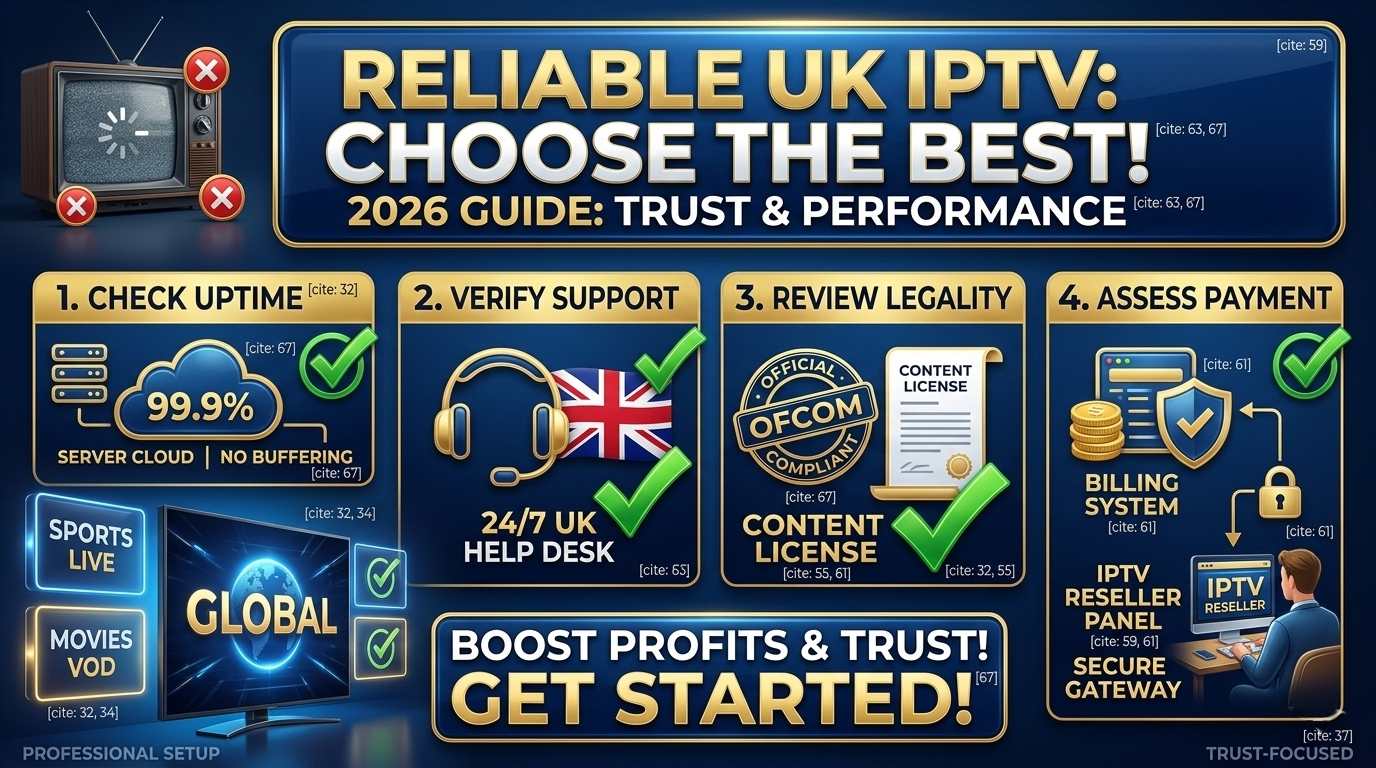
When evaluating anyone, ask specifically for uptime documentation from the past 12 months. Not a number on a marketing page, actual records. Ask how they handle server failures: does redundant infrastructure automatically reroute traffic, or does a single server failure take out all accounts simultaneously?
Anything consistently below 99.5% is a meaningful risk for a subscriber-facing business. Providers who can’t or won’t share uptime data should be treated as a significant red flag. If the numbers were good, they’d share them.
One thing I noticed during my own evaluation: providers with genuine redundancy are usually comfortable discussing their failover setup in detail. The ones who get vague about it are often running leaner infrastructure than they’d like to admit.
Why UK Server Presence Actually Matters
Physical server location affects delivery speed and latency for your subscribers. A stream routed from infrastructure geographically close to the viewer arrives faster and with lower latency than one travelling across the world through multiple routing hops.
For live sport and news, where real-time timing genuinely matters to the viewer, this isn’t a theoretical concern. A few hundred milliseconds of additional latency produces noticeable degradation in live stream experience, especially during high-motion content.
When evaluating a provider for UK operations, confirm whether they have servers physically in the UK or in nearby European data centres. Ask specifically, and don’t accept vague assurances about “global infrastructure. A provider with UK-based servers is meaningfully better positioned to serve your subscriber base than one routing everything through remote locations.
This also reduces your exposure to international routing disruptions that can affect streams for hours at a time without the provider being able to resolve it quickly.
Support Quality, Tested for the Day Something Breaks
Support quality becomes the critical variable the instant something goes wrong — which it will. The question isn’t whether you’ll need support. It’s whether your provider is actually useful when you do.
Before committing to anyone, test their support. Not a casual inquiry, but a specific technical question about reseller panel functionality, and measure both the response time and the quality of the reply.
What you’re looking for: a response within a few hours through a real communication channel, from someone who actually understands the reseller panel environment and can engage with the specific issue you raised.
What you’re not looking for: a response two days later that’s clearly a copy-pasted template with no relevance to what you actually asked.
The distinction matters because when a subscriber account has an issue at 8pm on a Sunday, a provider who takes 36 hours to reply with a generic answer is essentially the same as no support at all. I’ve been in that situation. It’s not a comfortable place to run a business from.
Also check which channels are actually staffed. Live chat is often listed on provider websites but unmanned outside business hours. Ask directly what their support hours are and through which channels they actually respond — not just which channels are listed.
The Panel: Features and Real Day-to-Day Usability
The panel is your control interface for every subscriber account you manage. A well-built panel makes subscriber management straightforward and scales with your business. A poorly built one creates operational friction that compounds as your subscriber count grows.
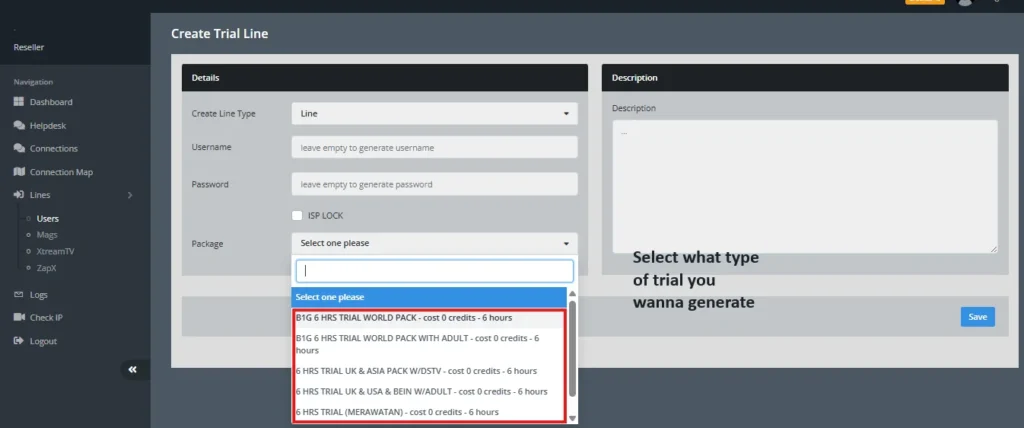
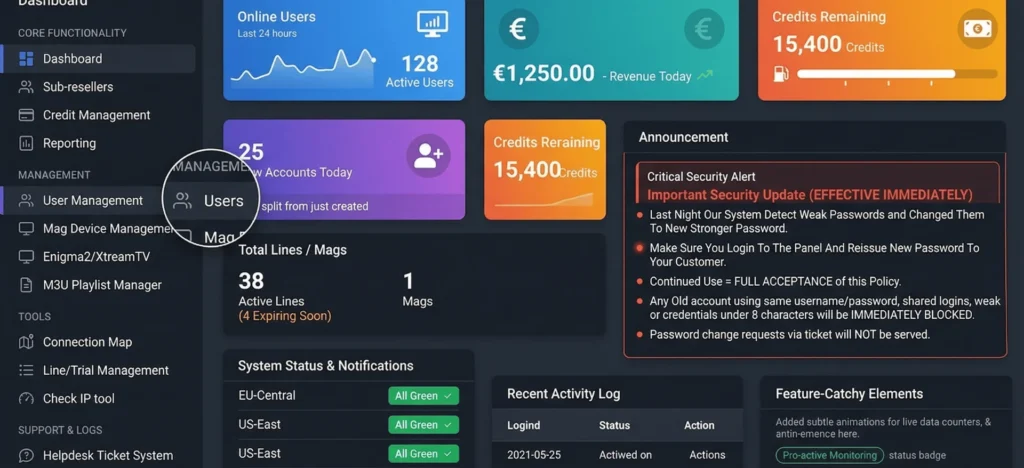
During evaluation, request access to the panel — either through a trial or a guided walkthrough. Navigate it yourself. Specifically check:
- How many steps it takes to create a new subscriber account in the Add User section
- Whether the User Management tab gives you a clear view of active, expired, and trial accounts without digging through sub-menus
- Whether the Renewal Tracking section shows upcoming expirations clearly and can be sorted by date
- Whether the Credit Management section shows your balance and transaction history without requiring multiple clicks to locate
- Whether connection limits per account are configurable from within the panel
- Whether session monitoring shows active connections in real time
One thing that caught me off guard on my first panel: the trial account creation flow was buried three menus deep, and there was no batch account management at all. Manageable at 15 subscribers. A genuine problem at 150 — the time cost per operation compounds fast when you’re working through renewals during a busy period.
Strong panels also include branding controls, plan configuration options, and clear reporting on credit usage. These aren’t luxury features. They’re basic operational tools that save time every day.
Pricing You Can Actually See Before You Commit
A trustworthy provider tells you exactly what things cost before you commit to anything. You should be able to calculate your exact cost per subscriber account — and therefore your gross margin at any retail price point — before spending a penny on credits.
Watch for providers who keep pricing vague until you’ve expressed purchase intent, or who add costs at the checkout stage that weren’t disclosed earlier. These aren’t minor transparency failures. They’re indicators of how the business relationship will continue once you’re committed and switching costs feel high.
Also check the credit structure: how credits are consumed per account per duration, whether unused credits roll forward, and whether pricing changes at different volume thresholds. Understanding this clearly before you’re in it prevents unpleasant surprises when you scale up.
The Full Evaluation Checklist
Use this table as a structured checklist when assessing any provider before committing.
| Factor | What to Look For | Red Flag |
|---|---|---|
| Uptime and Reliability | Documented 99.9%+, redundant infrastructure, clear outage communication | No data available, vague claims, repeated unexplained downtime |
| UK Server Presence | Servers physically in or near the UK | All infrastructure overseas, no local edge presence |
| Support Quality | Response within hours, technically competent, reseller-familiar staff | 24–72 hour response times, generic replies that miss the question |
| Panel Features | Full subscriber management, credit control, session tracking, branding | Limited panel, workarounds needed for basic tasks |
| Pricing Transparency | Clear wholesale pricing, no hidden fees, rates confirmed before purchase | Prices change without notice, extra charges appear at checkout |
| Terms of Service | Written, accessible terms covering reseller rights and refund policy | No written terms, or terms heavily weighted against the reseller |
| Trial Access | Trial or demo before credit purchase required | Immediate pressure to buy credits with no testing opportunity |
| Community Reputation | Positive, verifiable feedback from active resellers | No verifiable reviews, pattern of unresolved complaints |
Strong Provider vs Weak One, in Practice
| Strong Provider | Weak Provider |
|---|---|
| Communicates proactively during outages | Goes silent when something is affecting your subscribers |
| Offers trial access before requiring purchase | Insists on immediate payment with no trial |
| Responds to support queries within a few hours | Takes 24–72 hours for basic questions |
| Provides written terms covering your rights | Can’t or won’t share clear written terms |
| Pricing fixed and confirmed before commitment | Prices shift without clear notice |
| Panel includes full subscriber management tools | Panel requires workarounds for basic tasks |
| UK server options available | No local server options for UK subscribers |
| Positive track record in reseller communities | Unresolved complaints or no verifiable history |
The Peak-Hour Test Most People Skip
Most comparison guides tell you to check uptime claims and test support. What they don’t tell you is the difference between a provider who performs fine during off-peak hours and one that actually holds up under real load.
I now stress-test every provider specifically on Friday evenings between 7pm and 9pm, and Saturday afternoons during major UK football fixtures. That’s when infrastructure gaps become impossible to hide.
One provider I evaluated recently checked every box on the standard criteria. Clean panel, navigation was intuitive, the User Management tab showed exactly what I needed without hunting for it. Support responses came back within two hours during my testing week. UK servers confirmed. Everything looked right.
What I only discovered by testing during peak hours: stream quality degraded noticeably during high-demand events, and the provider’s explanation was that peak content pressure affects all infrastructure. True enough, but an honest provider tells you this upfront. They don’t let you discover it after you’ve onboarded 30 subscribers who are now messaging you during the second half.
Also worth noting: the panel lagged noticeably on first load during my evaluation, about 6 to 8 seconds before the Overview populated. Not a dealbreaker on its own. But a platform that feels sluggish during evaluation often reveals more friction once you’re running real subscriber volumes through it. I’ve found this to be a reasonably reliable signal.
Test during peak hours. It’s the evaluation most resellers skip, and it’s the one that tells you the most.
The Mistakes I Made, and What Fixed Them
Testing only during business hours. Stream quality at 2pm on a Tuesday tells you almost nothing about how a provider performs under real load. Test at 8pm on a Saturday. That’s when infrastructure weaknesses reveal themselves and there’s no hiding them.
Skipping the terms of service entirely. I signed up for my second provider without reading the credit refund terms. When I needed to recover unused credits after switching away from them, there was no recourse. The terms I hadn’t read made that crystal clear. Now I read the terms before activating a trial, let alone purchasing credits.
Treating the first provider as a permanent default. The provider that works adequately at 20 subscribers isn’t necessarily the right choice at 200. Panel limitations that are manageable at small scale become genuinely painful at larger volumes. Review the relationship at least every six months.
Not checking community feedback before committing. Other resellers who’ve worked with a provider for months are the most candid source of real-world operational information available. UK reseller forums and community groups contain experience that no provider’s marketing reflects. I now spend at least 30 to 45 minutes reading community feedback before evaluating any new provider. It’s saved me from at least two poor choices.
Assuming a good demo equals good real-world performance. One provider gave an impressive guided panel demonstration. Responsive, feature-complete, clean interface. The actual panel I accessed after purchase was noticeably slower and had a renewal tracking section that required three extra clicks to reach compared to what I’d been shown. Test the real panel yourself, not a curated demo environment.
Who This Guide Is Honestly Not For
Worth being direct about the context this guide applies to.
If you’re evaluating providers with the intention of distributing unlicensed content, this guide isn’t relevant to that use case and those concerns are outside its scope. This guide covers the business and operational evaluation of providers for operators building compliant UK IPTV reseller operations.
If you’re looking for a provider that requires zero evaluation effort, just pick the cheapest option and sign up — this guide is going to frustrate you. The evaluation process I’m describing takes time. It should. The providers worth committing to are the ones who hold up to scrutiny. The ones who don’t are revealed by that scrutiny before they cost you subscribers.
If you’re at a stage where you haven’t yet validated that the reseller model works for you at all, an extensive provider evaluation may be premature. Start with a trial from a reasonably well-reviewed provider, validate the business model with your first few subscribers, and then do a more thorough evaluation before scaling.
Best Practices, Before, During, and After Signing Up
While You’re Evaluating
- Test the service personally on at least three different device types including Fire Stick and an Android box
- Test specifically during evening peak hours on weekdays and weekend afternoons
- Send a support query and measure both response time and answer quality before committing
- Request full terms of service and read them — specifically the sections on credits, refunds, and service levels
- Check at least two or three independent community sources for operator feedback on the provider
After You’ve Signed Up
- Document your provider’s support contact details and which channel actually gets responses
- Monitor stream quality reports from your subscribers during the first few weeks closely
- Keep a record of any outages, including how the provider communicated and how long resolution took
- Review the provider relationship formally at the six-month mark against your original evaluation criteria
When Something Goes Wrong
- Contact your provider immediately with specific details — affected account usernames, times, device types, error descriptions
- Communicate proactively with affected subscribers while the issue is being investigated
- Document the timeline and resolution of any significant outage in your own records
- If issues persist without genuine resolution, begin evaluating alternatives in parallel — don’t wait until the situation is critical
If You Decide to Switch
- Evaluate the new provider fully before moving any subscriber accounts — don’t assume it’s better until you’ve tested it under the same conditions
- Plan a migration period that minimizes service interruption for active subscribers
- Retain access to your old panel until all accounts are confirmed active and working on the new provider
- Communicate the transition to subscribers only if service interruption is likely — unnecessary communication creates unnecessary concern
Frequently Asked Questions About Choosing an IPTV Reseller Provider
What does 99.9% uptime actually mean for a UK reseller operation?
A 99.9% uptime figure means the service is expected to be available 99.9% of the time in any given month — roughly 43 minutes of acceptable downtime monthly, or around 8.7 hours per year. Whether that downtime is spread across many brief interruptions or concentrated in one longer outage makes a real difference to subscriber experience. Always ask a provider how their downtime is typically distributed and whether redundant infrastructure minimises the impact of any single server failure.
Does my provider really need UK-based servers?
For serving a UK subscriber base, yes — and meaningfully so. Server location directly affects delivery speed and latency. For live sports and news content where real-time experience matters to viewers, the difference between UK-proximate servers and remote infrastructure is noticeable. It also reduces your exposure to international routing disruptions that can affect streams for extended periods without the provider being able to resolve them quickly.
How do I verify a provider’s uptime claims before committing?
Ask for documented uptime records from the past 12 months. Reputable providers who actively monitor their infrastructure can produce this data. You can also ask for contact details of existing resellers who can speak to real-world experience. Testing the service yourself during peak hours over several days provides direct evidence that no marketing document can replace. Providers who resist these verification requests, or whose claims aren’t backed by any verifiable data, should be treated with significant caution.
What should I do if I’m unhappy with my current provider?
Document the specific issues — uptime failures, slow support responses, billing discrepancies — and raise them formally with your provider. Give them a reasonable opportunity to respond and improve. If problems persist without genuine resolution, begin evaluating alternatives using the criteria in this guide. Once you’ve identified a strong alternative, trial it thoroughly before migrating any subscriber accounts. Plan the migration carefully to minimise service interruption.
Can I use more than one provider at the same time?
Technically yes. Some operators run accounts with multiple providers — either to compare performance or to maintain a backup option during outages. This adds management complexity and doubles your credit oversight, but it provides operational resilience. For most operators at small to medium scale, a single strong provider is the simpler and more manageable approach. Running multiple providers makes more sense once your subscriber base is large enough that a provider outage represents a significant revenue risk.
What is white-label support and do I need it as a reseller?
White-label support means the provider allows you to deliver the service entirely under your own brand, with no visible reference to the underlying provider. Subscribers interact with your brand, not your provider’s. This is valuable for building subscriber loyalty tied to your business rather than your upstream supplier. Not all panels offer meaningful white-label options — confirm the extent of branding control during evaluation if this matters to your strategy.
How often should I review my provider relationship?
At minimum, every six months. The provider landscape changes — new options enter the market, existing providers improve or decline, and your subscriber base and operational needs evolve. A provider that was the strongest available option six months ago may not be today. A structured periodic review, using the evaluation framework in this guide, keeps your provider choice aligned with your current business needs rather than anchored to a decision made when your operation was at a different scale.
Final Thoughts
The right provider for UK operations isn’t picked quickly or off the back of a single factor. It’s the infrastructure foundation that every subscriber interaction your business has will rest on.
A provider with verified uptime, UK-appropriate server infrastructure, genuine support, a capable panel, and transparent pricing is worth a higher wholesale rate than a cheaper alternative that fails on two or three of those dimensions. The operators building sustainable, low-churn businesses in the UK market are almost always the ones who invested real evaluation time in this decision. The ones who struggled are typically those who chose fast, based on price, and found themselves rebuilding subscriber trust after repeated service issues.
Use the framework in this guide systematically. Test during peak hours, not just at 2pm on a Tuesday. Read the terms before you sign anything. Check community feedback from other operators who’ve actually worked with the provider. Review the relationship regularly as your business grows.
The provider you choose shapes everything else in the operation. Get this one decision right first, and most of the others become considerably easier.
This article covers reseller panel management, software tools, and provider evaluation practices only. No media content, channels, or streams of any kind are hosted or provided here. All guidance is strictly educational and informational.